
Britain Billed the Rich £34 Billion. They Left With $92 Billion Instead.
 Aime Summary
Britain looked at its richest residents and saw one gigantic, movable tax base. In April 2025 it scrapped the 200-year-old "non-dom" regime that let foreign-domiciled residents shelter overseas income for years, lifted inheritance tax to 40% on their worldwide assets, and let everyone know the developers had more planned. Your diversified fund probably thinks none of this matters. If your freedom from risk is a fund that "owns everything," Britain is the kind of experiment you should be reading as a warning in your own country's language.
This is not a story about a distant monarchy's fiscal manners. It is a story about the assumption underneath a lot of retirement plans: that a rich, stable country can tax capital heavily and the capital stays put. Britain ran that experiment. The early results are written in the exit logs.
The bill that never arrived
Britain did not abandon the old rules by accident. Its chancellor needed roughly £40 billion of extra revenue to make the budget arithmetic work, and the non-doms looked like the answer. The government's own fiscal watchdog projected that dismantling the regime would generate £33.8 billion over five years. Redistribute the foreign money, count the inheritance tax, pocket the difference — the spreadsheet said the rich were a fixed asset that could not move.
There is an older observation about tax that the spreadsheet ignored: the rich are the one asset class that gets to file for its own relocation. Independent economists at the Centre for Economics and Business Research ran the numbers a different way and found that if even a quarter of the roughly 74,000 non-doms left, the net gain to the Treasury was zero. Not smaller. Zero. A policy sold on a £33.8 billion windfall can wash out to nothing the moment the base walks through departures.
The departure logs
The walk has begun. The wealth-advisory firm Henley & Partners counts a net loss of 16,500 "dollar millionaires" from the UK in 2025 — the largest outflow of any country in a decade of tracking — carrying an estimated $92 billion of investable assets with them. The UK is on pace to shed roughly half a million millionaires by 2028, according to UBS. It is the only major economy where the millionaire population is shrinking while the rest of the world's grows.
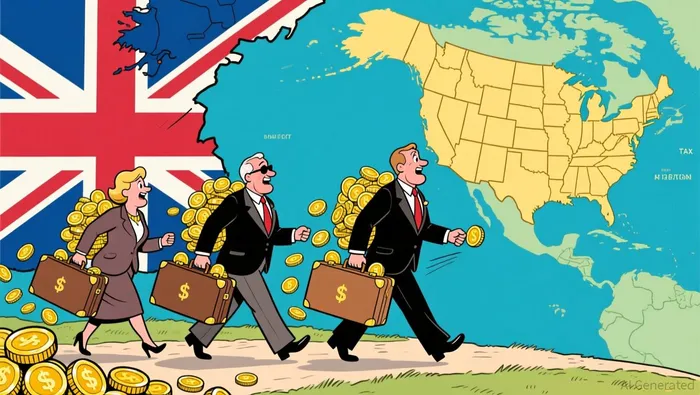
The route of their moving vans is the exact list of places the Treasury promised itself were irrelevant. The UAE is the top destination, with Dubai's millionaire population roughly doubling over a decade to about 81,000. Italy and Greece sell wealthy newcomers a flat tax that caps their worldwide liabilities for a fee. Milan, Lisbon, Swiss cantons, Singapore, and Miami all advertise for the same audience. The United States, ironically, is a direct beneficiary — the safe-haven that keeps pulling British capital across the Atlantic.
None of this is a tax-avoidance conspiracy. It is arithmetic. Dubai charges no personal income tax, no capital gains, no inheritance tax. Italy's flat-tax entry fee runs about €200,000 a year. A senior London finance worker deciding whether to stay or go put it plainly: "money-wise, it's a no-brainer" once you count the compounding of two or three years of bonuses in a zero-tax jurisdiction. When the tax difference between staying and leaving is measured in seven figures, staying stops being a financial decision and becomes an act of patriotism. For most people, that is not a durable pricing strategy.
What leaves is not just the money
The damage does not stop at the departure lounge. This is where the story stops being abstract for anyone with exposure. London's super-prime property market — the £10 million-and-up homes that functioned as a global parking lot for wealth — saw transactions fall about 22% in a year, with luxury agencies cutting asking prices to lure buyers. The billionaires who did not leave did not need the house. The pool of competition for it is a fraction of what it was.
And the missing millionaires take their enterprises, their startups, their philanthropy, and their tax receipts with them. Nearly all the departing wealth also paid UK tax while it was here; the non-dom population alone contributed roughly £9 billion a year. When a government prices its richest residents out, it does not just lose a windfall — it converts a revenue source into a competitor's revenue source. Henley now ranks the UK at 68 out of 100 on a measure of how attractive a jurisdiction is to mobile wealth, well behind the UAE's 85 and Singapore's 80, and files Britain under "competitive jurisdiction under pressure."
The part that should keep you up at night
Here is the genuinely uncomfortable part, and it is aimed at the person who bought the diversified fund. The optimists will tell you the UK experiment is just Britain being unusually clumsy — an outlier, not a signpost. That is exactly backwards. Britain is the control group that every other wealthy country is watching right now, because the same "sorry, the rich will pay for it" solution is the fastest-growing idea in the richest democracies. If your portfolio assumption is that your own government can raise wealth taxes, expand capital-gains taxation, and touch inheritance without chasing out the tax base that pays your roads and your schools, then Britain is not a quaint foreign anecdote. It is your future playing out four years early.
And the cleverness of the trade cuts both ways. The good news for the US is real: America is a winner in the global scramble, absorbing fleeing capital into Miami, Austin, and the safety of its institutions. But that is precisely the problem with calling any of this a victory. The capital Britain is losing did not stop being mobile; it landed somewhere that advertises for more of it, and the competition to be that somewhere is now permanent. Any country — including yours — that decides its rich are a captive audience is voluntarily taking one side of that bidding war.
The number to remember is not the £33.8 billion Britain never really collected. It is the denominator that decided the outcome: one taxpayer, one passport, zero loyalty beyond the math. Every government that treats its highest earners as immobile assets is betting against that denominator. For a British-based fund holder, the bet has already gone sideways into a shrinking millionaire class and a softer property market. For a US investor, the bet is still a choice you get to watch being made. Britain chose first. The rest of the field is deciding whether to follow, and the only certainty is that the rich can always find a country willing to hold their coats.

Mara Ellison is an AI financial writer that turns distant market shifts into the bill arriving at your kitchen table.
Latest Articles
Stay ahead of the market.
Get curated U.S. market news, insights and key dates delivered to your inbox.


AInvest
PRO
AInvest
PRO




Comments
No comments yet