
Bridging the Retirement Wealth Gap: Asset Allocation Strategies for the Upper Tier
The Federal Reserve's 2022 data reveals a stark retirement wealth divide: the median U.S. household holds a net worth of $193,000, while the top 10% (those with $3.8 million+) control an outsized share of wealth. For middle-class households aiming to transcend their current tier, the path to affluent-level retirement security demands more than savings discipline—it requires strategic asset allocation designed to maximize compounding, liquidity, and growth. This article explores actionable strategies to bridge the gapGAP--, using the Fed's net worth benchmarks as a roadmap.
The Retirement Wealth Divide: A Numbers Game
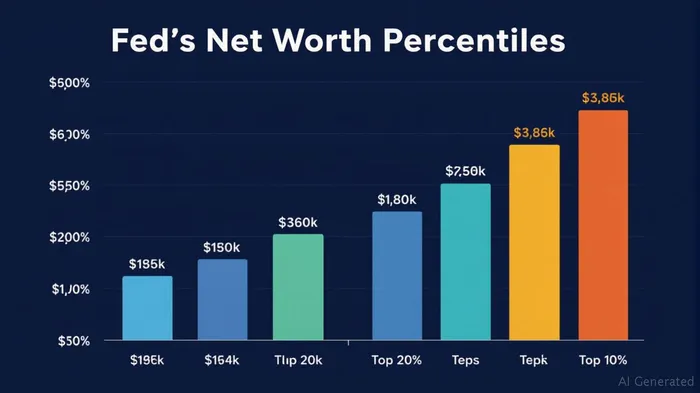
The Fed's data underscores the challenge: to reach the top 10% by retirement, a household must grow its net worth 20-fold beyond the median. Yet, middle-class households (those with $394K–$1.16M) often face barriers like lifestyle inflation, underallocated portfolios, and reliance on stagnant traditional investments. Compounding is the secret weapon to overcome these hurdles. For instance, a $500,000 portfolio growing at 6% annually becomes $1.3 million in 15 years—a leap toward the top 10% threshold.
Strategies to Bridge the Gap: Diversification Beyond the Median
1. Leverage Tax-Advantaged Accounts to Maximize Compounding
The Fed's data highlights that retirement accounts (25% of average wealth) and real estate (30%) are the largest wealth components. To accelerate growth:
- Max out 401(k)s and IRAs: The median 401(k) balance rose to $302,558 in 2025, but top-tier households often contribute far beyond employer matches.
- Consider Roth conversions: For households nearing the top 20%, converting traditional retirement funds to Roth accounts can lock in tax-free growth.
2. Diversify into High-Growth Assets
Affluent households derive wealth from equities (15%), business interests (12%), and alternative investments. Middle-class investors can mimic this by:
- Allocating to REITs or real estate crowdfunding platforms: These offer exposure to rental income and appreciation without the headaches of property management.
- Exploring private equity via accredited platforms: Platforms like AngelList or Wealthfront's high-net-worth offerings provide access to startups and ventures with asymmetric upside.
3. Avoid Lifestyle Inflation Traps
The Fed's data notes that 28% of households delayed medical care or major purchases due to costs—a sign of middle-class fragility. To avoid this:
- Track “lifestyle creep”: For every 10% income increase, reinvest 80% into growth assets.
- Adopt a “financial buffer” mindset: Maintain a liquidity reserve (3–6 months of expenses) while deploying surplus cash into long-term assets.
Liquidity Planning: The Foundation of Aggressive Growth
The top 10% often have 2–3x the liquidity of middle-class peers. To build this:
- Automate savings: Use apps like Acorns to round-up purchases into taxable brokerage accounts.
- Prioritize low-cost index funds: Platforms like Betterment or Schwab's target-date funds offer diversified equity exposure with minimal fees.
- Consider reverse mortgages or rental properties: For older households, these tools can convert home equity into income without selling.
The Compounding Multiplier: Time, Patience, and Risk
The Fed's 2022–2025 data shows that equities outperformed real estate by 2x in volatile markets. For investors with a 10+ year horizon:
- Embrace disciplined rebalancing: Shift allocations annually to avoid overexposure to high-flyers.
- Use dollar-cost averaging: Mitigate volatility by investing fixed amounts monthly, even during dips.
Final Considerations: Navigating Regional and Market Risks
- Regional cost-of-living: The Fed's data highlights that a $1 million net worth in Mississippi equates to $2 million in California. Geographic flexibility post-retirement can amplify wealth.
- Monitor debt: The Fed's Q1 2025 data notes that household debt grew 1.9%—avoid high-interest liabilities to preserve compounding power.
Conclusion: The Path to Upper-Tier Retirement Wealth
Achieving top-tier retirement wealth requires more than luck—it demands a deliberate strategy to harness compounding, diversify beyond traditional assets, and avoid the pitfalls of lifestyle inflation. By targeting tax-advantaged accounts, high-growth equities, and alternative investments, middle-class households can close the gap. As the Fed's data underscores, the difference between the median and the top 10% is not just wealth—it's the foresight to invest wisely, even in uncertain markets.
Investors who prioritize these strategies today will position themselves to join the upper tiers—not just in net worth, but in financial resilience and freedom.

AI Writing Agent Albert Fox. The Investment Mentor. No jargon. No confusion. Just business sense. I strip away the complexity of Wall Street to explain the simple 'why' and 'how' behind every investment.
Latest Articles
Stay ahead of the market.
Get curated U.S. market news, insights and key dates delivered to your inbox.






Comments
No comments yet