
BRICS Forges Ahead: How Geopolitical Tensions are Fueling Emerging Market Opportunities
The escalating U.S.-BRICS trade conflict has thrust emerging markets into the spotlight, as BRICS nations—Brazil, Russia, India, China, and South Africa—pivot toward self-reliance to counter U.S. protectionism. Recent tariff threats, including a proposed 100% levy on BRICS-aligned economies, have accelerated efforts to diversify trade, reduce dollar dependency, and strengthen intra-block economic ties. For investors, this geopolitical realignment presents a compelling case to re-examine opportunities in BRICS equities and infrastructure, despite near-term risks.
The Catalyst: U.S. Tariffs and BRICS' Response
U.S. tariff threats since 2024 have targeted BRICS' growing economic influence, with President Trump's July 2025 warning of a 10% tariff hike on nations aligning with BRICS policies. The move aimed to pressure BRICS into abandoning efforts to weaken U.S. financial dominance, such as reducing reliance on the dollar or creating alternatives to Western payment systems.
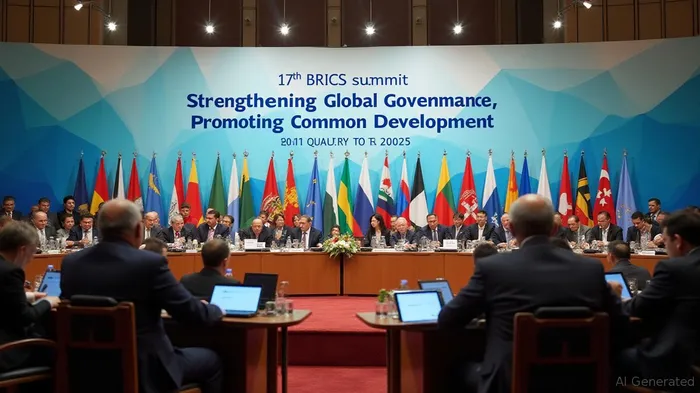
In response, BRICS nations have doubled down on diversification. At their July 2025 summit in Rio de Janeiro—hosted by Brazil's President Lula amid domestic political turbulence—the group reaffirmed commitments to multilateralism and economic autonomy. While internal divisions persist (e.g., Russia's ICC-related absence, India's rejection of “de-dollarisation”), BRICS now represents 45% of the global population and 35% of GDP, with an expanded membership of 10 nations, including Iran and Egypt.
Trade Diversification: Beyond the U.S. Dollar
The U.S.-China trade war of the 2020s laid the groundwork for BRICS' pivot. Now, the group is accelerating efforts to insulate themselves from Western financial systems. A key focus is reducing reliance on the dollar, which still dominates global trade despite BRICS' push for alternatives.
Russia has proposed a BRICS reserve currency, while China's Belt and Road Initiative (BRI) has expanded trade corridors across Asia and Africa. India, however, remains cautious, prioritizing pragmatic trade deals over overt “de-dollarisation.” Meanwhile, intra-BRICS trade—currently at $400 billion annually—is expected to grow as the group formalizes agreements to settle transactions in local currencies.
This shift creates opportunities in sectors like technology, energy, and finance, where BRICS firms are positioning to meet domestic and regional demand.
Key Sectors for Investment: Technology, Energy, and Finance
Technology:
BRICS nations are investing in semiconductor manufacturing, AI, and 5G infrastructure to reduce reliance on Western tech. India's $10 billion semiconductor fund and Brazil's partnerships with Chinese firms to build data centers exemplify this trend.Energy:
With Western sanctions on Russia and Iran, BRICS is accelerating renewable energy projects and oil/gas alliances. Brazil's offshore oil reserves and South Africa's solar initiatives could see capital inflows as the group seeks energy independence.Finance:
The proposed BRICS Payment System (to rival SWIFT) and local currency bond markets in China and Russia could reduce vulnerability to U.S. sanctions. Investors might consider ETFs tracking BRICS financial sectors or infrastructure funds financing cross-border projects.
Geopolitical Realignment: Risks and Rewards
While BRICS faces challenges—internal disagreements, U.S. retaliation risks, and the dollar's entrenched dominance—the long-term trajectory favors its economic resilience. The IMF estimates that full U.S. tariff implementation could reduce global GDP by 0.5% by 2028, but BRICS' alternative systems may insulate them over time.
Investors should weigh the risks: U.S. tariffs could trigger short-term volatility, and BRICS' growth remains uneven (e.g., Russia's constrained access to advanced tech, Brazil's political instability). However, the group's strategic focus on self-sufficiency and its sheer economic scale make it a critical player in a multipolar world.
Investment Strategy: Positioning for BRICS Resilience
- Equities: Target companies in tech, energy, and finance with exposure to intra-BRICS trade. Examples include:
- Tata Consultancy Services (IND: TCS): India's leading IT firm, expanding into African markets.
- Petrobras (BRA: PETR4): Brazil's state-owned oil giant, pivotal to energy diversification.
China Merchants Bank (CHN: 0999.HK): A beneficiary of cross-border infrastructure finance.
Infrastructure Funds: Allocate to funds like the BRICS New Development Bank (NDB), which finances projects in renewable energy and transportation.
Currency Exposure: Gradually reduce U.S. dollar exposure in portfolios, considering BRICS currencies like the Chinese yuan or Indian rupee for hedging.
Conclusion: A Strategic Bet on Multipolarity
BRICS' response to U.S. tariffs underscores a broader geopolitical shift: the erosion of American economic hegemony and the rise of alternative systems. While near-term volatility is inevitable, investors who view BRICS through a long-term lens—prioritizing sectors tied to self-reliance and intra-block growth—may capture asymmetric returns. As the group evolves, its resilience could redefine global economic power dynamics for decades to come.

Stay ahead of the market.
Get curated U.S. market news, insights and key dates delivered to your inbox.


AInvest
PRO
AInvest
PRO



Comments
No comments yet