
Brevis (PIN) Nears Coinbase Listing Amid Cross-Chain Data Demand
 Aime Summary
- Brevis (PIN) included in Coinbase's listing roadmap signals institutional validation for its ZK-based data platform.
- The platform enables trustless cross-chain data verification for DeFi and AI applications through zero-knowledge proofs.
- Binance plans a January 2026 listing following successful airdrops to institutional investors.
- Over $230 million in rewards distributed demonstrates strong ecosystem adoption.
Brevis (PIN) approaches potential CoinbaseCOIN-- and Binance listings in early 2026 as institutional interest surges according to reports. The zero-knowledge proof platform enables decentralized applications to securely access historical blockchain data across networks without intermediaries as research shows. Strategic partnerships with KaitoAI and AsterASTER-- DEX expand PIN's utility in privacy-preserving verification and scalable micropayments according to analysis. This positions PIN at the convergence of DeFi interoperability and institutional-grade blockchain solutions.
How Does PIN's ZK Tech Enable Cross-Chain Verification?
Brevis solves critical interoperability challenges through its modular zkVM called Pico. This technology allows smart contracts to perform off-chain computations with on-chain verification, significantly reducing gas costs. Developers can customize functionalities without deep circuit language knowledge, accelerating adoption. The platform has processed over 278 million ZK proofs to date across integrated protocols like UniswapUNI-- and MetaMask according to data.
ProverNet establishes a decentralized marketplace for proof generation using economic incentives as reports indicate. This architecture enables efficient data access across chains while eliminating third-party trust requirements according to analysis. The PIN 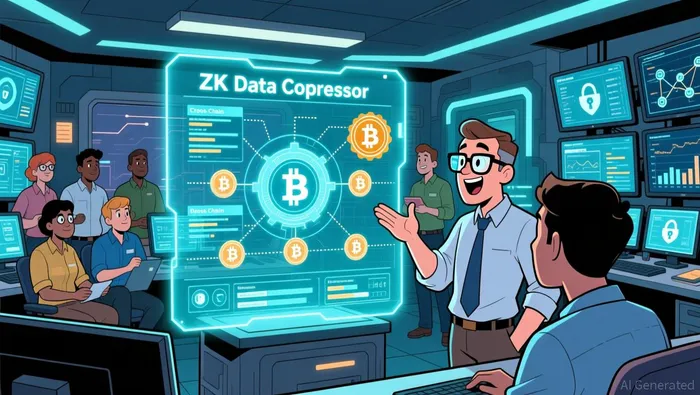 allows any dApp to compute historical on-chain data securely. Such capabilities address fundamental scalability limitations in Web3 infrastructure.
What Drives Institutional Adoption of the PIN Token?
Coinbase's roadmap inclusion indicates PIN cleared initial technical and compliance reviews. Binance's HODLer airdrop in late 2025 distributed tokens through capital-protected products, attracting institutional participants. The token's supply allocation prioritizes long-term growth with 37% dedicated to ecosystem development according to reports. Another 32.2% funds community incentives, aligning stakeholder interests as data shows.
Tokenomics feature staking mechanisms where provers must lock PIN to qualify for computational tasks according to analysis. Slashing risks deter malicious behavior while governance participation lets holders adjust proof parameters as research indicates. Vesting schedules spanning 24 months for ecosystem funds mitigate short-term selling pressure. These structures appeal to institutions seeking sustainable blockchain investments.
Can PIN Capture the Growing ZK Proof Market?
Brevis reports $2.8 billion in ecosystem TVL alongside 195,000 active users according to reports. Partnerships with Kite aim to build verifiable trust infrastructure for AI micropayments as analysis shows. Integration with Aster DEX brings faster execution speeds and selective privacy to on-chain positions according to data. Such collaborations expand PIN's utility beyond DeFi into emerging AI verification markets.
The platform distributed over $230 million in cumulative rewards through its proof network according to reports. Pico zkVM's multi-GPU version achieves 99.6% EthereumETH-- mainnet block coverage in real-time. As ZK technology matures, PIN's early network effects could position it for exponential growth as research indicates. Mainnet adoption across multiple protocols demonstrates technical feasibility at scale according to analysis.

Combina la sabiduría tradicional en el comercio con las perspectivas más avanzadas en el área de las criptomonedas.
Latest Articles
Stay ahead of the market.
Get curated U.S. market news, insights and key dates delivered to your inbox.




Comments
No comments yet