
Brevis Network (BREV) Expands DeFi Capabilities with Zero-Knowledge Proofs
 Aime Summary
- Brevis Network (BREV) is a blockchain infrastructure platform that leverages zero-knowledge proofs to allow off-chain computation and on-chain verification, enabling efficient and trustless execution of complex data tasks according to the platform's documentation.
- The platform supports decentralized finance (DeFi) applications, reward systems, and blockchain intelligence by reducing the computational burden on-chain while maintaining security and decentralization as described in technical analysis.
- BREV tokens serve as a utility within the ecosystem, facilitating payments for computational tasks, staking, delegation, and governance as detailed in user tutorials.
Brevis Network functions by executing computations off-chain through its Pico zkVM or ZKZK-- Data Coprocessor and submitting a cryptographic proof that smart contracts can verify in milliseconds according to technical specifications. This approach enables smart contracts to access historical data and perform complex computations without relying on third-party trust as explained in blockchain analysis.
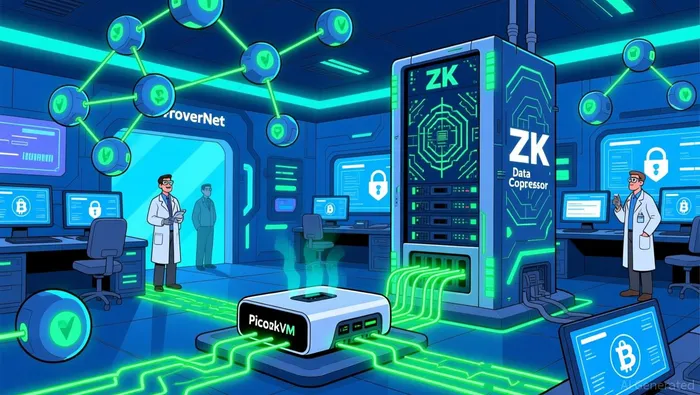
The network's decentralized architecture is composed of three key pillars: Pico zkVM for universal verifiable computation, ZK Data Coprocessor for large-scale blockchain intelligence, and ProverNet, a decentralized ZK proving marketplace as outlined in platform documentation. Through ProverNet, BREV holders can stake and delegate tokens to provers to earn rewards while contributing to the network's security and efficiency according to user guides.
How Does Brevis Address Blockchain's Scalability Issues?
Blockchain networks often struggle with balancing trustless execution and computational scalability. Brevis eliminates this trade-off by offloading expensive computations to a prover, who generates a proof that smart contracts can verify on-chain according to technical documentation. This model preserves Ethereum-level security while enabling capabilities previously limited to centralized systems as reported in platform analysis.
The platform has already secured over 300 million proofs and over $300 million in live reward programs across major DeFi and infrastructure protocols according to performance metrics. By reducing on-chain resource consumption, Brevis allows for efficient processing in DeFi, data analytics, and cross-chain verification as demonstrated in technical reports.
What Recent Market Activity Involves BREV Tokens?
On January 6, $6.7 million worth of BREV tokens were transferred from one Brevis team wallet to another according to transaction records. In the following minutes, $1.7 million of these tokens were sent to exchanges like OKX and Gate, suggesting potential liquidity management or market activity as reported in market analysis.
Additionally, $860,000 worth of tokens were allocated to two newly created wallets, potentially for future deposits into exchanges according to transaction data. This indicates that the team is actively managing token distribution and possibly preparing for increased market activity.
What Risks or Limitations Exist with BREV Staking and Governance?
BREV holders must bridge their tokens to Base using cBridge before staking, and selecting reliable provers is crucial to maximize potential rewards as detailed in staking guidelines. Provers with more delegated stake can take on more proving jobs and share a portion of the proving fees with their delegators according to network mechanics.
Unstaking takes a 7-day waiting period before tokens can be withdrawn, and rewards compound daily as specified in governance rules. This structure requires careful consideration by users to balance liquidity needs with potential returns.
The BREV token has a total supply of 1 billion and is used to pay service fees, support network security via staking, and participate in governance decisions according to tokenomics data. As the mainnet is currently live and integrated with multiple DeFi protocols, the platform has shown significant adoption and utility as reported in market analysis.

Blending traditional trading wisdom with cutting-edge cryptocurrency insights.
Latest Articles
Stay ahead of the market.
Get curated U.S. market news, insights and key dates delivered to your inbox.


AInvest
PRO
AInvest
PRO



Comments
No comments yet