

Brent Oil Price Nears $69 Amid Trump-Iran Tensions: Is $80 the Next Stop?
 Aime Summary
Oil prices extended gains for a third straight session on Wednesday, January 28 , with Brent crude edging toward the significant psychological level of $69 a barrel—its highest closing price since September. West Texas Intermediate (WTI) followed suit, trading near $64, as the energy sector reacted sharply to renewed geopolitical friction in the Middle East. The catalyst for this sudden bullish momentum was a direct warning from President Donald Trump, who issued an ultimatum to Tehran to secure a nuclear deal or face military consequences. In a social media post that reverberated through trading desks globally, Trump stated that US naval forces were prepared to execute missions with "speed and violence, if necessary".
From a market perspective, this development is fundamentally bullish. While the broader energy narrative has recently struggled with "swelling supply" dampening prices, this geopolitical shock has re-injected a necessary risk premium. The immediate market reaction suggests that traders are no longer comfortable shorting oil in an environment where the Commander-in-Chief is openly discussing kinetic military action. We view this as the beginning of a potential breakout, where fear of supply interruption overrides inventory data.
The Geopolitical Tinderbox: Iran and Venezuela
The current rally is driven by the realization that the geopolitical tranquility priced into the market over the last quarter was premature. President Trump’s rhetoric has shifted from diplomatic pressure to explicit military threats, reviving concerns about unrest and disruption in the Middle East. This is not merely bluster; the market recalls the volatility following the US military strike on Iran in 2025. While oil facilities were spared in that instance, causing premiums to collapse, the current threat creates a binary risk environment where any miscalculation could result in physical damage to energy infrastructure.
Options markets are already signaling panic buying. Traders are paying the highest premiums for bullish call options in 14 months, aggressively hedging against the risk of a new US-Iran confrontation. This behavior indicates that institutional money is positioning for a "tail risk" event—a low probability but high impact scenario.
Furthermore, the supply picture is complicated by the ongoing situation in Venezuela. While the headlines are dominated by Tehran, the structural decline in Venezuelan output provides a firm floor for oil prices. With US sanctions potentially tightening on both Iran and Venezuela simultaneously, the global heavy sour crude market faces a severe crunch. If the Trump administration moves to enforce a "maximum pressure" campaign on both nations simultaneously, the assumed "swelling supply" globally could evaporate rapidly, leaving the market in a deficit.
Supply Chains at Risk: The Strait of Hormuz
The most critical variable in this valuation equation is the Strait of Hormuz. A US strike, or even the credible threat of one, could imperil crude flows from the Middle East, a region that accounts for approximately one-third of global supply. The strategic calculus for Tehran, if pushed, involves asymmetric retaliation. Iran has warned it would respond with "unprecedented force," and historical precedent suggests this could extend to disruptions of shipping through the Strait.
This narrow passage separating Iran and the Arabian Peninsula is the jugular vein of the global energy economy. Tankers carrying not just oil, but also liquefied natural gas (LNG), must transit this strait to deliver cargoes worldwide. Any military engagement in these waters renders shipping insurance prohibitively expensive or void, effectively blockading the flow of oil even without a physical closure.
Tehran has stepped up diplomacy with key Middle Eastern powers to head off conflict, indicating they understand the severity of the US threat. However, Trump's assertion that the regime’s atomic program was "obliterated" in June strikes has backed the Iranian leadership into a corner. When a major oil producer is cornered, the risk of "lashing out" against regional infrastructure—pipelines in Saudi Arabia or tankers in the Gulf—rises exponentially. For the investor, this means the "security of supply" discount that has depressed oil prices is rapidly eroding.
Technical Analysis: The Gold-Oil Divergence
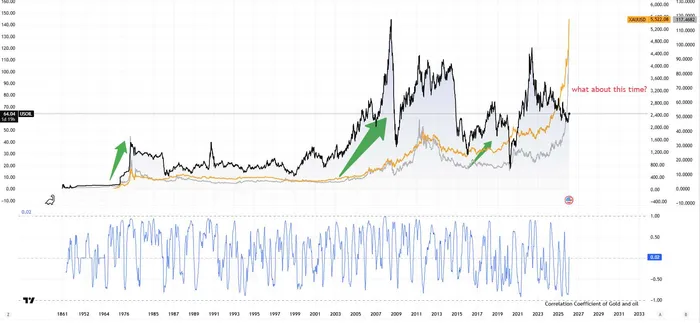
According to Ainvest analysis, a compelling technical signal has emerged that supports a continued bullish trajectory for crude oil. The chart below illustrates the historical correlation between Gold (XAU/USD) and US Oil (USOIL). Historically, these two major commodities share a positive correlation; they often move in tandem during periods of inflation or dollar devaluation.
However, the recent price action shows a stark divergence. As shown in the "what about this time?" section of the chart, Gold prices have surged aggressively (indicated by the orange line spiking vertically), pricing in monetary debasement and geopolitical fear. Conversely, oil prices (the black line) have lagged behind, only recently beginning to turn upward.
This gap represents a significant opportunity. Geopolitical crises that drive Gold higher typically drive Oil higher as well, as energy is a tangible asset sensitive to conflict. The current divergence suggests that Oil is undervalued relative to the broader "fear trade." If the historical correlation, which has oscillated but generally trended together since 2005, is to revert to the mean, Oil must rally aggressively to "catch up" with Gold. We are seeing the early stages of this reconciliation now (indicated by the green arrow), suggesting significant upside potential for WTI and Brent independent of supply/demand fundamentals.
Wall Street Outlook: The Bull Case Strengthens
Major financial institutions are revising their outlooks to reflect the heightened risk environment. Analysts at Goldman Sachs have noted that the "complacency" in the energy market is ending. They argue that while US shale production has been robust, it cannot offset a sudden disruption in the Persian Gulf. Goldman emphasizes that the risk premium, which had largely evaporated in late 2025, is returning and could add $5 to $10 per barrel in the short term.
Similarly, Morgan Stanley maintains a bullish stance, suggesting that the market has over-indexed on demand fears related to the global economy and under-indexed on supply shocks. Their analysts point out that spare capacity is tighter than reported, and any conflict involving Iran would immediately test the limits of global production buffers.
Bank of America also highlights the options market activity, noting that the skew toward calls is a leading indicator of institutional sentiment shift. They project that if Brent sustains a close above $70, algorithmic trading desks will be forced to chase the momentum, potentially driving prices toward the $80 mark rapidly. The consensus among these top-tier desks is clear: the path of least resistance for oil is higher.
Conclusion
The convergence of aggressive US foreign policy, fragile Middle Eastern supply chains, and compelling technical signals creates a robust bullish case for oil. President Trump's ultimatum to Iran has acted as the spark, but the fuel for this rally comes from a market that is structurally tighter than the bearish "oversupply" narratives suggest.
Investors should watch the $70 level on Brent closely. A breach of this resistance, combined with the "catch-up" trade relative to Gold, could open the door for a rally toward $80. In an environment defined by "speed and violence," cash is not king—commodities are. The era of low-volatility oil appears to be over; the market must now price in the reality of conflict.

Tianhao Xu is currently a financial content editor, focusing on fintech and market analysis. Previously, he worked as a full-time forex trader for several years, specializing in global currency trading and risk management. He holds a master’s degree in Financial Analysis.
Latest Articles
Stay ahead of the market.
Get curated U.S. market news, insights and key dates delivered to your inbox.






Comments
No comments yet