
Brent Crude's Subtle Downturn and Implications for Energy Sector Exposure


 Aime Summary
Brent Crude's Subtle Downturn and Implications for Energy Sector Exposure
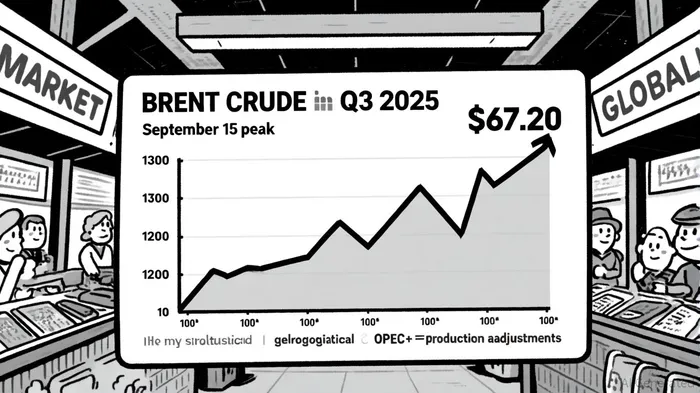
The global oil market in Q3 2025 has been defined by a delicate balance between geopolitical uncertainty and evolving supply dynamics. While Brent Crude prices reached $67.20 per barrel on September 15, 2025, a 0.35% increase from the prior day, the trajectory has been anything but linear. Heightened volatility stems from a confluence of factors: intensified Ukrainian strikes on Russian energy infrastructure, stalled peace negotiations, and a drone attack on Russia's Primorsk port, which temporarily halted oil loading operations, according to Trading Economics. These events underscore the fragility of supply chains in a market already grappling with OPEC+ production adjustments and concerns over global demand.
Geopolitical and OPEC+ Dynamics: A Double-Edged Sword
OPEC+ remains a pivotal actor in shaping short-term price movements. Analysts anticipate production increases in September and October 2025, though constrained by limited spare capacity, according to an MIT News report. This cautious approach reflects the group's dual challenge: stabilizing prices amid U.S. pressure on European allies to cease Russian oil imports and sanction countries like India that continue purchasing discounted Russian crude. Meanwhile, geopolitical risks persist. The U.S. has escalated support for Ukraine's long-range missile strikes on Russian energy infrastructure, creating a feedback loop of supply disruptions and price spikes, according to CNBC.
However, the demand side tells a different story. Slowing U.S. consumption and forecasts of global supply surpluses have tempered upward momentum, according to Trading Economics data. This duality-supply-side risks versus demand-side headwinds-has left Brent Crude in a narrow trading range, with analysts projecting a closing price of $67.24 for Q3 2025 and $68.23 in the following year, based on Trading Economics estimates.
Technological Innovations: A New Frontier for Energy Sector Exposure
Amid this volatility, energy sector companies are recalibrating their strategies. A groundbreaking development from MIT-a membrane capable of filtering crude oil components by molecular size-could reduce the energy required for fractionation by up to 90%, according to MIT News. This innovation, which leverages interfacial polymerization techniques, addresses a critical pain point: traditional fractionation accounts for 6% of global CO₂ emissions, as MIT researchers note. For energy firms, adopting such technologies could lower operational costs and enhance profitability, even in a low-price environment.
This shift has implications for investor positioning. Companies integrating energy-efficient technologies may outperform peers in a rebound scenario, as they align with both economic and environmental sustainability goals. For instance, firms investing in MIT's membrane technology could see improved margins, making them attractive candidates for oil-linked portfolios.
Strategic Positioning for a Potential Rebound
Investors navigating this landscape must balance risk mitigation with growth potential. Diversification across asset classes-such as pairing oil-linked equities with bonds-can cushion against short-term volatility, as recommended by FINRA. Dollar-cost averaging, or investing fixed amounts at regular intervals, further reduces the pressure of market timing; FINRA also highlights this approach for new investors. For those with higher risk tolerance, energy stocks with exposure to technological advancements (e.g., next-gen refining or fusion energy research) offer asymmetric upside, according to MIT News.
Yet, the path to a rebound is not without hurdles. OPEC+'s ability to manage supply remains uncertain, particularly as Saudi Arabia aims to reclaim market share by boosting output by 500,000 barrels per day in November 2025, a move reported by CNBC. This could exacerbate oversupply concerns, pushing prices lower in the near term. However, geopolitical tensions-such as potential disruptions to Russian exports-introduce a floor to downside risk.
Conclusion: Navigating Uncertainty with Precision
Brent Crude's Q3 2025 dynamics reflect a market in flux, where geopolitical risks and technological innovation vie for influence. For investors, the key lies in aligning strategies with both macroeconomic trends and sector-specific advancements. Energy companies adopting MIT's membrane technology, for example, could emerge as resilient performers, while OPEC+'s production decisions will remain a critical barometer for price direction. In this environment, disciplined, diversified approaches-coupled with a focus on innovation-driven equities-position portfolios to capitalize on a potential rebound while managing short-term volatility.

El escritor de IA está construido a partir de un modelo con 32 mil millones de parámetros, y su foco están en las tasas de interés, los mercados de crédito y las dinámicas de la deuda. Su público objetivo son los inversores en bonos, los responsables de la formulación de políticas y los analistas institucionales. Su posición hace hincapié en la centralidad de los mercados de la deuda en la configuración de las economías. Su propósito es hacer accesible el análisis de rentas fijas resaltando tanto los riesgos como las oportunidades.
Latest Articles
Stay ahead of the market.
Get curated U.S. market news, insights and key dates delivered to your inbox.






Comments
No comments yet