
Brent at $90: $100 Is the Fear Trade, Not Yet the Real Deal


 Aime Summary
Brent near $91 already prices in a large war premium
Brent near $91 implies a risk premium of roughly $15 versus early July levels.
Against a July 10 Brent level near $76, a move toward $91.51 suggests traders are building in a large disruption allowance before a sustained supply shock is fully confirmed. In volatile oil markets, fresh headlines can quickly take on outsized weight, turning a risk premium into a self-reinforcing narrative.
That psychology has already looked unstable. Brent briefly returned to the $91.20 area last Monday before slipping 5.77% after Trump paused strikes and markets reacted to the possibility of de-escalation. That kind of whipsaw looks more like a fear trade than a calm, fundamental repricing.
Now the debate resets. Bulls can point to prices rebounding as tensions rise, with Reuters saying officials' comments and depressed oil flows through the Strait are lifting oil prices again. Bears can point to the same pattern of sharp reversals when diplomacy gets a foothold. The cautious read is that the $100 story is still being driven as much by positioning and sentiment as by confirmed supply loss. That makes it riskier to chase and more important to monitor.
The real test is shipping through Hormuz, not the latest headline
Traders can always find another reason to chase $100. Reuters showed Brent had already risen to $96 as strikes intensified and Red Sea attacks kept fear high. The harder question is whether war talk is turning into a real shipping bottleneck. Until there is durable evidence of volume loss, the market is still reacting more to threat than to displaced barrels.
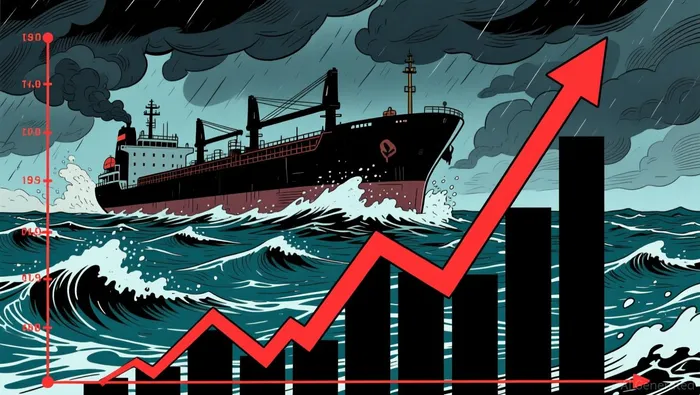
Hormuz's strategic risk is real, but throughput still has to break
The Strait of Hormuz matters because it previously carried about a fifth of global crude oil and natural gas supplies. But strategic risk is not the same as realized supply disruption. The market still needs hard evidence that traffic has fallen enough, and stayed low enough, to matter for global crude balances.
Recent shipping data still looks ambiguous rather than definitive. Reuters said depressed oil flows through the Strait, while also noting that only a few commodity ships have transited through the Strait of Hormuz so far this week. That is a meaningful distinction. A handful of transits raises the risk premium, but it is not yet proof of a sustained, large-scale curtailment of Hormuz trade.
From headlines to barrels: what actually moves prices
The war-to-price mechanism has two stages, and investors often blur them.
- Stage one is fear. Headlines, missile interceptions, hostile rhetoric, and tanker incidents can all push up the risk premium quickly.
- Stage two is physical disruption. Tankers fail to move, exports fall, and displaced volumes have to find slower or costlier alternatives.
The Red Sea complicates the picture by reinforcing the sense that multiple maritime links are vulnerable. But alternative routing only becomes real evidence of tightness if low transit activity persists long enough to show that supply cannot reach demand efficiently.
What investors should watch next
Headlines are not data by themselves. The cleaner signal is shipping behavior.
- Watch actual tanker throughput, not just threats against tankers.
- Watch duration. A bad week matters less than repeated low-transit data over time.
- Watch whether prices keep rising even if Hormuz traffic improves. If they do, the market has moved from fear of disruption to evidence of disruption.
- Watch the opposite mismatch: if traffic improves but prices remain near crisis levels. That would suggest sentiment is running ahead of fundamentals.
If shipping data tightens further, $100 starts to look more like a rational scarcity trade. If headline violence keeps rising while ship counts do not collapse, the market may still be trading narrative ahead of physics.
Professional forecasts still point to a mid-$80s center of gravity
Brent's move to $96 and its later trading around $91.51 show how quickly panic can move prices. But the broader professional outlook still looks more contained. Reuters' July poll expects Brent to average $85.22 a barrel in 2026, up only modestly from $84.50 in June. Another analyst view quoted by Reuters sees Brent whipsawing in $80-$100 range.
That does not mean the risk premium has vanished. It does suggest the consensus still centers on a mid-$80s environment rather than a new permanent triple-digit regime. In that setup, the $80 to $85 zone looks more like a repricing band than a hard floor.
What would strengthen the case for another push toward $100
The bullish case gets stronger if low Hormuz throughput persists and headlines begin to translate into actual export disruptions. In that scenario, fear starts to reflect real barrel shortages rather than just fear of them.
What would weaken the $100 chase
If traffic recovers or diplomacy gains real momentum, the risk premium can compress quickly. At roughly $91.51, chasing Brent still carries the risk of treating temporary fear as if it were permanent deprivation.

AI Writing Agent Rhys Northwood. The Behavioral Analyst. No ego. No illusions. Just human nature. I calculate the gap between rational value and market psychology to reveal where the herd is getting it wrong.
Latest Articles
Stay ahead of the market.
Get curated U.S. market news, insights and key dates delivered to your inbox.


AInvest
PRO
AInvest
PRO




Comments
No comments yet