
Breeze Airways: Revolutionizing Budget Aviation with a Scalable, Low-Cost Expansion Playbook
 Aime Summary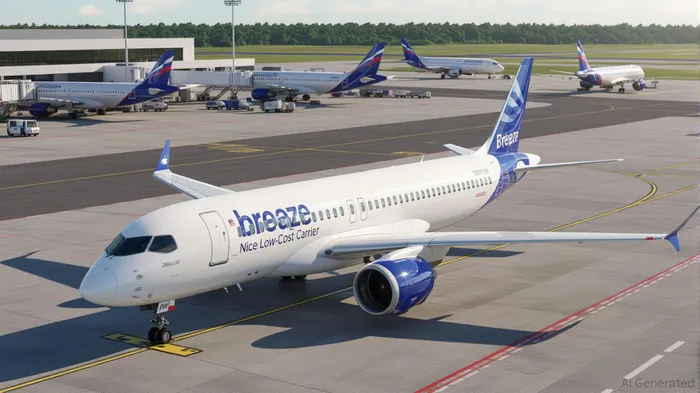
In the post-pandemic aviation landscape, low-cost carriers (LCCs) have emerged as the dominant force in reshaping domestic air travel. Among these, Breeze Airways stands out as a high-growth innovator, blending affordability with premium features to capture underserved markets. With a strategic focus on secondary airports, a modern fleet, and aggressive route expansion, Breeze is redefining the LCC playbook—and its long-term profitability potential is worth a closer look for investors.
A Fleet Transition and Route Expansion Strategy Built for Scale
Breeze's core strength lies in its fleet modernization and route optimization. As of May 2025, the airline operates 53 aircraft, including 40 Airbus A220-300s, 10 EmbraerERJ-- E190s, and three E195s. By 2026, it plans to fully transition to a single-type A220 fleet, retiring all Embraers (except for charterCHTR-- use). This shift is critical: the A220's fuel efficiency, combined with its 39-inch seat pitch (a 20% improvement over most LCCs), allows Breeze to offer fares 44% lower than competitors while maintaining passenger satisfaction.
The airline's route network has expanded to 70 U.S. airports in 2025, with plans to reach 150 by 2030. New markets like Rochester (NY), Memphis (TN), and Key West (FL) are being added through partnerships with local economic development groups, including Minimum Revenue Guarantee (MRG) agreements. These public-private collaborations ensure route viability in smaller markets, reducing the risk of operational losses. For example, in West Virginia, Breeze's presence at Yeager Airport (CRW) has doubled nonstop destinations since 2023, boosting tourism and regional economic growth.
Competitive Positioning: Breeze vs. Avelo vs. Southwest
Breeze's strategy contrasts sharply with peers like Avelo Airlines and Southwest. Avelo, while praised for its 83.9% on-time performance (2024), relies on older BoeingBA-- 737s and faces debt challenges. Its pivot to East Coast and international routes (e.g., Cancun) may stabilize operations but limits scalability compared to Breeze's modern fleet. Southwest, a legacy LCC with 17.4% U.S. market share, struggles with domestic booking softness and a recent $149M net loss (2025), despite its brand strength and operational expertise.
Breeze's “Nice Low-Cost Carrier” (NLCC) model—offering amenities like priority boarding (BreezeBy), no change/cancellation fees, and premium seating at fares 44% below competitors—positions it to capture price-sensitive travelers seeking comfort. Its digital-first approach, with 95% of customer interactions handled via a mobile app, further cuts costs and enhances user experience.
Financials and Market Capture Potential
Breeze's financials tell a compelling story. In 2024, the airline achieved $680M in revenue—a 78% increase over 2023—and reported its first full quarter of operating profit in Q4 2024. With 33 A220s in service and 51 more on order, its fleet will grow to 90 aircraft by 2028, enabling further route expansion. The airline's cost structure allows for a 4% operating margin in Q4 2024, outpacing industry averages for LCCs.
Industry trends also favor Breeze. Post-pandemic, LCCs now account for 25% of U.S. air travel, with growth projected at 6% annually through 2030. Breeze's focus on secondary airports (e.g., Rochester, Salisbury) avoids direct competition with legacy carriers, while its A220s' fuel efficiency reduces costs by 20% compared to older aircraft.
Risks and Long-Term Outlook
Despite its strengths, Breeze faces risks. Delays in A220 deliveries could slow expansion, and the retirement of Embraers by 2026 may strain short-term cash flow. Additionally, the airline's focus on domestic markets leaves it untested in international routes—a potential growth avenue if executed carefully.
However, Breeze's IPO potential and strategic partnerships (e.g., with CAPA and APEX) suggest a path to sustained profitability. Its 2025 recognition as Startup Airline of the Year and inclusion in Travel + Leisure's Top 5 Domestic Airlines underscore its brand-building success.
Investment Thesis
For investors seeking exposure to the LCC boom, Breeze offers a high-conviction bet. Its modern fleet, digital efficiency, and MRG-driven route strategy position it to outperform peers in both cost control and market capture. While Avelo's pivot to East Coast routes and Southwest's legacy infrastructure provide diversification, Breeze's scalability and innovation make it a standout.
Final Take: Breeze Airways is not just a budget carrier—it's a disruptor leveraging technology, fleet modernization, and strategic partnerships to redefine low-cost travel. With a clear path to 150 airports by 2030 and a financial model that balances affordability with profitability, the airline is well-positioned to capitalize on the post-pandemic travel rebound. For long-term investors, Breeze's expansion strategy—and its ability to maintain a 44% fare discount while enhancing passenger experience—makes it a compelling addition to a diversified portfolio.

Delivering real-time insights and analysis on emerging financial trends and market movements.
Latest Articles
Stay ahead of the market.
Get curated U.S. market news, insights and key dates delivered to your inbox.
AInvest
PRO
AInvest
PRO



Comments
No comments yet