
Why Breeze Airlines Is Soaring in a Crowded Sky: A Post-Pandemic Growth Story
The aviation industry has long been a battleground for legacy carriers like DeltaDAL-- and United, but a new player is carving out its own path with razor-sharp precision. Breeze Airways, founded in the depths of the pandemic in 2021, has emerged as a disruptor in the U.S. airline sector. By focusing on underserved markets, a modern fleet, and a customer-centric digital strategy, Breeze is now positioned to capitalize on post-pandemic demand—and investors should take note.
A Blueprint for Growth: Network Expansion and Strategic Route Selection
Breeze's rise is rooted in its relentless pursuit of overlooked markets. Since 2023, the airline has added 29 airports to its network, reaching 70 destinations by May 2025, with plans to expand to 150 by 2030. Unlike traditional carriers, Breeze avoids direct competition by targeting secondary cities and routes with little to no existing service. For instance, its launch in Salisbury, Maryland—the first commercial flights there since 2012—highlighted its knack for unlocking untapped demand.
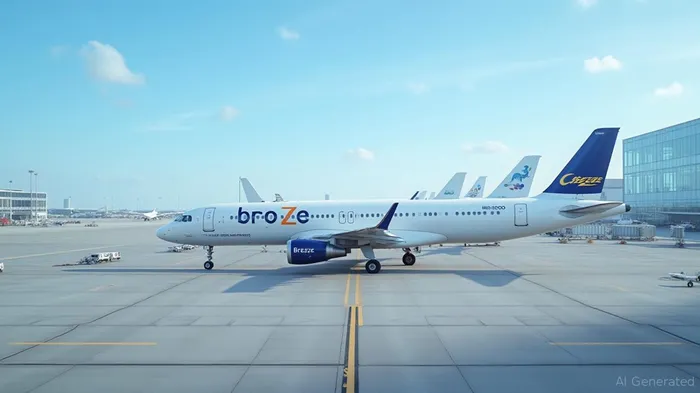
This strategy isn't just about geography. Breeze prioritizes leisure and visitation travel, routes that are 87% noncompetitive, avoiding price wars with major carriers. Its “BreezeThru” service—offering one-stop connections to major hubs—further solidifies its position as a connective tissue for smaller markets. By June 2025, Orlando International, its busiest hub, will host 13 daily flights, serving as a gateway to 33 destinations, 72% of which lack alternatives.
The Power of a Modern Fleet
At the core of Breeze's efficiency is its Airbus A220-300 fleet, which now accounts for 80% of its aircraft. The A220's fuel efficiency and spacious 39-inch seat pitch (20.5-inch width) enable fares 44% lower than competitors, a critical edge in price-sensitive markets. By 2026, Breeze plans to retire its Embraer fleet entirely, accelerating its reliance on the A220. With 90 firm orders and 30 options for additional A220s by 2028, the airline is doubling down on scalability.
Digital-First Innovation and Strategic Partnerships
Breeze's digital backbone is its secret weapon. The airline's app handles 95% of customer interactions, from booking to real-time flight adjustments—a stark contrast to competitors' clunky systems. Its partnership with Barclays, launched in 2023, introduced a co-branded credit card and loyalty program, integrating seamlessly with its app. This program rewards everyday spending with flight points, driving customer retention and brand stickiness.
The results? Breeze has earned accolades like the CAPA 2025 Startup Airline of the Year and APEX's Four-Star Low-Cost Carrier rating, while its Net Promoter Score (NPS) rivals industry leaders.
The Financial Case for Breeze
Breeze's financial trajectory is nothing short of impressive. In 2024, revenue surged 78% year-over-year to $680 million, with its first profitable quarter in Q4 2024 ($200 million revenue, 4% operating margin). While its 0.5% U.S. domestic market share is small, it's growing fast: 4.4 million passengers in the past year rank it as the 11th-largest U.S. airline by traffic.
Critics point to its 77% load factor—below the industry average of 83%—but this reflects Breeze's deliberate focus on profitability over volume. With a $600 million valuation and a balance sheet fortified by low debt, the airline is primed to scale without overextending.
The Risks, and Why They're Manageable
No investment is without risk. Breeze has exited three airports in 2025 due to low demand and faces headwinds like rising fuel costs and labor constraints. Yet its strategy of focusing on underserved markets inherently reduces competition-driven price erosion. Moreover, its A220 fleet's fuel efficiency mitigates cost pressures, and its crew basing in Akron (Ohio) and other hubs strengthens operational resilience.
Why Investors Should Act Now
Breeze is at an inflection point. Its $600 million valuation is a fraction of peers like Allegiant ($2.4B) or Spirit ($3.1B), despite comparable growth trajectories. With a 2030 target of 150 airports—including potential international routes—and a proven model of profitability, Breeze is poised to capture a growing share of the $200 billion U.S. domestic air travel market.
The stock, which has risen 140% since its 2023 IPO, now offers a compelling entry point. As leisure travel rebounds and regional connectivity becomes a priority, Breeze's niche as a “nice low-cost carrier” (NLCC) is uniquely positioned to thrive.
Final Analysis: A Jet Stream of Opportunity
In an industry still recovering from pandemic turbulence, Breeze Airways is the airline to watch. Its combination of strategic route selection, fleet modernization, and digital innovation has turned it into a disruptor with sustainable growth potential. For investors seeking exposure to the aviation sector's next chapter, Breeze is not just a bet—it's a boarding pass to the future.
The skies may be crowded, but Breeze is flying first class.

Stay ahead of the market.
Get curated U.S. market news, insights and key dates delivered to your inbox.
AInvest
PRO
AInvest
PRO



Comments
No comments yet