
Breaking Barriers: How Alternative Credit Scoring is Reshaping Mortgage Access and Creating Fintech Opportunities
The U.S. mortgage market is undergoing a quiet revolution. Regulatory shifts, driven by the Federal Housing Finance Agency (FHFA) and the Consumer Financial Protection Bureau (CFPB), are dismantling decades-old credit scoring systems and replacing them with modern models that could unlock up to $1 trillion in new mortgage opportunities. At the heart of this transformation are alternative credit scoring models—tools that assess borrowers' creditworthiness using non-traditional data like rent payments, utility bills, and even cell phone usage. For investors, this shift presents a rare chance to capitalize on both market disruption and regulatory tailwinds.
The Regulatory Pivot: Why Now?
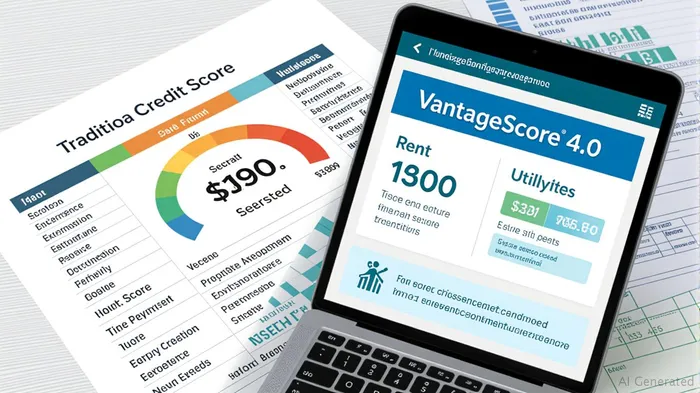
The FHFA's adoption of VantageScore 4.0 in 2025 marks a watershed moment. This new system eliminates exclusionary practices that once denied mortgages to millions of Americans—veterans, rural residents, and young adults—by no longer requiring a six-month credit file history or recent credit activity. Instead, it incorporates alternative data such as on-time rent and utility payments, validated by Bank of AmericaBAC-- research as reliable predictors of repayment. Simultaneously, the CFPB's focus on fair lending compliance has forced lenders to rigorously test models for bias, pushing them toward less discriminatory alternatives (LDAs).
The removal of medical debt from credit reports in 2025 further reduces barriers for borrowers, potentially improving scores for 15 million people. These changes are not just about inclusivity—they're about economic efficiency. A more accurate credit assessment system means lenders can safely expand their customer base while minimizing risk.
Market Disruption: Fintechs Lead the Charge
While traditional lenders scramble to adapt, fintechs are already capitalizing on this shift. Companies like ZestFinance, Blend, and Scoreplex are leveraging AI and alternative data to redefine credit scoring. ZestFinance's “Zest Model Management System,” for instance, uses machine learning to analyze vast datasets, increasing approval rates by 20-30% for underbanked borrowers. Blend's platform streamlines mortgage approvals for major banks like Wells FargoWFC--, integrating alternative data seamlessly into traditional workflows.
The Lending & Credit fintech sector is particularly ripe for investment. Its median valuation multiples (10.6x EV/Revenue) reflect both its growth potential and the urgency of incumbent banks to partner with these innovators. For example:
- Scoreplex (Amsterdam-based) uses 140+ data sources, including social media activity, to assess risk in real time.
- Tala targets underbanked populations globally by analyzing cell phone usage patterns.
- Fundbox automates small-business loans using accounting software data—a model increasingly relevant to mortgage lending as well.
Investment Opportunities: Where to Look?
Partnership-Driven Fintechs:
Firms with existing alliances to major lenders (e.g., Blend with U.S. Bank) have a clear path to scale. Their integration into legacy systems reduces friction and accelerates adoption.AI-Driven Compliance Tools:
The CFPB's emphasis on testing for bias creates demand for “white box” AI solutions like those from ZestFinance. These tools ensure compliance while maintaining profitability—a dual win for investors.Geographic Expansion Plays:
Companies like Tala and Scoreplex targeting emerging markets (e.g., Nigeria, Mexico) could see outsized returns as global financial inclusion efforts gain momentum.Regulatory Arbitrage:
Firms like Reggora (streamlining appraisals) or Point (shared equity financing) are solving niche pain points in the mortgage lifecycle, creating defensible moats.
Risks and Considerations
- Regulatory Overreach: The CFPB's focus on “clear consumer harm” over statistical disparities reduces risk but demands rigorous compliance infrastructure.
- Data Privacy: Over-reliance on alternative data (e.g., social media) could invite scrutiny under the EU's AI Act or U.S. state-level laws.
- Market Saturation: Early-stage valuations (e.g., 43x for Flowpay) may face downward pressure as competition intensifies.
Final Take: Invest in the Infrastructure, Not Just the Apps
The real winners here are not just the scoring models themselves but the back-end infrastructure enabling their adoption. Companies like Experian (integrating utility payments via Experian Boost) and Scoreplex (real-time risk engines) are building the plumbing of tomorrow's mortgage market. For investors, this means prioritizing firms with strong partnerships, scalable tech, and a focus on compliance.
The rise of alternative credit scoring isn't just about fairness—it's about building a more efficient financial system. For those willing to navigate the regulatory landscape, the rewards could be monumental.

Delivering real-time insights and analysis on emerging financial trends and market movements.
Latest Articles
Stay ahead of the market.
Get curated U.S. market news, insights and key dates delivered to your inbox.
AInvest
PRO
AInvest
PRO



Comments
No comments yet