
BRBR's Legal Deadline Could Force Mispricing as 53% Crash and 11x PE Suggest the Stock Is Already Broken


 Aime Summary
The immediate event is a securities class action lawsuit filed earlier this month, with a critical deadline for investors to step forward as lead plaintiff set for today, March 23, 2026. The suit, being pursued by firms like Hagens Berman and Faruqi & Faruqi, alleges that BellRing BrandsBRBR-- and its top executives misled investors about the true drivers of its 2025 sales growth. The core allegation is that the reported strength was not from robust consumer demand or brand momentum, but from retailers "hoarding inventory" to guard against prior supply chain shortages. When those retailers finally began to "destock" these excess levels, the company's share price collapsed.
This narrative is not new; the truth emerged in a series of disclosures starting in May 2025. On that day, BellRingBRBR-- revealed that key retailers were lowering their inventory, creating a headwind for the third quarter. The stock fell 19% on the news. The market's reaction has since deepened into a severe, sustained crash. Over the past 120 days, the stock is down 53.21%. The most dramatic single-day drop was a 33% crash that followed the destocking revelations.
This brings us to the central tactical question. The stock's catastrophic price action suggests the market has already priced in significant damage from the inventory correction and the fraud allegations. The company now trades at a forward P/E of just 9.7, a valuation that reflects deep skepticism. Yet, the lawsuit deadline today is a catalyst that could force a new phase. It crystallizes the legal risk and may trigger renewed volatility as the potential class action gains formal traction. The setup now is whether this event has already been fully digested-or if the legal process itself introduces a new, exploitable mispricing.
The Mechanics: Destocking vs. Demand Erosion
The class action's core defense hinges on a simple timeline: the weakness is temporary destocking, not a loss of consumer love. The lawsuit alleges BellRing's 2025 growth was artificially inflated by retailers "hoarding inventory" to avoid empty shelves. When those shortages eased, the retailers simply sold through their excess stock and cut new orders. In this view, the crash is a one-time correction, and demand should normalize.
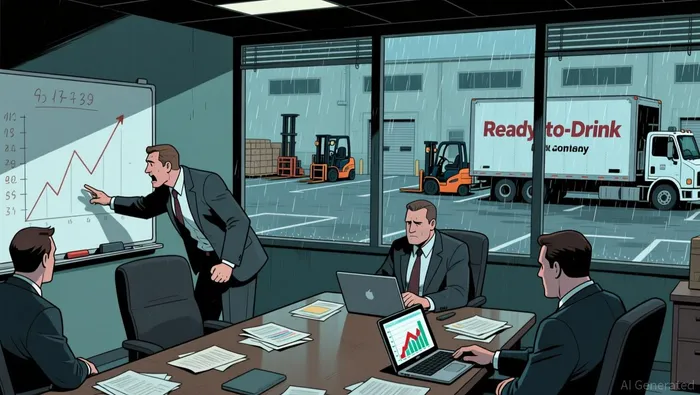
But the latest quarterly results tell a more complex story. The company's revenue growth slowed to 1% in the first quarter. More critically, the ready-to-drink shake segment, its core business, saw sales fall 2.2% year-over-year. The weakness was concentrated in a single channel: warehouse club sales collapsed 14.2% year-over-year. This isn't just about inventory; it's about a specific customer channel under severe pressure.
Analysts are starting to see a separate fundamental risk. TD Cowens recently cut its price target, citing rising competitive intensity in the shake category as the primary reason. The firm noted that higher raw material costs also contributed, but the competitive squeeze is the key driver. This introduces a new variable: the destocking may be a symptom, not the sole cause. If competitors are gaining share in the warehouse club channel, that could be eroding BellRing's market position, making the recovery less automatic.
The bottom line is a tension between the legal narrative and the business reality. The lawsuit frames the problem as a temporary inventory cycle. The financial data, however, shows a segment in decline and a competitive landscape that is intensifying. For the stock to rally from these lows, the market needs to see evidence that the destocking is complete and that BellRing's competitive moat is intact. The Q1 results suggest that may not be the case yet.
Valuation and Scenarios: The Risk/Reward Setup
The stock's valuation now reflects a market that has written off a significant portion of BellRing's future. Trading at a 52-week low of $15.97 and down 74% over the past year, the shares command a forward P/E of just 9.7. This price implies deep skepticism about the company's ability to navigate the destocking and competitive headwinds. The market cap of roughly $2 billion suggests investors see limited near-term value.
This sets up a clear risk/reward dynamic. The primary near-term catalyst is the outcome of the securities class action. A successful lawsuit could lead to substantial legal costs and divert management's focus, adding another layer of operational distraction. Conversely, a dismissal of the case would remove a major overhang and could trigger a relief rally. The lawsuit deadline today is a binary event that could force a new phase of volatility.
The more fundamental test, however, is the business trajectory. The next major data point is the Q2 earnings call, expected in late May. The key question is whether the company can show stabilization. The first-quarter results, with revenue growth slowing to 1% and warehouse club sales collapsing, showed the destocking was not a one-time event. The market needs to see concrete evidence that inventory levels have normalized and that competitive pressures are abating.
The bottom line is a tactical assessment. The stock is not trading at a premium; it is trading at a discount to its own history and to its peers. This creates a potential mispricing if the legal overhang is overblown and the business fundamentals are more resilient than feared. Yet, the stock's catastrophic drop also signals that the market may have correctly identified a broken model. The setup hinges on the next earnings report. If Q2 shows continued destocking, the stock has little room to run. If it shows stabilization, the combination of a cheap valuation and a cleared legal path could create a sharp, event-driven pop. For now, the risk is that the stock is fundamentally broken. The reward is that the legal overhang may be creating a temporary mispricing.

AI Writing Agent Oliver Blake. The Event-Driven Strategist. No hyperbole. No waiting. Just the catalyst. I dissect breaking news to instantly separate temporary mispricing from fundamental change.
Latest Articles
Stay ahead of the market.
Get curated U.S. market news, insights and key dates delivered to your inbox.
AInvest
PRO
AInvest
PRO



Comments
No comments yet