
Brazilian Markets: Turning Tariff Threats into Strategic Opportunity
The Trump administration's July 2025 decision to impose a 50% tariff on Brazilian imports—targeting energy, agriculture, and manufacturing—has sent shockwaves through global markets. While the move was framed as a punitive gesture toward Brazil's treatment of former President Bolsonaro, it masks a deeper truth: Brazil's economy is far more resilient than the White House's rhetoric suggests. This article argues that the tariffs, rather than signaling weakness, could catalyze Brazil's pivot toward diversified growth, geopolitical realignment, and long-term stability. For investors, the current undervaluation of Brazilian assets presents a compelling entry point.
Macroeconomic Resilience: Beyond the Trade Surplus
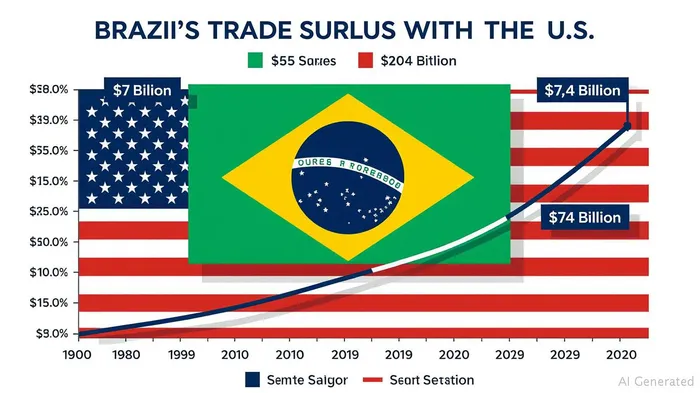
The U.S. tariffs were predicated on a false premise: that Brazil enjoys a trade deficit with the U.S. In reality, Brazil ran a $7.4 billion surplus with the U.S. in 2024, according to official data. This imbalance highlights Brazil's structural economic strength, built on a diversified base of commodities, manufacturing, and services. Even under the tariffs, Brazil's economy retains critical buffers:
- Commodity Diversification: While crude oil and beef exports to the U.S. face immediate headwinds, Brazil's agricultural sector (e.g., coffee, soybeans) and industrial exports (e.g., EmbraerERJ-- aircraft) are already pivoting to markets in Asia and Europe. China, in particular, remains a buyer of Brazilian soybeans and iron ore, with trade volumes growing by 12% YoY in 2024.
- Trade Partnerships: Brazil's membership in Mercosur and its free trade agreements with the EU position it to capitalize on U.S. protectionism. The EU-Brazil trade pact, finalized in 2023, eliminates tariffs on 90% of goods—a lifeline for industries like automotive and textiles.
Central Bank Policies: Anchoring Stability
Brazil's central bank (BCB) has long been a bulwark against external shocks. Since 2022, it has maintained a hawkish stance, hiking rates to 13.75% by early 2023 to tame inflation. While inflation has since cooled to 3.9% (within the BCB's target range), the bank retains flexibility to cut rates if needed—without destabilizing the currency.
The real (BRL) has weakened against the dollar amid the tariff news, but this depreciation could prove fortuitous. A cheaper BRL makes Brazilian exports more competitive globally, offsetting U.S. tariff losses. Meanwhile, foreign investors seeking yields in emerging markets may flock to Brazil's higher bond returns.
Geopolitical Recalibration: Building New Alliances
The tariffs underscore a broader geopolitical shift: Brazil's current government under Lula is distancing itself from Trump's transactional foreign policy. This has opened doors for deeper ties with:
- China: Bilateral trade talks are advancing, with Beijing signaling interest in Brazilian lithium and rare earth minerals for its EV supply chain.
- European Union: The EU is Brazil's largest trading partner, and the bloc has explicitly condemned the U.S. tariffs as “unilateral and protectionist.”
- Regional Powerbrokers: Brazil's leadership in South America, via Mercosur, positions it to mediate U.S.-Latin America trade tensions—a role that could yield diplomatic and economic dividends.
Investment Opportunities: Equities and Bonds in the Crosshairs
The market turmoil has created asymmetric upside for investors.
Equities: Focus on Resilient Sectors
- Consumer Discretionary: Domestic demand remains robust, with unemployment at a decade-low 7.2%. Companies like Lojas Renner (LREN3.SA) and Magazine Luiza (MGLU3.SA) are beneficiaries of rising middle-class spending.
- Technology & Infrastructure: Brazil's tech sector is booming, with unicorns like Nubank and 99 driving innovation. Meanwhile, infrastructure projects—backed by the Growth Acceleration Program—offer long-term returns.
- Export Diversification Plays: JBS (JBSS3.SA), the world's largest beef exporter, is expanding into Middle Eastern markets, while Embraer (EMBR3.SA) is negotiating deals with Asian airlines.
Bonds: A Yield Advantage in Emerging Markets
Brazil's 10-year bonds currently yield 10.2%, a stark contrast to the 3.5% offered by U.S. Treasuries. While risk-averse investors may hesitate, the BCB's inflation targeting and the real's undervalued status suggest asymmetric upside.
Risks and Mitigants
The primary risks are geopolitical: if the U.S. escalates tariffs further, or if Brazil's domestic politics destabilize (e.g., Bolsonaro's legal challenges). However, the Lula administration's focus on fiscal discipline and international cooperation reduces this likelihood.
Conclusion: A Buy Signal for Patient Investors
The U.S. tariffs are a short-term storm, but Brazil's economic fundamentals—diversification, central bank credibility, and geopolitical agility—position it to emerge stronger. Investors who deploy capital now into undervalued equities (e.g., Bovespa-indexed ETFs) and bonds (e.g., Brazilian sovereign debt) stand to benefit as markets recalibrate. The real question isn't whether Brazil can weather the storm—it's whether investors will seize the opportunity before the rally begins.
Investment advice: Consider a phased allocation to Brazil's equities and bonds, with a focus on consumer staples, tech, and infrastructure. Maintain a 12–18-month horizon to capitalize on stabilization and geopolitical realignment.

Stay ahead of the market.
Get curated U.S. market news, insights and key dates delivered to your inbox.
AInvest
PRO
AInvest
PRO



Comments
No comments yet