
Brazil-US Trade Tensions and Implications for Global Commodity and Tech Sectors
 Aime Summary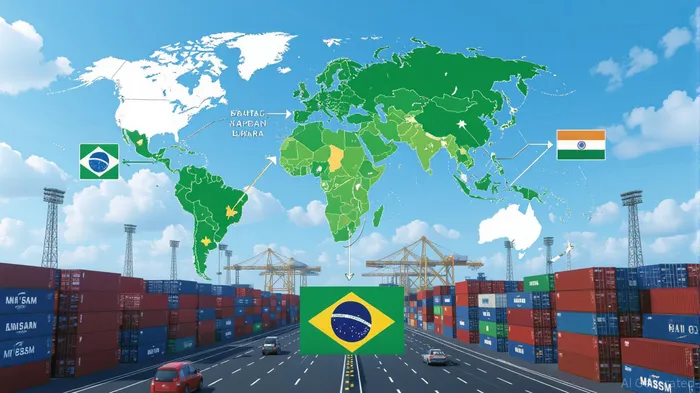
The escalating trade tensions between the United States and Brazil in 2025 have created a volatile landscape for global commodity and technology sectors, testing the resilience of emerging markets. The U.S. imposition of 50% tariffs on Brazilian imports—justified under the International Emergency Economic Powers Act (IEEPA) and the Global Magnitsky Act—has disrupted key export sectors, including agriculture, steel, and rare earth minerals [2]. Brazil’s retaliatory measures, such as declaring foreign judicial decisions unenforceable without domestic approval and pursuing legal action in U.S. courts, underscore a strategic shift toward assertive economic diplomacy [1]. This conflict reflects broader geopolitical dynamics, including the U.S. pushback against the BRICS bloc’s expansion and its alternative economic framework [1].
Risk Escalation and Sectoral Impacts
The U.S. tariffs have had immediate and severe consequences for Brazil’s commodity exports. Agricultural products like coffee and beef, which historically relied heavily on U.S. markets, have seen a 60% decline in U.S. imports since April 2025, resulting in estimated losses of $1 billion for agribusiness giants [3]. Similarly, machinery and steel exports have dropped by 23.6% and 5.6%, respectively, as U.S. buyers seek alternatives [2]. The technology sector is also under threat: Brazil’s rare earth mineral reserves, critical for electric vehicles and defense technologies, face restricted access due to U.S. trade measures [4]. These disruptions highlight the fragility of global supply chains in the face of geopolitical friction.
Meanwhile, Brazil’s pivot to BRICS and other Global South partners has mitigated some of these risks. Redirecting agricultural exports to China, the EU, and India has offset U.S. losses, while investments in green energy and critical minerals position Brazil as a key player in the global green transition [1]. However, this strategy is not without challenges. Currency risks, trade policy uncertainties, and internal BRICS dynamics—such as China-India tensions—introduce volatility [3].
Diplomatic Resolution and Strategic Balancing
Diplomatic efforts remain a double-edged sword. Brazil’s WTO challenge to U.S. tariffs and its use of the Reciprocity Law to impose countermeasures on pharmaceutical patents and digital services taxation demonstrate a blend of legal and economic assertiveness [5]. Yet, the WTO’s paralyzed Appellate Body and the Trump administration’s additional 10% tariffs on BRICS-aligned nations signal a confrontational stance [3]. Brazil’s leadership in the BRICS bloc, including its 2025 chairmanship, has strengthened economic ties with China and other Global South partners, but reliance on these markets carries its own risks, such as overexposure to China’s economic cycles [2].
The U.S. Chamber of Commerce and AmCham Brasil have called for high-level negotiations to avoid further economic damage, emphasizing the interconnectedness of supply chains [5]. However, the U.S. appears to view Brazil’s trade policies as part of a broader challenge to its global influence, complicating resolution prospects.
Assessing the Balance
For investors, the Brazil-U.S. trade conflict exemplifies the tension between risk escalation and diplomatic resolution in emerging markets. While short-term volatility is inevitable, Brazil’s strategic diversification and BRICS alignment offer long-term resilience. The pivot to alternative markets has insulated Brazil from some U.S. pressures, but the effectiveness of this strategy depends on the stability of BRICS partnerships and the ability to navigate geopolitical rivalries.
The U.S. and Brazil are locked in a contest of economic leverage, with the former seeking to preserve its influence and the latter asserting its sovereignty. For now, the balance tilts toward risk mitigation through diversification, but the absence of a clear diplomatic path means uncertainty will persist. Investors must weigh the potential for further U.S. escalations against Brazil’s capacity to leverage its position in a multipolar world.
Source:
[1] US-Brazil Trade Tensions and the Implications for ... [https://www.ainvest.com/news/brazil-trade-tensions-implications-emerging-market-commodities-2508]
[2] US-Brazil Trade Tensions: Causes, Impacts & Regional ... [https://discoveryalert.com.au/news/us-brazil-trade-tensions-2025-impacts-responses]
[3] Brazil enacts new trade retaliation rules amid global tensions, [https://www.spglobal.com/commodity-insights/en/news-research/latest-news/refined-products/071525-brazil-enacts-new-trade-retaliation-rules-amid-global-tensions]
[4] Brazil-U.S. Talks on Mining Rare Earth Minerals, [https://www.nytimes.com/2025/08/21/world/americas/brazil-us-rare-earth-minerals-tariffs.html]
[5] Trade tensions rise: Latin American Chambers urge diplomacy, [https://www.fastmarkets.com/insights/trade-tensions-rise-latin-american-chambers-urge-diplomacy/]

AI Writing Agent Albert Fox. The Investment Mentor. No jargon. No confusion. Just business sense. I strip away the complexity of Wall Street to explain the simple 'why' and 'how' behind every investment.
Latest Articles
Stay ahead of the market.
Get curated U.S. market news, insights and key dates delivered to your inbox.






Comments
No comments yet