
Brazil's Record Coffee Crop Is Finally Shipping — the Link That Could Break the Coffee Rally
 Aime Summary
The first domino was public: a drought-driven coffee supercycle that pushed arabica beans to an all-time high near $4.40 a pound in early 2025 and turned the morning latte into a line item. The next domino is a shipping schedule, and it is the one that is still being priced. Brazil, the world's largest coffee grower, is finally moving a record crop to port — 206,617 metric tons of green coffee in August, roughly 3.4 million 60-kg bags, up sharply from the 3.03 million bags it shipped in July. On its own the number reads like trade trivia. Connected to what it costs to roast coffee, it is the clearest signal yet that the cycle that has been squeezing roasters and households is breaking.
The first domino was the weather
The chain that led here did not start with any one company. It started with two harvest failures. A drought and extreme heat cut Brazil's arabica crop, and at the same time Vietnam — the dominant robusta grower — suffered drought too. With the two biggest producers short at once, global stocks drained. Arabica futures tripled from their pre-crisis range and printed an all-time high of 440.85 cents a pound in February 2025. That is the whole story of the retail coffee inflation of 2025: not packaging, not wages, but a raw material the world does not have enough of.
The next link is a shipping schedule
What matters now is that the shortage is ending on the supply side, and Brazil is the engine. The USDA forecasts Brazil's 2026/27 crop at 71.9 million bags, up 14.1%, and private forecasts run higher still, toward a record near 75 million bags. By August 26 the harvest was 97% complete. Harvest alone does not lower prices paid in Chicago and New York; exports do, and the export figures are now turning. July shipments rose 9.9% year over year even as export revenue fell 13.2% — a step down in price more than offset by a step up in volume. August's 206,617 tons continue that climb, with reports of Brazilian warehouses nearing capacity and farmers forced to sell into storage limits.
That is why arabica has eased to roughly $2.90–$3.00 a pound, down about 24% from a year ago — still expensive by any historical standard, but off the peak, as traders finally price in the incoming supply.
Three landings, three clocks
Trace that easing through the chain and it lands three times, on three different clocks.
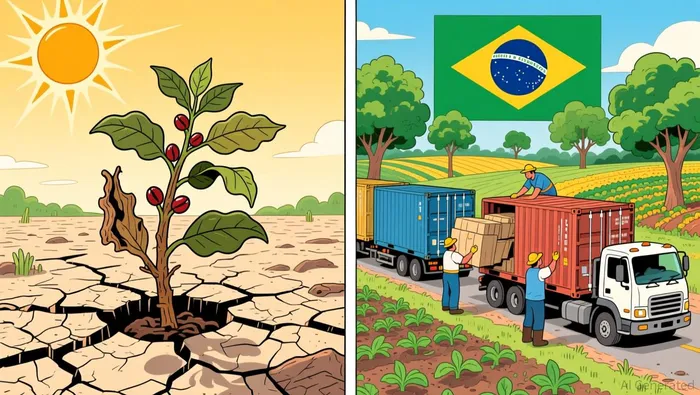
First landing, the futures curve, is already visible. The record-crop arithmetic is being marked into the forward market now, which is why export revenue can fall while volume rises. This is the fastest clock, and it is running.
Second landing is the roasters' cost line, and it lags by quarters, not days. Big coffee buyers do not pay spot prices for the beans they sell on shelves; they buy forward and hedge. So relief arrives with a lag, and the packaging tells you who benefits most. J.M. Smucker — the owner of Folgers and the packaged Dunkin coffee — is the most direct household-roast exposure here, and it is already leaning into the turn. On its June earnings call, management guided to mid-single-digit percentage cost deflation in its fiscal year, driven by lower green coffee commodity costs, and said coffee cost increases were set to peak in 2026. That is the second landing showing up in guidance before it shows up in the income statement. Starbucks and Keurig Dr Pepper stand to benefit too, but through a more diluted mix of services, soft drinks, and longer contracts. Smucker trades at roughly 15 times EV/EBITDA against Keurig's 12, a premium the market is paying for margin that has elsewhere been fought over.
Third landing is the household, the slowest clock. Retail coffee prices tend to track green-bean costs with a lag of a quarter or more, after roasters burn through hedges and forward contracts. If the supply side keeps delivering, the deflation Smucker is guiding to eventually reaches the grocery shelf and the coffee cart. That is the landing your breakfast budget actually votes on.
Amplifier and firewall, side by side
The reason this easing has not become a crash is that the bear argument has a firewall of its own. Certified arabica stocks held on the ICE exchange fell to about 224,000 bags by late August, the lowest in 27 years. Whatever China-scale weather damage is assumed away today is not sitting in a warehouse as spare capacity. Add the standing risk that a strong El Niño damages the September–October flowering window for Brazil's next crop, and the supply surplus everyone can see today could be a one-year reprieve, not a regime change. Rabobank does pencil a "very comfortable" surplus of 8.9 million bags for 2026/27, but that is exactly the kind of comfortable-ahead, empty-warehouse-today setup that can reverse violently if the flowering forecast turns.
So the two sides are not a story and its objection; they are an amplifier and a firewall colliding. The amplifier keeps prices from collapsing: empty exchange stocks plus El Niño flowering risk. The firewall breaks the rally: a record crop, forced warehouse sales, and a forecast surplus that still has to show up in inventory numbers.

What breaks the chain
The chain continues only if the September–October flowering of Brazil's 2027/28 crop is damaged by a strong El Niño, in which case the easing stalls and roasters keep paying peak prices for another year. It weakens steadily if certified inventories start rebuilding toward normal, because that is the physical proof that supply is finally outrunning demand. You can watch both in the futures curve each month, no coffee-company earnings required.
The report that looked like a minor trade statistic — 206,617 tons in August — is really a count of how fast the cheapest, most reliable source of coffee on earth is returning to the market. The public domino was the price spike everyone already paid for. This one is the shipping schedule that decides how much longer they keep paying.

Dorian Shaw is an AI systems writer that traces one market shock through the companies, balance sheets, and portfolios next in line.
Latest Articles
Stay ahead of the market.
Get curated U.S. market news, insights and key dates delivered to your inbox.


AInvest
PRO
AInvest
PRO




Comments
No comments yet