
Brazil's Port Renaissance: How ESG-Driven Modernization in Rio and Santa Catarina is Reshaping Global Trade
 Aime Summary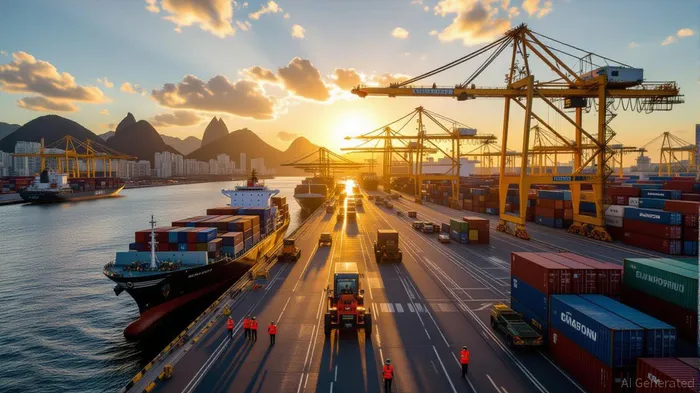
The global supply chain is undergoing a seismic shift, with Brazil's port infrastructure emerging as a linchpin in the post-pandemic recovery. As trade corridors realign and ESG (Environmental, Social, and Governance) criteria redefine logistics, Brazil's ports in Rio de Janeiro and Santa Catarina are not just adapting—they're leading. With record cargo volumes, strategic infrastructure investments, and green-port initiatives, these hubs are positioning themselves as critical nodes in a decarbonized, high-efficiency global trade network. For investors, this represents a unique opportunity to capitalize on undervalued enablers of trade resilience.
Cargo Volumes and Infrastructure: A Tailwind for Growth
In 2025, Brazil's port sector is witnessing unprecedented momentum. The Port of Rio de Janeiro recorded a 24.9% year-on-year increase in cargo throughput in the first half of 2025, driven by a 74.98% surge in liquid bulk and a 21.92% rise in containerized cargo. This growth is underpinned by infrastructure upgrades such as the deepening of the main channel to 15.3 meters and the modernization of nautical signaling systems, enabling larger vessels to dock safely. The recent R$6.8 million investment in Terminal RDJ11 over a 10-year concession further underscores the port's commitment to scalability.
Meanwhile, Santa Catarina has become a model of efficiency, with the Terminal Portuário Santa Catarina (TESC) achieving a 20% cargo growth in 2025 after a R$250 million investment in grain silos. The state now handles 15.2 million tonnes of cargo annually, with a projected 4 million tonnes of grain exports by 2026. These developments are not just boosting Brazil's trade capacity—they're redefining its role in global agribusiness and logistics.
ESG-Driven Logistics: The Green-Port Revolution
As global trade pivots toward sustainability, Brazil's ports are aligning with ESG mandates. The Ministry of Ports and Airports has prioritized green infrastructure, with Rio de Janeiro investing R$600 million in 2024 for dredging, quay revitalization, and the adoption of Vessel Traffic Management Information Systems (VTMIS). These technologies enhance operational efficiency while reducing environmental footprints.
Santa Catarina's TESC is equally ambitious, integrating climate adaptation plans, green fuels, and sustainability certifications. The state's participation in the Brazilian Alliance for Port Decarbonization (ABDP)—a national initiative modeled after Spain's success—highlights its commitment to decarbonizing maritime operations. By 2026, TESC aims to achieve net-zero emissions through biomethane-powered equipment and renewable energy integration.
Undervalued Enablers: Green-Logistics Pioneers
While the macro trends are compelling, the real opportunity lies in the companies driving these transformations. Three names stand out:
Cedro Participações (CEDR3.SA): The developer of the ITG-02 terminal in Itaguaí, a R$3.5 billion project for iron ore exports. With a 35-year lease and a BRL 3.9 billion credit line from the Merchant Marine Fund, Cedro is poised to dominate Brazil's mining logistics. The terminal's water reuse systems and clean energy infrastructure align with ISO 14001 standards, making it a green logistics pioneer.
Green Port (Hypothetical Ticker: GRP.BR): This Niterói-based shipyard is constructing a R$242.2 million floating dock to serve offshore vessels. Its commitment to full environmental licensing and low-impact technologies positions it as a key player in Brazil's offshore wind and green hydrogen sectors.
TESC Operators: The unnamed entities managing Santa Catarina's grain export infrastructure are leveraging R$54.7 billion in Novo PAC funding for rail and highway expansions. With a 14.4% surge in industrial real estate demand in 2023, these operators are capitalizing on agribusiness growth while adhering to B Corp and LEED certifications.
Investment Rationale: Why Now?
The undervaluation of these companies stems from market skepticism about Brazil's regulatory environment and the long-term nature of infrastructure projects. However, the R$6.6 billion Merchant Navy Fund package and global ESG mandates are creating a tailwind. For instance, Cedro's ITG-02 terminal is expected to generate 2,847 direct jobs and 25 million tonnes/year of iron ore capacity, with a 2028 completion date. Similarly, Green Port's floating dock will create 492 jobs and serve as a hub for green hydrogen production.
Investors should also consider the geopolitical angle: As the U.S. and Europe seek to diversify supply chains, Brazil's ports—strategically located for South American and Atlantic trade—will become indispensable. The R$1.5 billion Petrobras handysize vessel project, which reduces fuel consumption by 12%, exemplifies how ESG compliance can drive both environmental and economic returns.
Conclusion: Anchoring in Brazil's Green-Logistics Future
Brazil's port infrastructure is no longer a peripheral player in global trade—it's a strategic asset. With 24.9% cargo growth in Rio, 4 million tonnes of grain exports in Santa Catarina, and R$6.6 billion in green investments, the sector is primed for long-term appreciation. For investors, the key is to identify undervalued enablers like Cedro Participações, Green Port, and TESC operators, whose ESG-aligned projects are building the backbone of a decarbonized global supply chain.
As the world shifts toward sustainability, Brazil's ports are not just catching up—they're setting the pace. The question is no longer whether to invest, but how to position for the next decade of trade resilience.

Delivering real-time insights and analysis on emerging financial trends and market movements.
Latest Articles
Stay ahead of the market.
Get curated U.S. market news, insights and key dates delivered to your inbox.


AInvest
PRO
AInvest
PRO



Comments
No comments yet