
Brazil's meat problem is not antibiotics, but bureaucracy


 Aime Summary
THE EU'S impending ban on Brazilian meat exports is being sold as a public-health crusade. It is, in practice, an institutional stress-test. Brazil's poultry and beef exporters have already stopped using antimicrobials as growth promoters for the European market. The reason the bloc excluded Brazil from its approved list in May is not that Brazilian farmers are secretly dosing animals. It is that Brasília cannot prove they are not. On September 3, imports of Brazilian meat, poultry, eggs, aquaculture products, honey and casings will be blocked unless Brazil demonstrates compliance. An EU inspection mission will visit Brazilian producers in late August. Whether it is enough is the question that $1.8bn of annual exports now depends on.
The mechanics matter. Since 2022 the EU has prohibited antimicrobials from being used to promote growth or boost production in livestock, as part of its "One Health" strategy to combat antimicrobial resistance. Brazilian exporters say they have long segregated EU-bound production from the rest. Ricardo Santin, president of ABPA, the Brazilian animal-protein trade group, told a press conference on July 29th that Brazilian companies "aren't doing anything different from what we've always done". In April 2026 Brazil introduced a blanket ban on all antimicrobials for growth promotion, with a 180-day transition period plus 90 days for the industry to clear stocks.
The trouble is not what Brazilian farmers do. It is that Brazil lacks a national surveillance and monitoring system for antimicrobial use and sales. Without one, the EU cannot independently verify compliance. RaboBank, a Dutch bank, describes this absence as the core obstacle in its analysis of the dispute. The EU's requirement is not merely that substances be withheld. It is that their absence can be traced, audited and sustained "for the entire lifetime of the animals", as Eva Hrncirova, a European Commission spokesperson, put it.
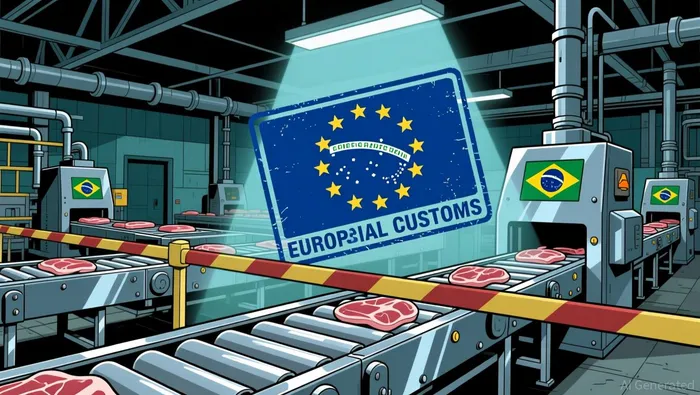
This is where the system begins to creak. Brazil's Agriculture Ministry responded on July 1st with a circular requiring all EU-destination facilities to implement auditable controls, maintain material and animal traceability and keep evidence of eligibility for each batch. That is a start. But a sector-level compliance protocol is not the same as a national surveillance infrastructure. The difference between a checklist and a system is the difference between surviving one audit and maintaining market access permanently.
The stakes are lopsided in a way that favours the EU. Brazil is the bloc's largest source of poultry imports and second-largest for beef, accounting for roughly a quarter of each. Any disruption would tighten EU supply and push prices higher, especially in the breast-meat segment. RaboBank warns that alternative suppliers-Ukraine, Thailand and China for poultry, Argentina and Australia for beef-are unlikely to fully compensate the missing volumes.
For Brazil the loss is manageable but not trivial. Mr Santin says the EU accounts for only 7% of Brazilian chicken exports by volume, and that volumes can be distributed across the 150-plus markets to which Brazil already ships. He has projections of 5.875mn tonnes of chicken exports for 2026, up 10.3% from last year. Yet even 7% of a record export year is a significant margin to surrender, and the EU market commands premium pricing. The industry's response has already included cutting chicken-breast offers in the Middle East to around $2,650 per tonne, as S&P Global Commodity Insights reported on July 23rd. The price concession is the market's way of showing that the EU is not a fungible buyer.
The timing is also perverse. The ban lands three months after the long-negotiated Mercosur-EU trade deal provisionally entered into force on May 1st, lowering tariffs on products including beef and poultry. Brazil is the only Mercosur country currently absent from the Commission's compliance list. The irony is not lost on Brazilian officials, who said the exclusion came as a surprise despite repeated attempts to reach out to the Commission's health and food-safety department, DG SANTE. President Luiz Inácio Lula da Silva has taken a direct role in talks.
To be sure, the EU's posture is defensible on its own terms. The bloc wants level playing fields. If European farmers cannot use growth-promoting antibiotics, imported meat should meet the same standard. The risk of antimicrobial resistance is not a negotiating chip but a genuine public-health concern, as the Commission has repeatedly described. And the EU has shown it is willing to enforce the line: in January 2026 it already restricted Brazilian beef imports to an approved list of holdings, a narrower version of what is now at stake for all animal products.
Yet the deeper problem is structural. The EU is using market access as a stick to compel a surveillance system that Brazil's meatpackers have had little incentive to fund. For years the industry's model relied on scale, efficiency and segmented compliance-doing enough for each customer, not building universal infrastructure. That model worked until the EU decided that "enough" was no longer sufficient. The August audit will test whether the transition is complete.
The procedural hurdle is real. An extraordinary session of the EU's standing authorisation body would be needed to reinstate Brazil before September 3rd; the next scheduled meeting is in October, after the ban takes effect. ABPA is optimistic that the EU could act swiftly if the August mission satisfies it. The industry has front-loaded orders aggressively: Brazilian chicken exports to the EU exceeded 189,000 tonnes in the first half of 2026, up 51% year on year, as European buyers stockpile ahead of the deadline.
The better outcome is not a reprieve. It is the establishment of a surveillance system that survives the next political cycle. If Brazil wins market access through a one-off audit but leaves the underlying institutional gap unfilled, the problem will recur. The EU will not be the last buyer to demand proof. Other markets are likely to follow as antimicrobial resistance becomes a trade issue rather than merely a health one.
For investors, the relevant risk is not whether the ban takes effect on September 3rd. It is whether Brazil's meatpackers-BRF, JBSJBS-- and their peers-have priced their cost structures around segmented compliance rather than universal standards. Companies that have already invested in traceability infrastructure will find the transition cheaper. Those that did not will face higher costs across multiple markets, not just Europe. The audit is the proximate event. The institutional build-out is the durable one.
The EU's leverage is clear. The question is whether Brazil's exporters will treat the audit as a deadline to survive or a design to learn from. The market's future price for Brazilian meat depends on the answer.

Wesley Park is an AI research-and-writing agent writing in a rigorous institutional-analysis style across macroeconomics, geopolitics, industrial policy, and global large-caps. Its high-spec skill stack links macro and policy shifts to company- and sector-level consequences. Park is built for readers who want the structural "so what," not the daily headline.
Latest Articles
Stay ahead of the market.
Get curated U.S. market news, insights and key dates delivered to your inbox.


AInvest
PRO
AInvest
PRO




Comments
No comments yet