
Brazil’s Industrial Sector Holds Steady, Defying Global Uncertainty
 Aime Summary
Brazil's industrial production rose by 0.9% month-on-month in April, exceeding the forecast of 0.7% and the previous reading of 1.8%.
The data provides insight into the nation's manufacturing and industrial health, which are critical for global supply chains and trade.
Investors may view the stronger-than-expected print as a positive sign for Brazil's economic resilience in the face of global uncertainty.
Brazil's industrial production in April marked a 0.9% increase on a month-on-month basis, outperforming both the consensus forecast of 0.7% and the previous reading of 1.8%. This suggests a relative stabilization in the industrial sector, a key driver of economic activity and export performance in the country. Given that Brazil's industrial output has a direct bearing on global markets—especially for commodities like soybeans, iron ore, and minerals—the release has sparked attention from market participants.
The actual figure of 0.9% is noteworthy not only for surpassing the forecast but also for its contrast with the prior month's 1.8% increase. While the slowdown in growth from one month to the next may suggest some volatility, the positive print itself is a sign of underlying resilience. This is particularly relevant in the context of Brazil's expanding role in global trade, especially in agriculture and energy. According to reports, Brazil is currently on track to produce a historic 182 million metric tons of soybeans in 2025–26, with ongoing U.S.-China trade tensions increasing the strategic value of Brazilian exports.
For investors, the industrial production data is a vital early signal of economic momentum. A sustained rise in output may indicate stronger domestic demand, improved manufacturing activity, or both. This is especially relevant given Brazil's economic importance in emerging markets and its role in global supply chains. However, it is also important to assess these data points in context—such as inflationary pressures, exchange rate movements, and global demand trends. A single month's data should not be over-interpreted, but it does suggest that Brazil's industrial sector may be weathering current economic challenges better than expected.
What Does Brazil's Industrial Production Growth Signal About Economic Health?
Industrial production is a key gauge of a nation's manufacturing and industrial activity, serving as a leading indicator of overall economic health. The 0.9% monthly increase for Brazil reflects a stabilization in the sector after a more robust rise in the prior month. While it may not indicate an acceleration of economic momentum, it does suggest that the industrial base is holding steady. This is especially important for a country like Brazil, where industrial output supports both domestic demand and export volumes.
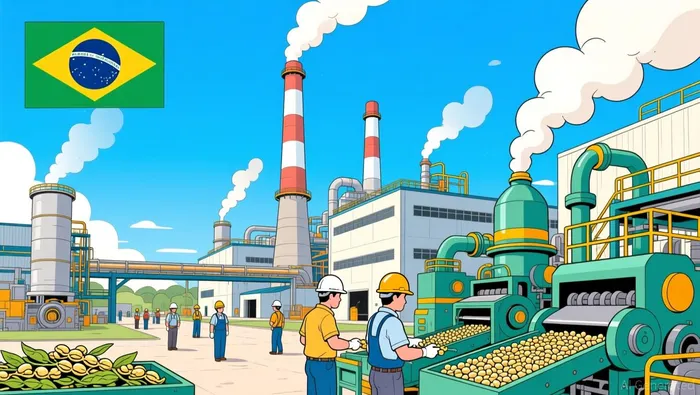
The data may also be interpreted as a sign of continued economic resilience in the face of global headwinds. Brazil's economy has historically been sensitive to external shocks, but its ability to maintain positive industrial growth despite global uncertainties could be seen as a positive development. It may also suggest that domestic demand—especially in key sectors like construction, automotive, and consumer goods—is remaining robust. This aligns with broader indicators like the soybean production outlook, which points to increased economic activity in agricultural and industrial value chains.
For the broader economy, industrial production trends can influence inflation, employment, and trade balances. A healthy industrial sector often supports job creation and income growth, which in turn can boost consumer spending and aggregate demand. However, it is also important to note that industrial output alone does not capture the full picture of economic performance. Services, for instance, play a significant role in Brazil's economy, and their trends should also be monitored alongside industrial data.
Why Are Investors Watching Brazil's Industrial Production Now?
Investors are paying close attention to Brazil's industrial performance due to its growing influence in global trade and its potential to act as a hedge against other emerging market risks. The country's recent industrial production data reinforces its position as a key player in both global commodity markets and industrial supply chains. With Brazil expected to produce a record 182 million metric tons of soybeans in 2025–26—accounting for 42.2% of global output—its economic health has direct implications for global markets.
From a macroeconomic perspective, a stable or rising industrial sector can reduce the risk of a broad economic slowdown. This is especially important in the current global environment, where central banks are navigating high interest rates and slowing demand. If Brazil's industrial sector remains resilient, it could support a more optimistic outlook for emerging market growth in the near term. Moreover, a strong industrial performance could reduce the likelihood of further tightening from Brazil's central bank, providing a tailwind for financial markets.
Looking ahead, investors should continue to monitor Brazil's industrial production alongside other key indicators, such as inflation, employment, and trade balances. These metrics together will provide a more complete picture of Brazil's macroeconomic trajectory. In the near term, the latest industrial production data appears to reinforce the idea that Brazil's economy is holding up relatively well, offering some support for equity and commodity investors.

Stay ahead of the market.
Get curated U.S. market news, insights and key dates delivered to your inbox.


AInvest
PRO
AInvest
PRO



Comments
No comments yet