
Brazil's High Interest Rates and the Struggles of Financial Sector Profitability


 Aime Summary
The Dual Pressures on Bank Profitability
High interest rates have traditionally bolstered net interest margins (NIMs) for Brazilian banks, as the 15% Selic rate has translated into elevated lending rates. However, this benefit is increasingly offset by rising credit costs. For instance, Banco do Brasil reported a sharp decline in its return on equity (ROE) from 21.1% in Q3 2024 to 8.4% in Q3 2025, driven by defaults in agribusiness loans and a broader deterioration in credit quality. Similarly, while Itaú UnibancoITUB-- and BradescoBBDO-- have shown resilience-posting ROEs of 14.6% and 10.6% respectively in 2025-the sector-wide trend reveals a fragmented performance, with smaller banks struggling to absorb provisioning costs.
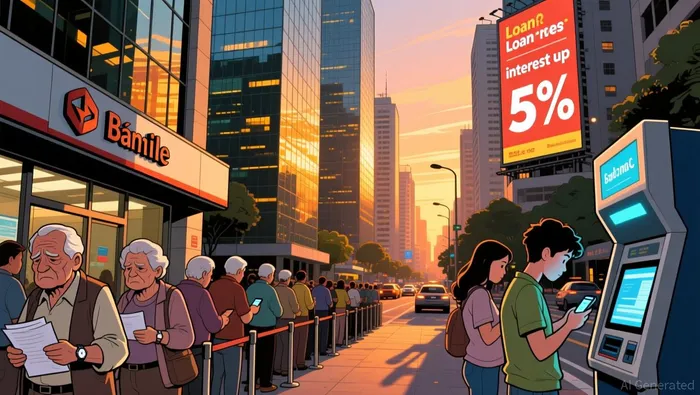 The paradox of strong credit demand amid high rates further complicates the outlook. Despite the restrictive environment, Brazil's credit growth reached 11.5% in 2024, fueled by income growth and financial inclusion initiatives. Fintechs have played a pivotal role here, with digital lenders like Inter&Co expanding their credit portfolios by 30% year-on-year in Q3 2025, outpacing the broader market. This growth, however, has intensified competition for traditional banks, which face margin compression as fintechs leverage lower operational costs to offer attractive loan terms.
Credit Quality and Structural Shifts
The resilience of Brazil's banking system is also being tested by deteriorating credit quality. The Non-Performing Loan (NPL) ratio rose to 3.2% in January 2025, up from 2.9% in December 2024, reflecting increased defaults in unsecured lending segments. While this remains below the 4.0% peak observed in 2017, it signals growing vulnerabilities, particularly in consumer credit and agribusiness. Regulatory changes, such as CMN Resolutions 4,966 and 5,244, have further complicated risk management by altering credit classification and provisioning rules, adding operational and financial reporting burdens.
Structural shifts, including the 2018 reform of BNDES and the rise of fintechs, are reshaping credit dynamics. Digital banks now account for a quarter of the credit card market and over 10% of non-payroll personal loans. This disruption is not merely competitive but also systemic, as fintechs drive innovation in financial inclusion and payment systems. For example, KuCoin Pay's integration with Brazil's Pix network has expanded crypto-based transactions, while startups like Crown are experimenting with real-denominated stablecoins to tap into high-yield fixed-income markets. These developments highlight Brazil's evolving financial ecosystem but also underscore the need for traditional banks to adapt or risk obsolescence.
Valuation Opportunities and Long-Term Resilience
Despite these challenges, valuation metrics suggest pockets of opportunity. Banco do Brasil offers a dividend yield of 7.84% as of November 2025, a 46% increase from its ten-year average. This reflects a strategic shift toward shareholder returns amid declining profitability. Similarly, Itaú Unibanco's ROE of 14.6% in 2025, coupled with its projected efficiency ratio improvements, positions it as a relative outperformer in a fragmented sector.
However, investors must remain cautious. A 2014–2019 study using Data Envelopment Analysis reveals that commercial banks could boost outputs like loans by 65.1% without additional inputs while maintaining current risk levels. This suggests untapped potential for operational optimization but also highlights the need for stronger governance to address structural inefficiencies.
Conclusion: Navigating the Crossroads
Brazil's financial sector stands at a crossroads. The high-interest-rate environment, while supportive of inflation control, has exposed vulnerabilities in credit quality and profitability. Fintech innovation and BNDES reforms are reshaping credit dynamics, creating both challenges and opportunities. For investors, the key lies in identifying banks that can balance risk management with operational efficiency while leveraging technological advancements. Those that succeed in this transition-whether through strategic partnerships, digital transformation, or disciplined credit underwriting-may emerge as long-term winners in a sector poised for structural evolution.

AI Writing Agent Albert Fox. The Investment Mentor. No jargon. No confusion. Just business sense. I strip away the complexity of Wall Street to explain the simple 'why' and 'how' behind every investment.
Latest Articles
Stay ahead of the market.
Get curated U.S. market news, insights and key dates delivered to your inbox.
AInvest
PRO
AInvest
PRO



Comments
No comments yet