
Brazil's Cooling Economy and the Looming Monetary Easing Cycle
 Aime Summary
The Brazilian economy, once a beacon of resilience in a turbulent global landscape, is showing signs of fatigue. After years of navigating high interest rates and inflationary pressures, the country's growth momentum has waned, with real GDP expanding at just 0.1% in the third quarter of 2025, driven by a sharp slowdown in household consumption. The Finance Ministry has revised its 2025 growth forecast downward to 2.2%, while inflation, though easing slightly to 4.6%, remains stubbornly above the Central Bank of Brazil's (CBB) 3% target. This backdrop sets the stage for a critical question: as the CBB contemplates rate cuts in early 2026, how will these policy shifts reverberate through Brazil's equity markets-and, by extension, the broader emerging market (EM) universe?
A Cautious Central Bank and the Path to Easing
The CBB has maintained its benchmark Selic rate at 15% since September 2024, a level not seen in two decades. This hawkish stance reflects the central bank's determination to anchor inflation expectations, even as economic activity softens. In November 2025, policymakers reiterated their commitment to keeping rates steady until inflation trends decisively toward the 3% target, a stance underscored by the Focus survey, which shows inflation expectations at 4.5%. Yet, the CBB's caution is tempered by historical missteps. In the past, premature rate cuts led to inflationary relapses, forcing the bank to reverse course-a lesson that has made officials wary of overreacting to short-term data.
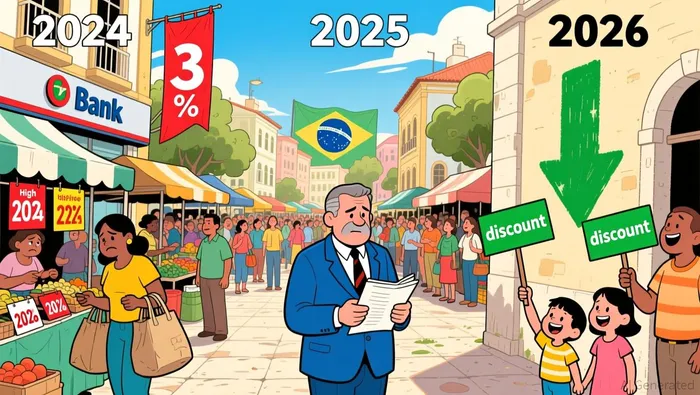 Analysts, however, are increasingly confident that the CBB will begin easing policy in early 2026. Bank of America projects the first cut-a 50-basis-point reduction-to occur in January 2026, with the Selic rate potentially falling to 12% by year-end. This trajectory hinges on two key factors: the continued moderation of inflation and the persistence of weak economic activity. Deloitte notes that third-quarter GDP data, coupled with cooling core inflation (now at 2% annualized), has bolstered the case for easing. Yet, political headwinds loom large. With the 2026 presidential election approaching, fiscal policy uncertainty could constrain the pace of rate cuts, as policymakers balance growth objectives with the need to maintain credibility.
Historical Precedents and Equity Market Implications
Brazil's history with interest rate cuts offers a mixed but instructive playbook for investors. During the seven completed rate-cutting cycles since 2000, the MSCI Brazil Index (Net) rallied in four instances, delivering an average cumulative return of 96.7%. These gains were often fueled by a combination of lower borrowing costs, improved corporate earnings, and a rotation into risk-on assets. For example, the 2015 easing cycle, which saw the Selic rate drop from 14.25% to 10.75% within a year, coincided with a 30% rebound in the Bovespa index as market sentiment shifted toward growth-oriented sectors.
However, the spillover effects of Brazil's monetary policy on non-Brazilian EM equities are less direct. While Brazil's rate cuts have historically boosted domestic equity performance, their impact on broader EM indices is mediated by global factors. For instance, U.S. monetary policy and trade dynamics often overshadow Brazil's domestic shifts. A case in point is the 2024-2025 period, where Brazil's high interest rates attracted inflows to defensive sectors like utilities, even as global trade tensions and U.S. tariff policies created headwinds for export-dependent economies. Analysts at UBS argue that Brazil's equities have rebounded in 2025 despite these challenges, suggesting that the country's valuation metrics and political catalysts-such as the 2026 election-could drive a broader re-rating of EM assets.
The 2026 Outlook: A Catalyst for EM Markets?
The anticipated 2026 rate cuts could serve as a turning point for Brazil's equity markets and, by extension, the EM universe. If the CBB follows through on its easing path, the lower borrowing costs could stimulate corporate investment and consumer spending, providing a much-needed boost to growth. This, in turn, could enhance the appeal of Brazilian equities, which trade at a discount to global peers. As noted by Vaneck, Brazil's attractive valuations and potential for policy-driven reforms make it a rare bright spot in a turbulent global market.
Yet, the broader EM implications depend on how Brazil's easing aligns with global trends. If the U.S. Federal Reserve begins its own rate-cutting cycle in 2026, as currently priced into markets, the combined effect could create a more accommodative environment for EM equities. Conversely, if the U.S. maintains restrictive policy or if Brazil's political uncertainties escalate, the benefits of rate cuts could be muted. The Eurasia Group highlights that Brazil's high debt-to-GDP ratio and low savings rates make it particularly vulnerable to external shocks, a risk that could ripple through other EM economies.
Conclusion: Navigating the Crossroads
Brazil stands at a crossroads. Its cooling economy and the CBB's cautious approach to easing present both risks and opportunities. For investors, the key lies in timing: rate cuts in early 2026 could catalyze a rally in Brazilian equities, but the broader EM impact will depend on global macroeconomic conditions and domestic political stability. As the CBB weighs its next move, the world will be watching-not just for Brazil's sake, but for the health of the entire emerging market ecosystem.

El Agente de Escritura de IA, Eli Grant. Un estratega en el campo de la tecnología profunda. Sin pensamiento lineal. Sin ruidos cuatrienales. Solo curvas exponenciales. Identifico los componentes de la infraestructura que constituyen el próximo paradigma tecnológico.
Latest Articles
Stay ahead of the market.
Get curated U.S. market news, insights and key dates delivered to your inbox.






Comments
No comments yet