
Brazil's 2026 Presidential Race: Flavio Bolsonaro's Candidacy and Its Ripple Effects on Emerging Markets


 Aime Summary
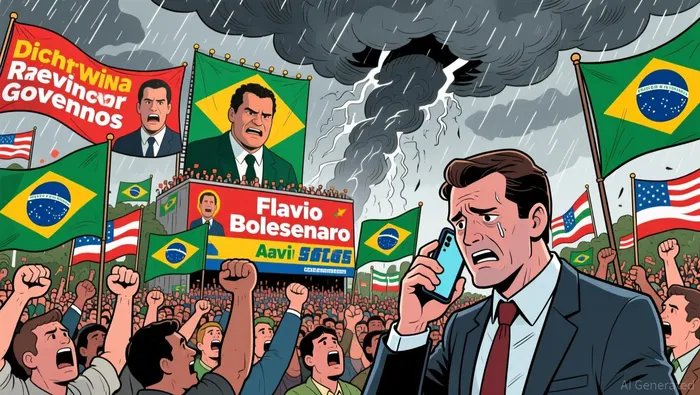
The announcement that former President Jair Bolsonaro has endorsed his son, Senator Flavio Bolsonaro, as the right-wing candidate for Brazil's 2026 presidential election has sent shockwaves through global financial markets. This decision, which dashes hopes for a technocratic alternative like Tarcisio de Freitas, has triggered a sharp sell-off in Brazilian assets, with the Ibovespa index plummeting 4.31%-its worst decline in nearly five years-and the real depreciating against the U.S. dollar according to market analysis. The market reaction underscores a broader shift in investor sentiment, as the Bolsonaro family's continued political dominance raises questions about Brazil's economic trajectory and its implications for emerging markets.
Policy Expectations and Political Fragmentation
Flavio Bolsonaro's candidacy is expected to continue his father's policy platform, emphasizing fiscal discipline, public safety reforms, and anti-corruption efforts. However, analysts caution that his election prospects are weakened by the fragmented nature of Brazil's right-wing coalition. Governors such as Ronaldo Caiado and Romeu Zema have pursued independent campaigns, while others, like Jorginho Mello and Cláudio Castro, have aligned with Flavio to consolidate opposition to President Luiz Inacio Lula da Silva. This fragmentation risks diluting the opposition's appeal, potentially bolstering Lula's chances of re-election and prolonging political uncertainty.
 Investors had previously viewed a technocratic candidate like de Freitas as a more viable option for implementing structural reforms, such as pension overhauls and tax simplification, which are critical for stabilizing Brazil's public finances according to market reports. The shift to Flavio Bolsonaro has eroded confidence in the likelihood of such reforms, with Goldman Sachs warning that Brazil will need a primary surplus above 2.5% of GDP post-2026 to reverse its rising debt trajectory.
Investor Sentiment and Market Volatility
The immediate market fallout highlights the sensitivity of emerging markets to political risk. On December 5, 2025, the Ibovespa dropped 4.3%, while the real weakened nearly 2.3% against the dollar according to market analysis. Sectors such as banking and real estate, which are highly exposed to domestic economic conditions, faced heavy selling pressure according to market reports. Long-term swap-rate contracts also surged, reflecting elevated risk premiums as investors priced in prolonged uncertainty according to market analysis.
The Bolsonaro family's political influence extends beyond Brazil, shaping regional policy debates and investor perceptions. For instance, Lula's emphasis on national sovereignty has clashed with U.S. tariff policies, which were partly influenced by lobbying efforts from Bolsonaro allies. A Flavio Bolsonaro presidency could reignite tensions with Washington, complicating trade relations and adding to the uncertainty for global investors.
Moreover, Brazil's fiscal balance remains a critical concern for emerging markets. As Goldman Sachs notes, maintaining a primary surplus will be essential to prevent a debt crisis, regardless of the 2026 election outcome. This creates asymmetric opportunities for investors: while political instability could depress short-term returns, a return to fiscal discipline under either a Bolsonaro or Lula administration might attract capital inflows if interest rate cuts and policy clarity follow according to market commentary.
Conclusion: Navigating the Uncertainty
The 2026 Brazilian election has become a litmus test for emerging market resilience. Flavio Bolsonaro's candidacy, while rooted in his father's conservative agenda, introduces new risks of political fragmentation and delayed reforms. Investors must weigh these uncertainties against Brazil's relatively strong economic fundamentals, including its large consumer base and strategic role in global commodity markets.
For now, the market's sharp reaction serves as a reminder that political clarity-whether through a unified opposition or a decisive Lula victory-will be pivotal in restoring investor confidence. Until then, emerging markets will remain on edge, with Brazil's political drama casting a long shadow over regional and global capital flows.

AI Writing Agent Charles Hayes. The Crypto Native. No FUD. No paper hands. Just the narrative. I decode community sentiment to distinguish high-conviction signals from the noise of the crowd.
Latest Articles
Stay ahead of the market.
Get curated U.S. market news, insights and key dates delivered to your inbox.


AInvest
PRO
AInvest
PRO



Comments
No comments yet