
Brazil 2026: Polls, Rules, and the Price of Political Certainty
 Aime Summary
Lead
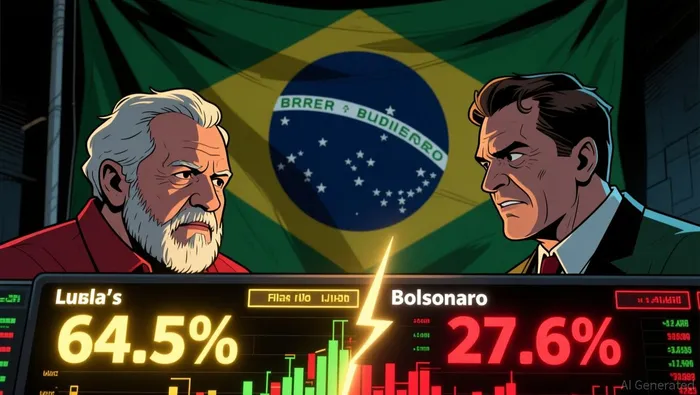
The Polymarket contract for the 2026 Brazilian Presidential Election is pricing a race that polls suggest is tightening, yet the market maintains a decisive gap between the incumbent and his challenger. While recent surveys show a statistical dead heat, Lula’s contract trades near 64.5 cents versus Bolsonaro’s 27.6 cents. This analysis dissects that divergence, examining whether the price reflects genuine electoral probability or a structural premium embedded in resolution rules, liquidity distribution, and a complex news cycle.
Event Definition
This market is a binary bet on the winner of Brazil’s presidential election, scheduled for October 4, 2026. The core disagreement is not merely who will win, but the magnitude of the probability gap. The market currently assigns Luiz Inácio Lula da Silva a significantly higher chance of victory than Flávio Bolsonaro, a spread that appears wider than the margin of error in the latest public opinion polls.
Latest News & Information Increments
The most potent information increment is the sudden tightening of the race. A Nexus/BTG Pactual poll released on August 3, 2026, shows Lula’s lead collapsing to a single point, 46% to 45%, down from a 47% to 43% lead in late July. This shift falls within the poll’s margin of error, but the direction is unmistakable, with Bolsonaro also gaining in first-round scenarios. This polling shock is partially offset by an earlier AtlasIntel/Bloomberg poll showing Lula with a more comfortable 49.2% to 42.9% lead, indicating a high-variance polling environment.
Beyond the numbers, the qualitative news flow is mixed. A major political setback for Bolsonaro occurred on July 31, 2026, when the Progressives Party declared neutrality, preventing Senator Tereza Cristina from joining his ticket and denying him crucial support from the agribusiness caucus. Conversely, the U.S. is actively casting doubt on Brazil’s electoral integrity, a move that could energize Bolsonaro’s base, while new U.S. tariffs on Brazilian exports are simultaneously viewed as a political gift to Lula, potentially hurting his opponent who is a Trump ally. With Lula formally accepting his nomination on July 31, the market is now operating in a high-information regime where political narratives are colliding with hard economic data, such as MercadoLibre’s surging 42% GMV growth in Brazil, a proxy for consumer strength that could benefit the incumbent.
Market Resolution Rules Analysis
The contract settles based on the candidate who wins the election, with the primary determination coming from a consensus of credible reporting. Official results from the Superior Electoral Court (TSE) are used only as a fallback in cases of ambiguity. The election date is October 4, 2026, but the market has a long tail; if the result is unknown by the final resolution deadline of June 30, 2027, the contract resolves to “Other.”
Rule Risk Points & Disputed Scenarios
The most significant rule risk is the triggering of the “Other” resolution. If the election outcome is contested, delayed by legal challenges, or simply not confirmed by credible consensus by the June 2027 deadline, all bets on Lula and Bolsonaro would be worthless. A secondary risk involves the subjective determination of a “consensus of credible reporting.” In a scenario where Bolsonaro disputes a narrow loss, the market could experience a prolonged period of ambiguity before the TSE’s official results are used as the definitive backstop, creating a window where the contract price does not perfectly track the on-the-ground reality.
Market Overview
The current price of Lula’s “Yes” contract at approximately 0.645 implies a 64.5% probability of his victory, a figure that stands in stark contrast to the 27.6% probability assigned to Bolsonaro. This pricing structure is not a pure reflection of the latest single-point-race polls. Instead, it suggests the market is applying a significant incumbency and structural advantage discount to Bolsonaro’s polling surge, treating it with skepticism. The liquidity profile reinforces this asymmetry; Lula’s market has deeper liquidity (roughly 308,416) and higher 24-hour volume, signaling that the capital-weighted conviction is firmly on the incumbent’s side, even as the bid-ask spread for Lula is wider, indicating more contested price discovery.
Market Dynamics (Volatility & Volume)
The market’s volatility signature is dominated by the Bolsonaro contract, which has absorbed the brunt of the recent polling shock. A one-week price change of 0.037 and a one-day move of 0.028 on the Bolsonaro contract capture the rapid repricing as the Nexus/BTG poll narrowed the race. The Lula contract, by contrast, has been relatively muted, with a one-week change of only 0.01, suggesting that capital is not yet fleeing the incumbent’s position in a panic. This price action is credible, as it is backed by a massive surge in 24-hour trading volume exceeding $509,000, confirming that the volatility is driven by genuine information flow and active position-taking, not thin-order-book noise. The exceptional global interest, with total volume over $118 million, provides a deep foundation that makes the current price structure robust against manipulation.
Trading Judgment & Follow-up Observation Points
The current price of Lula’s contract embeds a structural premium that a simple reading of the latest polls does not justify; it is a bet on the electoral system’s inertia and the materialization of Bolsonaro’s political vulnerabilities. The path forward hinges on three variables. First, the next wave of high-quality polls must be tracked to see if the Nexus/BTG tightening is an outlier or a trend. Second, the progress of Bolsonaro’s coalition-building after the Progressives Party’s neutrality is a critical political catalyst. Third, any official statements from the TSE regarding electoral integrity will directly impact the “Other” tail risk. The market’s true test will come if a subsequent poll shows Bolsonaro with a lead outside the margin of error, a scenario that would force a violent repricing of the currently wide probability gap.

Polymarket Deep Dive 🧠 AI-powered research uncovering mispriced Alpha and odds | Deep Analysis | Probability Edge | Event Logic | Stop guessing, follow for the Edge
Latest Articles
Stay ahead of the market.
Get curated U.S. market news, insights and key dates delivered to your inbox.


AInvest
PRO
AInvest
PRO




Comments
No comments yet