
Brazil’s 2026 Election Trade: When Polls, Rules, and Liquidity Diverge
 Aime Summary
Lead
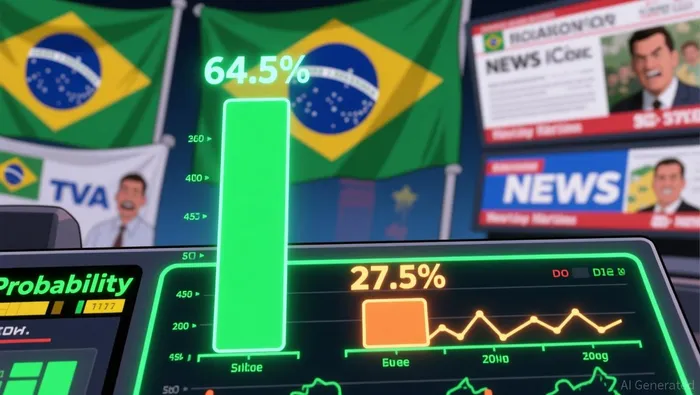
The Polymarket contract for the 2026 Brazilian presidential election is pricing a contest that appears increasingly unsettled, yet the market for incumbent Luiz Inácio Lula da Silva’s victory remains anchored at a commanding 64.5% probability. This divergence between a tightening polling landscape and a market that still treats Lula as a clear favorite is the analytical core of this trade. This article examines the information increments that have driven recent repricing, the resolution rules that define what “winning” actually means for settlement, and whether the current volume and volatility structure supports the price signal or warns of a fragile consensus.
Event Definition
This market is a binary bet on the winner of Brazil’s October 2026 presidential election. The contract settles to the candidate that emerges victorious, as determined by a consensus of credible reporting or, in the event of ambiguity, official results from the Superior Electoral Court (TSE). The key date is the first-round vote on October 4, with a likely runoff three weeks later, and the ultimate settlement deadline is June 30, 2027. The core disagreement is not merely about who leads in polls, but whether the market is adequately discounting a rapidly narrowing race and a candidate, Flávio Bolsonaro, whose price remains in the low 27% range.
Latest News & Information Increments
The most consequential information increment is the unambiguous tightening of the electoral race. A BTG Pactual/Nexus poll released on August 3 shows Lula’s lead collapsed to a single point, 46% to 45%, down from a four-point margin in late July. This shift, while within the margin of error, is directionally consistent with a July 27 survey that had Lula ahead 47% to 43%, indicating a clear trend of erosion in the incumbent’s advantage. In a first-round scenario, Lula’s support dipped to 41% against Bolsonaro’s 37%, with no other candidate breaking 5%.
This polling compression is not happening in a vacuum. Bolsonaro formally launched his campaign on July 25, leveraging endorsements from Milei and an AI-generated message from his jailed father, former President Jair Bolsonaro, to consolidate his base. Yet, the campaign is also battling significant legal headwinds, including a Supreme Court-authorized investigation into bank fraud allegations, which investors describe as a source of fragility. The market appears to be processing these cross-currents by modestly repricing Bolsonaro’s odds upward, but the 27.5% mid-price suggests the market still heavily discounts his chances relative to the polling reality. This is a low-catalyst environment where incremental polling data is the primary driver, and the absence of a decisive shift in fundamentals means price movements are gradual rather than explosive.
Market Resolution Rules Analysis
The contract settles based on the candidate who wins the Brazilian presidential election. The primary source for determination is the Superior Electoral Court (TSE), but the market allows for a consensus of credible reporting to trigger resolution if the official result is clear. The critical temporal boundary is June 30, 2027, at 11:59 PM ET. If the election result is not known by that deadline, the market resolves to “Other.” This structure means that a bet on Lula or Bolsonaro is not simply a bet on who gets more votes, but a bet on a timely and unambiguous declaration of a winner.
Rule Risk Points & Disputed Scenarios
Two rule risks dominate the settlement calculus. First, any ambiguity in reporting — whether from a contested result, legal challenges, or a delayed official count — forces the market to rely solely on the TSE’s official determination. This could delay resolution and inject volatility if the official process is protracted. Second, and more critically, the hard deadline of June 30, 2027, creates a tail risk: if the election outcome is not formally known by that date, all positions resolve to “Other,” wiping out both Lula and Bolsonaro contracts. In a polarized environment where legal challenges to results are plausible, this is not a theoretical risk but a structural one that the current price may not fully embed.
Market Overview
The pricing structure reveals a market that is far more confident in a Lula victory than the latest polling warrants. Lula’s contract trades at a mid-price of 0.645, implying a 64.5% probability of reelection, while Bolsonaro’s contract sits at just 0.2755. This spread is notable given that the most recent runoff poll shows a statistical tie. The Lula market’s higher liquidity of 306,401 and a 24-hour volume of approximately $63,417, combined with a tighter spread, suggest more efficient price discovery and a stronger consensus. In contrast, Bolsonaro’s market, despite slightly higher raw 24-hour volume of roughly $78,123, has a lower liquidity base and a higher volatility score, indicating that its price is more susceptible to sharp moves on less capital. The market is pricing Lula as a clear favorite, but the polling data increasingly describes a coin flip.
Market Dynamics (Volatility & Volume)
Price movements over the past month have been modest but telling. The maximum one-month price change is 0.05, and the one-week change is 0.037, with the dominant market ID driving these shifts across short time horizons. This suggests that repricing has been gradual and concentrated in the most active contract, rather than a broad-based reevaluation. The 24-hour volume surge exceeding $500,000 confirms that genuine trading activity is backing these incremental shifts, not just a few large orders. However, the divergence between the magnitude of the polling shift — a four-point collapse in Lula’s lead — and the relatively small price adjustment in his contract raises questions. If the market were efficiently incorporating the new polling information, one would expect a more pronounced decline in Lula’s price. The current stability may reflect liquidity-driven anchoring, where a deep order book absorbs selling pressure without a dramatic price breakdown, or a persistent belief that polling trends will not translate into an electoral defeat. The lower volatility score for Lula’s market (0.065) compared to Bolsonaro’s (0.2088) reinforces the view that the incumbent’s price is stickier, but that stickiness may be a function of liquidity depth rather than conviction.
Trading Judgment & Follow-up Observation Points
The current price embeds an expectation that Lula’s institutional advantage and the market’s liquidity depth will outlast the polling noise. Whether that expectation is well-founded depends on the next wave of information. The most critical variable to track is the trajectory of runoff polling over the next four weeks; if Bolsonaro pulls ahead in a credible survey, the Lula contract’s price floor will be tested. Equally important is the legal calendar surrounding Bolsonaro’s fraud investigation — any escalation could cap his upside, while a resolution in his favor could trigger a rapid repricing. Finally, monitor the volume and spread dynamics in the Lula market for signs of liquidity withdrawal, which would signal that the current consensus is cracking. The market is not pricing a coin flip, but the polls are describing one; the resolution of that tension will define the trade.

Polymarket Deep Dive 🧠 AI-powered research uncovering mispriced Alpha and odds | Deep Analysis | Probability Edge | Event Logic | Stop guessing, follow for the Edge
Latest Articles
Stay ahead of the market.
Get curated U.S. market news, insights and key dates delivered to your inbox.


AInvest
PRO
AInvest
PRO




Comments
No comments yet