
Brazil’s 2026 Election Markets: Reading the Polls, Rules, and Diplomatic Shockwaves
 Aime Summary
Lead
The Polymarket contract on Brazil’s 2026 presidential election prices Luiz Inácio Lula da Silva at a commanding 65.5 cents, yet a recent flurry of polls and a sharp diplomatic crisis with the United States are compressing the race. This article dissects the gap between polling data, market pricing, and the resolution rulebook, arguing that current prices embed not just electoral probabilities but also structural rule risks and a low-liquidity premium on the challenger’s side. We examine why the market’s implied probability for a Flávio Bolsonaro victory may be artificially depressed by thin depth, and why the diplomatic escalation is a high-stakes variable that could reprice the entire curve.
Event Definition
The market asks: who will win the Brazilian presidential election on October 4, 2026? The contract resolves to the candidate who secures victory, either in the first round or a potential second-round runoff. The core disagreement is not about Lula’s frontrunner status—every major poll shows him leading—but about the magnitude of his advantage and whether the tightening race, combined with external shocks, justifies the current 65.5-cent price. The settlement deadline extends to June 30, 2027, accommodating any protracted electoral disputes.
Latest News & Information Increments
The information environment has shifted from a stable polling lead to a narrowing race punctuated by a diplomatic crisis. A Nexus/BTG Pactual poll released on August 3 showed Lula’s second-round lead collapsing to just 46%–45%, down from a 47%–43% margin in late July. This is a genuine information increment: it signals that Bolsonaro’s campaign launch converting undecided voters, even as center-right parties remain neutral. Earlier, an AtlasIntel/Bloomberg poll had shown a more comfortable 49.2%–42.9% Lula lead, but that survey’s field period ended July 27, before the latest tightening became evident.
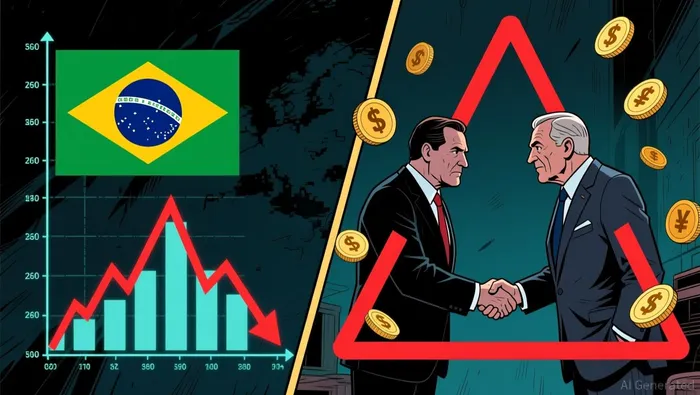
The second major catalyst is diplomatic. On August 4, US State Department revoked visa of Brazil’s ambassador to the US, retaliating for Brasília’s refusal to approve Trump’s nominee for ambassador. The Trump administration explicitly linked the move to the election, with Lula’s office condemning it as interference. This is a high-impact variable: it injects nationalism into the race and could either rally voters around Lula as a defender of sovereignty or hurt him by signaling a dysfunctional relationship with a key trading partner. The US has also imposed tariff hikes and designated Brazilian drug-trafficking groups as terrorist organizations, compounding the pressure.
In a low-catalyst environment, minor poll shifts would be noise. But the combination of a tightening race and an active diplomatic confrontation means the market is now pricing a qualitatively different electoral landscape than it was two weeks ago.
Market Resolution Rules Analysis
The market resolves to the candidate who wins the election, as determined by consensus of credible reporting. If ambiguity exists, resolution relies solely on the official results from Brazil’s Superior Electoral Court (TSE). Crucially, the contract includes a long-stop date: if the result is not known by June 30, 2027, at 11:59 PM ET, the market resolves to “Other.” This means a protracted legal challenge or a failure to certify results by that date would trigger a binary wipeout for all named candidates.
Rule Risk Points & Disputed Scenarios
Two rule risks merit attention. First, the “Other” deadline risk: if the election outcome is contested and litigation drags beyond June 2027, all positions in Lula and Bolsonaro contracts would expire worthless. This tail risk is not priced in a standard probability model but is a real structural feature of the contract. Second, the resolution hierarchy prioritizes “credible reporting” over official TSE results, creating a potential gray zone where major media outlets call the race but the TSE delays certification. In a disputed election, this ambiguity could lead to a multi-week period where the market’s settlement source is unclear, amplifying volatility. These risks are not trivial in a polarized political environment where electoral court challenges are increasingly common.
Market Overview
The Lula “Yes” market trades at a mid-price of 0.655, implying a roughly 65.5% probability of victory. The Flávio Bolsonaro market sits at 0.2605, or about 26%. This 39-point spread is wide, but it masks a critical liquidity asymmetry. The Lula market has a liquidity depth exceeding 345,000 and a 24-hour volume of approximately 43,000, while the Bolsonaro market, despite higher 24-hour volume of 64,000, shows a much thinner liquidity number of 226,000. The Bolsonaro market’s tight 0.001 spread (0.261 ask vs. 0.26 bid) suggests high immediate tradability for small orders, but the lower depth means larger orders can move the price more easily. This structure implies that the Bolsonaro price may be more fragile and less representative of genuine conviction than the Lula price.
Market Dynamics: Volatility & Volume
Price movements have been incremental, not disruptive. The Lula market posted a one-day change of 0.01 and a one-week change of 0.02, while the Bolsonaro market showed a one-day decline of 0.02 and a one-week increase of 0.022. This low-volatility regime is deceptive: it coexists with a massive surge in 24-hour trading volume exceeding $150,000 and total global volume of over 119 million. The volume surge without corresponding price volatility suggests two-way flow—both buyers and sellers are active, absorbing the new information without a decisive directional break. This is consistent with a market where participants are repositioning around the tightening polls and diplomatic shocks but have not yet reached a new consensus.
A critical flag is the ultra-low price level of the Bolsonaro contract and the overlap of the one-day and one-month maximum price changes. This indicates that recent incremental moves are the dominant source of variation over the past month, meaning the market has not experienced a large discrete repricing event. The risk is that the current price stability is a function of balanced order flow rather than deep conviction, and a sudden shift in sentiment—triggered by a new poll or diplomatic escalation—could cause a rapid, liquidity-driven repricing in the thinner Bolsonaro market.
Trading Judgment & Follow-up Observation Points
The current price of 0.655 for Lula reflects a strong but not overwhelming lead, consistent with a polling average that shows him ahead but with a narrowing margin. However, the price does not fully discount the “Other” deadline risk, nor does it reflect the possibility that the diplomatic crisis with the US could become the central issue of the campaign. The Bolsonaro price at 0.26 may be artificially constrained by thin depth, meaning its signal-to-noise ratio is lower than the Lula market’s.
Going forward, three variables matter most. First, the next round of high-quality polls: a further tightening below a 2-point margin would likely compress the spread. Second, the trajectory of US-Brazil diplomatic relations: any de-escalation—such as the US accepting Brazil’s conditions for ambassador approval—could neutralize a potent Lula vulnerability. Third, the market’s liquidity profile: if the Bolsonaro market’s depth improves, it would signal that the price is becoming more reliable. If depth remains thin, any price moves should be interpreted cautiously, as they may reflect order-flow dynamics rather than genuine probability shifts.
This market is not just betting on an election; it is betting on the resolution mechanism itself. In a polarized race with external interference, the gap between apparent probability and structural risk is where the real analytical edge lies.

Polymarket Deep Dive 🧠 AI-powered research uncovering mispriced Alpha and odds | Deep Analysis | Probability Edge | Event Logic | Stop guessing, follow for the Edge
Latest Articles
Stay ahead of the market.
Get curated U.S. market news, insights and key dates delivered to your inbox.


AInvest
PRO
AInvest
PRO




Comments
No comments yet