
Brazil’s 2026 Election Market: How Lula’s Lead, Polling Fragility, and Resolution Rules Shape the True Odds
 Aime Summary
Lead
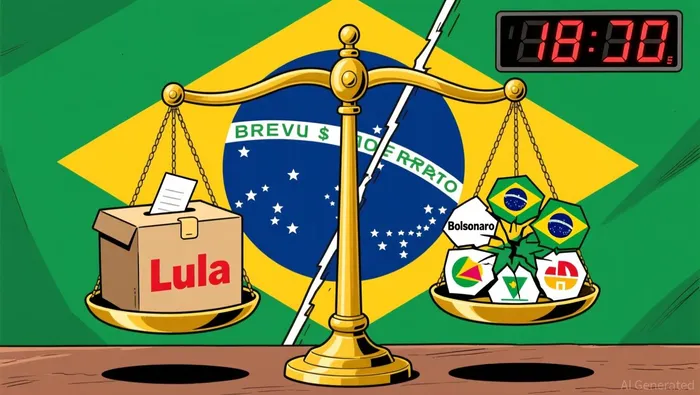
The Polymarket contract on the 2026 Brazilian presidential election shows incumbent Luiz Inácio Lula da Silva trading at 66 cents against challenger Flávio Bolsonaro’s 24.6 cents, a spread that superficially suggests a commanding lead. But the price gap masks a more complex reality: polling is tight, the challenger’s coalition is fracturing, and the contract’s resolution rules introduce a hard deadline and a strict official-results tiebreaker that could punish complacency. This article dissects what the market is actually betting on, which news has genuinely shifted expectations, and why the current price may embed rule risk that raw polling numbers do not capture.
Event Definition
This market asks whether Lula, Bolsonaro, or any other candidate will win Brazil’s presidential election scheduled for October 4, 2026. The contract resolves based on the consensus of credible reporting, with official results from the Superior Electoral Court (TSE) serving as the sole tiebreaker in ambiguous scenarios. The critical deadline is June 30, 2027, at 11:59 PM ET — if no winner is known by that cutoff, the market resolves to “Other.” The core disagreement among traders is not just who will win, but whether the current polling lead is durable enough to survive both the campaign and the contract’s mechanical constraints.
Latest News & Information Increments
Polling data has been the primary catalyst for price formation, and the latest surveys paint a consistent but not overwhelming picture. A Nexus poll commissioned by BTG Pactual, conducted between July 24 and 26, shows Lula leading Bolsonaro 47% to 43% in a simulated runoff, with a first-round advantage of 42% to 33%. An AtlasIntel survey published July 29 gives Lula a 49% to 43% edge in a runoff, with his approval rating rising to 48% amid aid delivery and tariff clashes with the Trump administration. These numbers are directionally positive for Lula but fall within a range where a single polling error or late swing could flip the outcome.
What has arguably been more damaging to Bolsonaro’s implied probability is the erosion of his political infrastructure. On July 31, the Progressives Party announced it would remain neutral in the race, denying Bolsonaro a key alliance and blocking Senator Tereza Cristina — a popular figure among agribusiness voters — from joining his ticket as a running mate. This structural setback compounds the candidate’s polling deficit and limits his ability to broaden his coalition beyond the conservative base. Meanwhile, Brazil’s decision to deny visas to two Trump administration officials, who were reportedly seeking to question the integrity of the electronic voting system, has been interpreted domestically as a preemptive defense of electoral sovereignty. The move may neutralize a narrative that Bolsonaro’s camp could have used to contest a loss, but it also introduces a layer of geopolitical friction that could resurface closer to the vote.
In a low-information environment for other contract-relevant events, peripheral news items — such as MercadoLibre’s 42% GMV growth in Brazil or U.S. debt ceiling legislation — have generated noise but no discernible impact on election pricing. The market is operating in a polling-driven regime where the absence of a game-changing catalyst has kept price movements incremental rather than structural.
Market Resolution Rules Analysis
The contract resolves to the candidate who wins the election, with the official TSE result serving as the ultimate authority in case of ambiguity. The settlement window extends to June 30, 2027, roughly nine months after the first-round vote. This extended timeline is designed to accommodate potential runoff scenarios and legal challenges, but it also creates a binary risk: if the result is not known by that date, the market resolves to “Other,” wiping out positions on both Lula and Bolsonaro. The primary source of truth is the TSE, meaning that media projections, concession speeches, or international recognition carry no contractual weight unless they align with the official tally.
Rule Risk Points & Disputed Scenarios
The most acute risk is the “Other” resolution trigger. If the election outcome is delayed beyond June 30, 2027 — whether due to protracted litigation, a contested runoff, or institutional deadlock — all shares on the major candidates expire worthless. This is not a theoretical tail risk in a polarized environment where the losing side has already signaled willingness to question the electronic voting system. Additionally, the contract’s reliance on the TSE as the sole tiebreaker means that any gap between credible media consensus and the official result will be resolved in favor of the government’s count. Traders who price in a candidate’s victory based on early calls or statistical projections risk holding a position that the contract does not recognize.
Market Overview
At a last trade price of 66 cents, the Lula market implies a roughly 66% probability of victory, while Bolsonaro’s 24.6 cents implies a near 25% chance. The spread is wide, but it is not a market pricing in a landslide; rather, it reflects a consensus that the incumbent is the clear favorite, with the challenger facing structural headwinds. The Lula market exhibits deeper liquidity, with a 24-hour volume of approximately 108,738 and a liquidity metric of 338,146, compared to Bolsonaro’s 39,618 in volume and 232,417 in liquidity. The Bolsonaro market’s tighter bid-ask spread of 0.001 versus Lula’s 0.01 may suggest more efficient short-term price discovery, but the thinner order book depth means that larger trades could move the price more sharply.
Market Dynamics (Volatility & Volume)
Price movements over the past month have been modest, with a maximum one-month change of 6 cents and a one-week maximum of 4 cents. The one-day maximum change of 2 cents suggests that no single news event has triggered a sharp repricing. This low-volatility regime is consistent with a market that has already absorbed the polling narrative and is waiting for a new information shock. The concentrated price action across the 1-day, 1-week, and 1-month windows, driven by the Lula market, indicates that traders are incrementally adjusting positions rather than making large directional bets.
Volume data supports the view that current prices are backed by genuine interest. Total global volume exceeds $117 million, and the 24-hour figure of roughly $648,000 is elevated, indicating active participation. The divergence between Lula’s higher volume and Bolsonaro’s lower activity suggests that the market’s conviction is asymmetrical: money is flowing more readily into the favorite’s contract, while the challenger’s market may be more vulnerable to sentiment-driven swings on lower liquidity.
Trading Judgment & Follow-up Observation Points
The current price of 66 cents for Lula is a defensible but not unassailable reflection of polling leads and Bolsonaro’s coalition difficulties. However, the contract’s resolution rules introduce a layer of risk — particularly the “Other” deadline and the strict TSE tiebreaker — that polling-based models do not capture. Traders should monitor three variables: first, whether Bolsonaro can secure a viable running mate and rebuild his coalition after the Progressives Party’s defection; second, whether the polling gap narrows to within the margin of error as the October vote approaches; and third, whether any institutional challenges to the electronic voting system emerge that could delay the official result beyond the June 2027 cutoff. The market is currently pricing a high-probability Lula win with limited tail-risk hedging; any sign that the resolution timeline is in jeopardy could trigger a sharp repricing across all contracts.

Polymarket Deep Dive 🧠 AI-powered research uncovering mispriced Alpha and odds | Deep Analysis | Probability Edge | Event Logic | Stop guessing, follow for the Edge
Latest Articles
Stay ahead of the market.
Get curated U.S. market news, insights and key dates delivered to your inbox.


AInvest
PRO
AInvest
PRO




Comments
No comments yet