
Brazil's $147 Million Market Just Crossed to Bolsonaro's Son — the Latest Poll Still Has Lula Ahead
 Aime Summary
The world's biggest prediction market on Brazil's presidency just flipped for the first time this cycle: Polymarket now prices challenger Flávio Bolsonaro at roughly 52% to beat the incumbent's 45%, a reversal that has drawn more than $147 million in trades. Read it as money, not math: at 45 cents a share, $100 buys about 222 Lula shares, which pay roughly $222 gross — about $122 of profit — if he wins, or go to zero if he does not.
The twist is not that the race tightened. It's that the crowd swung to the son of Brazil's imprisoned former president on a late surge — while the freshest national survey still shows Lula ahead in both rounds. One side is pricing campaign momentum. The other is measuring voters. The first-round vote is October 4, with a runoff on October 25 if nobody clears 50%. Twenty days is all this bet has before the gap gets settled.
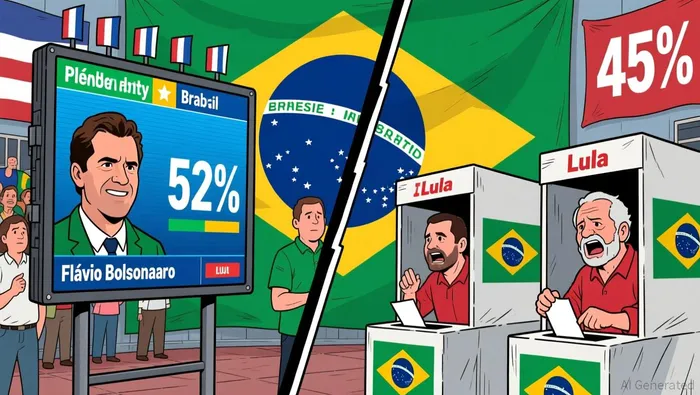
The market moved. The poll didn't.
For most of 2026, Lula was the comfortable favorite. The milestone here is that Flávio Bolsonaro — who inherited the base of his father Jair Bolsonaro, sentenced in 2025 to 27 years for plotting a coup — overtook the incumbent on Polymarket for the first time in the entire cycle, flipping the spread from a Lula lean to a Flávio lean.
The measured vote tells a different story. Datafolha's latest national survey, released September 11 (2,002 respondents, ±2 points), puts Lula ahead in both scenarios: 46%–44% in a runoff, a lead that was unchanged from the previous week, and 39%–35% in the first round. An earlier September Datafolha confirmed the shape, with Lula at 38% to Flávio's 33%, and centrist Augusto Cury climbing to 8% on the strength of a fragmented field.
That is the collision worth staring at. The market leans challenger; every major published poll leans incumbent. The gap is roughly seven points in the market's lean toward Flávio relative to the polls' lean toward Lula — narrow enough to be a coin flip, wide enough to be a real disagreement between two credible information sources over who should be the favorite.
What flipped the price — and what could flip it back
The trigger is momentum, not turnout. The Washington Post reported this week that Flávio is enjoying a late surge as a Supreme Court scandal energizes the right, after "several stumbles" earlier in the race. That is exactly the kind of story prediction-market crowds love to price into the board before the polling establishment catches up — and it is the mechanism behind the first-ever flip.
But momentum is not a vote until it moves the numbers, and the September 11 poll was taken with the race essentially concurrent to that surge. Datafolha's own result — Lula still ahead, runoff unchanged week over week — is the honest counter. So too is the fact that not every pollster agrees: an AtlasIntel/Bloomberg survey had the runoff essentially tied at 46.4%–46.2%, which is largely what the market is reflecting. If the next wave of surveys reproduces the surge the market has already noticed, Flávio is cheap, not overpriced.
That cuts both ways, which is the point. The market has climbed to favor the challenger on a narrative while the incumbent still leads the hard numbers — a rare, live discrepancy with a finite shelf life.
A two-stage clock, and a rule most readers will miss
This contract does not pay out on October 4. It resolves on the winner of the election including any second round, so with a 13-candidate field and no one near 50% in any poll, the practical deadline is the runoff on October 25. The first round on October 4 is the first repricing trigger — the moment the market finds out whether the surge survives a real ballot, even if the final answer waits three more weeks. Settlement ultimately leans on the official results of Brazil's Superior Electoral Court, with a "Other" fallback if no winner is known by June 30, 2027.
Run the asymmetry from the incumbent's side. At 45 cents, Lula is the poll leader trading under the challenger: $100 buys ~222 shares, worth ~$222 gross if he prevails — a roughly +122% payoff before the October 25 resolution. The clean loss is just as legible: if the surge is real and Lula drops the first round, he almost certainly loses the runoff too, and the entire stake is gone. There is no refund for being the incumbent, and no bonus for having led the polls.
The whole trade reduces to one question: is the crowd ahead of the polling, or running ahead of reality? The market says the son of the jailed ex-president takes it. Every current national survey says the eighty-year-old incumbent still leads. You have until the votes are counted on October 4 to decide which number you trust — and then the market will settle the argument for you, either way.
_43ca838f1775813865579.png?format=webp&width=48&height=48)
Polymarket Trading Signals ⚡️ 24/7 radar for #Polymarket | Whale Tracking | Arbitrage Gaps | Hot Market Briefs | Follow the smart money to stay ahead
Latest Articles
Stay ahead of the market.
Get curated U.S. market news, insights and key dates delivered to your inbox.


AInvest
PRO
AInvest
PRO




Comments
No comments yet