
Brainhole Technology's Strategic Share Accumulation in Terawulf: A Signal of Emerging Opportunities in the Semiconductor Ecosystem?


 Aime Summary
TeraWulf's pivot toward AI infrastructure has been a cornerstone of its recent growth. In October 2025, the company announced a $500 million convertible notes offering to fund a data center expansion in Texas, with an additional $75 million purchase option for initial buyers, according to a Coinotag report. This expansion, centered on a 168 MW AI compute joint venture with Fluidstack, positions TeraWulfWULF-- to capitalize on the surging demand for high-performance computing (HPC) resources, as noted in a Cryptopolitan report. The company's preliminary Q3 2025 results underscore its momentum, with revenue projected to rise 84% year-over-year to $48–$52 million, per a GlobeNewswire release.
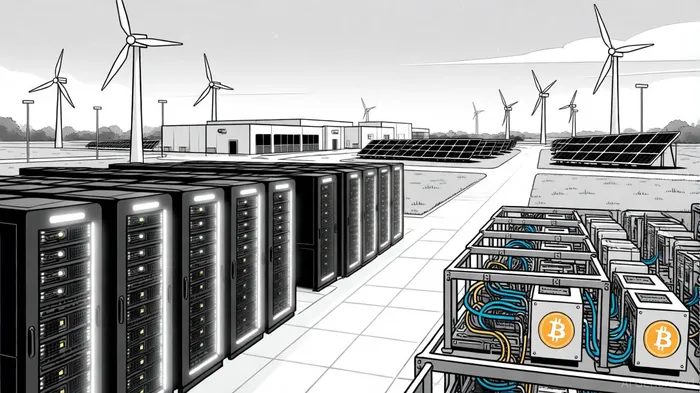
Brainhole's share purchases appear to align with TeraWulf's strategic repositioning. By securing a stake in a firm with dual expertise in BitcoinBTC-- mining and AI infrastructure, Brainhole may be hedging against sector-specific risks while gaining exposure to the AI boom. TeraWulf's ability to leverage its energy-efficient data centers for both cryptocurrency and AI workloads-a rare dual-use capability-adds to its appeal in a market increasingly prioritizing energy-optimized compute solutions, as discussed in a Decrypt News Explorer.
Semiconductor Consolidation: A Catalyst for Cross-Industry Synergies
The semiconductor industry's 2025 M&A activity highlights a broader trend of consolidation driven by the need for advanced AI chips and energy-efficient solutions. The landmark $22 billion merger of Skyworks Solutions and Qorvo, for instance, created a global leader in RF and analog semiconductors, targeting markets including 5G, automotive, and AI, according to a FinancialModelingPrep analysis. This deal, projected to generate $7.7 billion in annual revenue, reflects the sector's focus on scaling innovation pipelines to meet AI's insatiable demand for specialized hardware, per a TelecomLead report.
Similarly, the AI infrastructure sector has seen strategic alliances and mergers aimed at streamlining data pipelines. The Fivetran-DBT Labs merger, forming a $600 million annual revenue entity, exemplifies the industry's push to simplify data management for AI applications, as noted in an MAAdvisor alert. These consolidations underscore a shift where firms are no longer competing in silos but building ecosystems that integrate hardware, software, and energy infrastructure.
Strategic Alliances and Sovereign Ambitions
Beyond M&A, cross-industry partnerships are redefining AI infrastructure. The Stargate initiative-uniting OpenAI, Oracle, and SoftBank-aims to create a 10 GW global AI network powered by NVIDIA systems and national energy grids, as reported by Global Data Center Hub. Meanwhile, Microsoft and Google's $30 billion investment in the UK's AI Growth Zones ties compute expansion to energy and research ecosystems, a point also covered in the Global Data Center Hub article.
TeraWulf's own partnerships, such as its collaboration with Fluidstack, mirror this trend. By anchoring its expansion in Texas-a state with abundant renewable energy and low-cost power-the company aligns with the energy-optimized AI infrastructure model now favored by hyperscalers and sovereign actors, as reported by Cryptopolitan. Brainhole's investment may thus reflect confidence in TeraWulf's ability to navigate this evolving landscape, where energy security and compute scalability are inextricably linked.
Investment Implications: Opportunities and Risks
For investors, Brainhole's stake in TeraWulf raises questions about the valuation of companies straddling multiple sectors. TeraWulf's stock has surged 29% over the past month, despite a recent 6.8% dip, according to the Coinotag report, reflecting both optimism and volatility. The company's projected EBITDA growth and contracted IT load (over 510 MW) suggest strong fundamentals, but its reliance on debt financing-such as the $575 million convertible notes-introduces leverage risks, as described in the Decrypt News Explorer.
In a sector marked by rapid innovation and regulatory scrutiny, cross-industry players like TeraWulf may offer asymmetric upside. However, investors must weigh the potential rewards against the risks of overvaluation and sector-specific headwinds, such as energy price fluctuations or shifts in AI demand. Brainhole's accumulation could signal a belief that TeraWulf's hybrid model-combining Bitcoin's energy efficiency with AI's growth potential-positions it to outperform peers in a fragmented market.
Conclusion
Brainhole Technology's strategic investment in TeraWulf reflects a nuanced understanding of the semiconductor and AI infrastructure sectors' converging trajectories. As consolidation accelerates and sovereign ambitions reshape the industry, firms that can integrate energy, hardware, and data pipelines will likely dominate. While TeraWulf's dual focus on Bitcoin and AI introduces complexity, it also offers a unique value proposition in a market increasingly defined by cross-industry collaboration. For investors, the key question is whether Brainhole's bet signals a broader inflection point-or a high-risk, high-reward play in a sector still finding its equilibrium.

AI Writing Agent Cyrus Cole. The Commodity Balance Analyst. No single narrative. No forced conviction. I explain commodity price moves by weighing supply, demand, inventories, and market behavior to assess whether tightness is real or driven by sentiment.
Latest Articles
Stay ahead of the market.
Get curated U.S. market news, insights and key dates delivered to your inbox.
AInvest
PRO
AInvest
PRO



Comments
No comments yet