
BP's Strategic Resilience in Volatile Energy Markets: A Defensive Play?
The global energy sector faces relentless volatility, with geopolitical tensions, macroeconomic shifts, and climate policy debates amplifying uncertainty. For investors seeking stability in this environment, BP's Q2 2025 results offer a compelling case study. The company's dual focus on upstream production growth and trading diversification has positioned it to navigate falling fuel prices while maintaining cash flow resilience. This analysis examines BP's strategies, evaluates their effectiveness, and considers their implications for long-term energy sector investments.
Upstream Production as a Buffer Against Price Declines
BP's upstream segment delivered a notable surprise in Q2 2025: production rose above expectations, exceeding Q1's 2.24 million barrels of oil equivalent per day (boe/d). Driven by robust U.S. onshore output and incremental gains in gas and low-carbon energy, this increase demonstrates BP's ability to leverage high-margin assets even as oil prices slid to $67.88 per barrel—down 10% from Q1.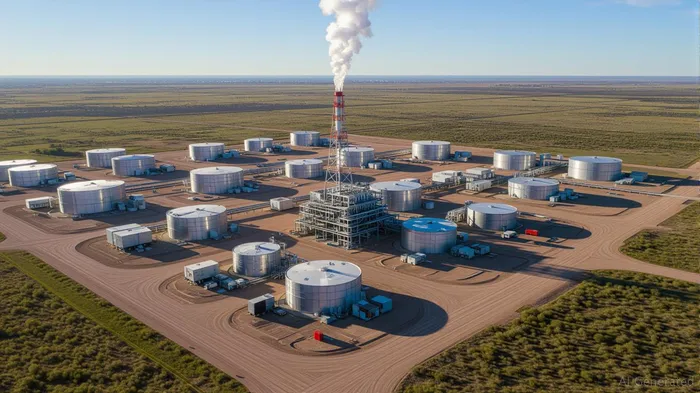
This production boost acts as a natural hedge against price declines. Higher volumes offset weaker pricing, a strategy BPBP-- has refined through asset sales—$20 billion in divestments by 2027—to focus on core, high-return fields. The result? A net debt target of $14–18 billion by 2027, underscoring financial discipline that contrasts with peers still burdened by legacy costs.
Trading Diversification: A Double-Edged Sword
BP's trading division, a critical profit driver, revealed a mixed but instructive performance. Oil trading delivered a “strong result,” likely exploiting volatility from Middle East tensions and OPEC+ policy swings. Meanwhile, gas trading lagged, with lower U.S. gas prices (-$300 million impact vs. Q1) highlighting sector-specific risks.
This bifurcated outcome underscores the importance of diversification. While gas trading underperformed, oil trading's resilience—bolstered by BP's market-making expertise—demonstrated the value of balancing exposures. Contrast this with ShellSHEL--, which reported weaker trading results across both segments in the same period. BP's focus on oil's geopolitical volatility as a profit lever appears strategically astute.
Financial Health: A Foundation for Resilience
BP's financial metrics reflect disciplined management. Despite impairments ($500–1.5 billion, largely non-cash), net debt remained near $27 billion—within targets—and dividends were held steady. The company's $750 million buyback plan signals confidence in cash flow stability, even as refining margins improved to $21.1/boe (vs. $15.2 in Q1), aided by turnaround activity.
Crucially, BP's strategy avoids overreliance on short-term trading luck. Instead, it combines upstream growth, asset-light trading, and balance sheet management to create a “floor” for cash flows during downturns. This contrasts with pure-play commodity traders, whose profits are more directly tied to price swings.
Implications for Investors: A Defensive Play?
For investors, BP presents a paradox: it is both a beneficiary of and a mitigator against energy market volatility. Its upstream growth and trading diversification reduce exposure to single-factor risks, while its asset sales and debt reduction lower financial fragility.
The Q2 results validate this approach. Even with lower oil prices, BP's shares rose 1.8% initially—though a subsequent dip to 2.2% below consensus earnings estimates highlights lingering risks. Yet, compared to peers struggling with refining slumps or overexposure to gas, BP's balanced strategy offers a safer harbor.
Investment Takeaway:
BP's integrated model—combining production growth, hedged trading, and disciplined capital allocation—positions it as a defensive energy equity in volatile markets. Investors seeking stability should view dips as buying opportunities, particularly if oil prices stabilize above $60–65/bbl. However, sustained price declines below $60/bbl or further impairments in refining could test this resilience.
The energy sector's next decade will demand agility in navigating climate policy and supply chain shifts. BP's Q2 results suggest it is among the better prepared. For now, its hedging strategies make it a prudent choice for investors seeking to weather the storm.

Stay ahead of the market.
Get curated U.S. market news, insights and key dates delivered to your inbox.
AInvest
PRO
AInvest
PRO



Comments
No comments yet