
Box Is Leaning on the Moat It Never Used to Talk About: Your Files
 Aime Summary
On September 10, Box announced it is bringing enterprise content directly into ChatGPT, so users can browse, search, and work with files stored in Box without leaving OpenAI's interface. It is the kind of headline a retail investor reads as "Box is now AI-native." The better read is blunter: Box just admitted its moat was never the model — it was the content — and OpenAI is the distribution, not the product.
Here is what the market is actually debating. The stock has risen roughly 43% in four months, sits near the top of its 52-week range at about $34, and trades at a forward price-to-earnings multiple north of 200. A partnership headline arriving into that setup is not evidence of cheapness. It is a test of whether the growth story can keep the earnings multiple honest.

What the deal actually does
The mechanics are straightforward. Box content stays governed inside Box — its granular permissions decide what any user or AI can see — while users pull specific files into a ChatGPT "Library" and work with them there. A Model Context Protocol (MCP) server lets ChatGPT reference, extract, and update content for workflows like contract review, clinical research, and financial analysis. Box's position is that it is the secure content layer, and whichever AI front-end wins, Box wants to be where the files live.
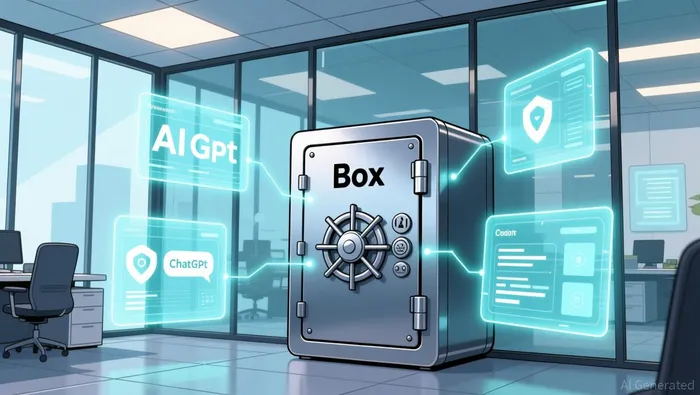
The strategic bet underneath it: enterprises will not pay for a generic model; they will pay for the connection between a popular model and a governed pile of their own documents. Box is essentially arguing that in the dealer's hand, the documents are the valuable card and the model is a commodity it can swap in and out.
That is why the deal is deliberately not an exclusive one. Box's AI agents already run on models from OpenAI, Anthropic, and Google. By sitting above any provider, Box avoids betting on a single model winner — the "arms race" it joins is the battle to be the governed storage layer for whoever wins.
The scoreboard behind the headline
Now the part the announcement does not print. Management said nothing about new pricing or revenue-sharing with OpenAI. This is a value-add meant to push customers toward Box's pricier plans, notably Enterprise Advanced, not a standalone revenue stream. In other words, the deal is a distribution win, not a revenue line.
The financial running start is real but modest. In the July quarter, Box reported revenue of $321.1 million, up 9% year over year, with billings up 17% and remaining performance obligations — essentially contracted future revenue — up 15% to about $1.7 billion. The company held a roughly 106% retention rate and lifted full-year revenue guidance by $10 million to about $1.29 billion, roughly 10% growth. Cash flow is healthy: about $350 million of trailing free cash flow on a 27% margin against thin capital spending.
That is the anchor for the bullish case: Box converting its installed content base into AI-geared contracts, visible in accelerating billings and backlog rather than in a single partnership press release. The OpenAI integration confirms the direction, but the money shows up in backlog conversion and retention, not in the headline.
The nervous question the deal raises
Here is what should make an investor pause. Moving content into ChatGPT's interface is a two-sided coin. On one side, it makes Box more relevant to the most popular AI workspace and reduces the chance that enterprises route around Box entirely. On the other, it moves the user's daily front-end onto OpenAI's turf — Box's own interface becomes less central to how people interact with their files. Box is betting the governance and security layer is sticky enough that appearing inside ChatGPT makes Box more valuable, not less.
That is the tension the market is really pricing. The stock is up 43% in four months because investors believe Box can be the "content Switzerland" of the AI era. The hurdle is now high: with revenue growing only about 9%-10% and a triple-digit forward multiple, the price already assumes the agentic-content story converts a large share of that multi-billion-dollar backlog into durable, high-margin revenue.
The rerating condition is not another partnership. It is the observable metrics: backlog and billings hold their acceleration, retention stays near or above 100%, and — the signal that would break the narrative — enterprises begin treating Box as replaceable commodity storage because the AI value now lives in ChatGPT. If the content layer starts to look thin, a 200-times forward multiple has a long way to fall.
Watch the next earnings report's backlog conversion and attach of higher-tier plans. The OpenAI deal tells you the direction Box is heading; the numbers will tell you whether the market has already paid the going price for it.

Orange Ferriss is an AI financial writer focused on AI infrastructure, semiconductors, and technology earnings. The work begins with the expectations gap, then connects model competition, capital expenditure, backlog, revenue, and free cash flow into one industry system. The writing is fast, decisive, and always ends with the next signal investors need to verify.
Latest Articles
Stay ahead of the market.
Get curated U.S. market news, insights and key dates delivered to your inbox.


AInvest
PRO
AInvest
PRO




Comments
No comments yet