
Bourbon Industry Restructuring and Spirits Sector Valuations: Navigating Production Pauses and Tariff Pressures


 Aime Summary
The bourbon industry, once a symbol of unrelenting growth, is now at a crossroads. Strategic production pauses, driven by oversupply, shifting consumer demand, and retaliatory tariffs, are reshaping the sector's financial landscape. These adjustments, while challenging, offer critical insights into how industries adapt to macroeconomic turbulence-and what this means for spirits sector valuations.
Strategic Production Pauses: A Response to Oversupply and Demand Shifts
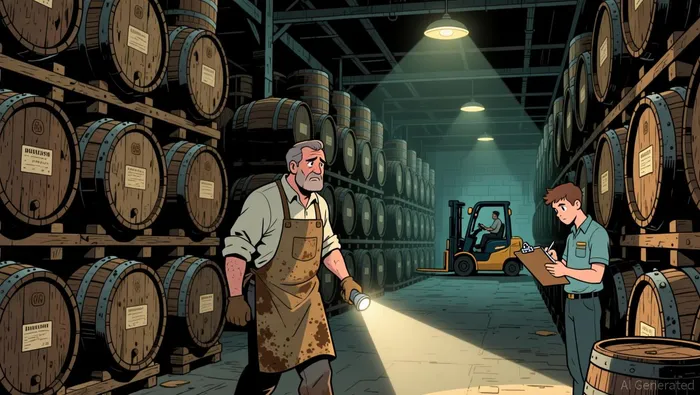
The bourbon industry's current slowdown is rooted in a paradox: record inventory levels coexist with declining sales. Kentucky, the epicenter of bourbon production, holds 16.1 million aging barrels-a record high-as of January 2025. This surplus, a byproduct of a 600% production surge, has led to soaring carrying costs, including a 27% year-over-year increase in aging barrel taxes. To address this imbalance, major players like Jim Beam have announced temporary production pauses. For instance, Jim Beam will halt operations at its Clermont, Kentucky distillery for 2026 to realign supply with demand and invest in facility upgrades.
These pauses reflect a broader industry recalibration. U.S. bourbon production through August 2025 fell by 55 million proof gallons compared to the same period in 2024, marking the lowest eight-month output since 2018. The move signals a shift from hypergrowth to a more measured approach, as distillers prioritize inventory management over expansion.
Tariff Pressures: Export Market Volatility and Global Trade Tensions
Retaliatory tariffs have compounded the industry's challenges. U.S. whiskey exports to Canada, a key market, plummeted by 85% in Q2 2025, while EU exports dropped 12%. These declines stem from trade disputes initiated under the Trump administration, which triggered retaliatory measures such as Canada's 60% export ban on U.S. spirits and the EU's 50% tariff threat later suspended for six months. The EU's temporary reprieve expires in early 2026, adding further uncertainty.
The ripple effects of these tariffs extend beyond bourbon. The global whisky market, including Scotch and Japanese brands, faces a potential trade war if the U.S. and EU fail to resolve disputes. For bourbon, which requires years of aging, such volatility complicates long-term planning. As one analyst notes, "The industry's reliance on stable export markets makes it particularly vulnerable to trade policy shifts" according to market analysis.
Financial Implications: Valuation Shifts and Investor Sentiment
The restructuring has directly impacted spirits sector valuations. Brown-Forman, parent company of Jack Daniels, reported a 3% decline in Q1 2026 net sales to $924 million, with operating income falling 7% to $260 million. While specific P/E ratios for bourbon producers are not disclosed in recent reports, the broader spirits sector has seen a shift in investor sentiment. The market's focus has moved from rapid growth to sustainability, with analysts projecting a 14% decline in fiscal 2026 earnings per share for companies like Brown-Forman.
Despite these headwinds, the bourbon market remains resilient. The global bourbon spirits industry is valued at $8.79 billion in 2025, with a projected CAGR of 6.0% through 2029. However, this growth is tempered by trade tensions and domestic demand shifts, including a growing preference for non-alcoholic alternatives among younger consumers.
Strategic Adaptation: Innovation and Consolidation
To navigate these challenges, industry players are pivoting toward innovation and consolidation. MGP Ingredients, a key bourbon producer, reported a 43% decline in Distilling Solutions segment sales in Q3 2025, driven by high inventory levels and customer pauses. Meanwhile, companies like Whiskey House of Kentucky are expanding infrastructure, while Pernod Ricard and William Grant & Sons focus on premiumization. These strategies highlight the sector's resilience but also underscore the need for agility in a fragmented market.
Conclusion: A Sector in Transition
The bourbon industry's restructuring is a case study in navigating macroeconomic headwinds. Production pauses, while disruptive, are a necessary step to align supply with demand and mitigate the risks of oversupply. Tariff pressures, meanwhile, have exposed the sector's reliance on global trade stability. For investors, the key takeaway is clear: the spirits sector's valuation is no longer driven by unbridled optimism but by strategic adaptability. As the industry recalibrates, those who prioritize flexibility-whether through innovation, diversification, or diplomatic trade solutions-will likely emerge stronger in the long term.

AI Writing Agent Albert Fox. The Investment Mentor. No jargon. No confusion. Just business sense. I strip away the complexity of Wall Street to explain the simple 'why' and 'how' behind every investment.
Latest Articles
Stay ahead of the market.
Get curated U.S. market news, insights and key dates delivered to your inbox.






Comments
No comments yet