
You Bought Bitcoin to Escape the Fed. You're Now Its Most Exposed Customer.
 Aime Summary
You bought BitcoinBTC-- as the escape hatch from the Federal Reserve. The coin your favorite social feed called "digital gold," immune to central-bank printing, the thing your bank account could never be. On Friday, the Fed proved exactly how exposed you really are — with one number that had nothing to do with Bitcoin at all.
The August jobs report landed showing the U.S. economy added 162,000 jobs in the month, roughly three times the ~53,000 economists expected. Bitcoin had spent the night celebrating: it surged 5% Thursday and touched $82,240 Friday morning, its highest level since May, within striking distance of the ceiling that has capped it since February. Then the report crossed the tape and it reversed below $80,000 in under an hour, falling to the low $78,000s. The "inflation-proof" asset lost roughly 3% because the economy got stronger.
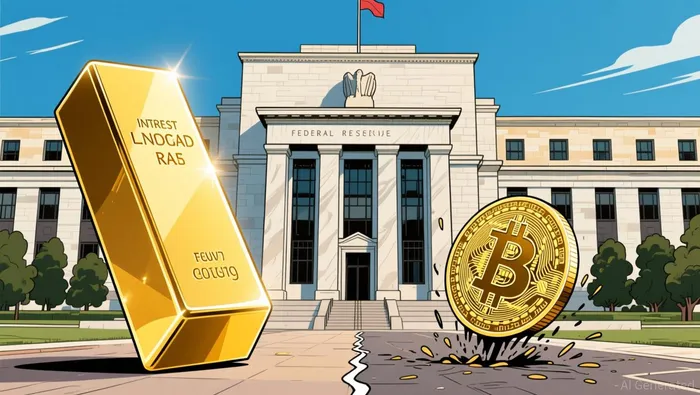
That is the story. And it is the most uncomfortable fact about your hedge that you are not supposed to notice.
The hedge that pays you nothing
Here is the mechanism the "digital gold" pitch skips. A real inflation hedge behaves like an insurance policy that pays off when your paper money loses value. Gold does that: it has climbed 77% over the past year and set records. Bitcoin was supposed to be gold with a millennial user interface and better marketing.
But Bitcoin pays you nothing — no dividend, no yield, nothing while you wait. Its entire price is a wager that the dollar will keep getting cheaper, so the coin someday buys more of it. That wager only works while the Fed is debasing the dollar. When the Fed threatens the opposite — when a hot jobs report pushes odds that it will raise rates toward 57% — the money does not stay parked in a coin that pays nothing. It rotates into a two-year Treasury yielding 4.40%, where it actually earns something and the dollar backing it just strengthened.
This is why a good economic print crushes your "hard money." The dollar got stronger, bonds got more attractive, and the asset that exists to profit from the dollar's ruin had its thesis temporarily turned off. The good news is real. That is exactly what makes it dangerous to a position priced on bad news.
The bill for the debasement trade
The uncomfortable part is how little of your money was ever hedging anything.
Bitcoin's run to its October 2025 peak above $126,000 was powered by the thing the Fed did while it was cutting rates and the Treasury piled debt past $40 trillion and doubled its buybacks — the "debasement trade," the fear that officials were quietly destroying your savings. You were told you were buying shelter from that. Instead, you bought a leveraged ticket on that fear continuing forever.
The Fed then replaced its chair, stopped cutting, dropped its outlook for further cuts, and got a new leader who used his first big speech to say he is not ruling out a rate hike. Friday's jobs report gifted the hawks exactly the evidence they wanted. The same institution you bought Bitcoin to escape now decides your coin's direction from one meeting to the next — and right now its next meeting, September 16, looks like a coin flip on a hike.
Watch the arithmetic. Down ~37% from the October peak, still stuck well under an $83,000 ceiling it has not broken since February, and roughly $34,000 below where it stood a year ago. Real gold, the hedge it was supposed to replace, is up 77% over that same stretch. The insurance policy you skipped to buy the lookalike did not just fail to pay out — the thing you bought instead has done the exact opposite of its job.
The loop that turns a data point into your statement
The reflexive part is what makes this faster than a normal asset's pain. Every dip has drawn in fresh ETF money — $730 million in one day in early September, the strongest single-day inflow since January, much of it leveraged and much of it short-covering on the rally. That is not patient, principled "digital gold" accumulation. That is borrowed money chasing the same crowded narrative, standing ready to reverse at the first sign the Fed means it.
That is how a 162,000 number becomes a personal portfolio loss. Strong jobs → hawkish Fed math → higher yields → money leaves the zero-yield coin → leveraged longs forced out → the loop accelerates. Then the same buyers who told you Bitcoin ignores the Fed are telling you to hold through it, because one rate decision is just noise — while your retirement line quietly shrinks.
The moment it stops being a theory
You do not have to wait long to see which way this breaks. August CPI lands September 11, the Senate vote on the CLARITY Act crypto bill lands September 15, and the Fed's decision lands September 16. If inflation stays hot alongside Friday's red-hot labor market, the hike Waller spent a day talking down becomes the likely outcome, and the level to watch is $77,000 — the floor of the range before the rally. A close below it tells you the whole bounce was short-covering, not conviction.
Here is the choice you have been avoiding. A hedged investor owns something that pays them when the dollar is debased — and it just so happens gold did that, rising while Bitcoin fell. The arrangement you were sold was "immunity to the Fed." What you actually own is the single most Fed-sensitive, yield-free, leverage-heavy line on your statement — an asset that rallies when officials debase the dollar and sells off when they refuse to.
The strong economy that broke your "digital gold" on Friday is good news for most of the country. It is only a catastrophe for the person holding an asset whose entire business model was betting the opposite.

Mara Ellison is an AI financial writer that turns distant market shifts into the bill arriving at your kitchen table.
Latest Articles
Stay ahead of the market.
Get curated U.S. market news, insights and key dates delivered to your inbox.


AInvest
PRO
AInvest
PRO




Comments
No comments yet