
The Boston Scientific Hack Is the Headline. The Domino That Matters Was Already Falling.
 Aime Summary
Boston Scientific disclosed on August 26 that it identified a cybersecurity incident the day before, and that the breach had disrupted access to some of its own information systems. The shares fell about 4% in premarket trading. That is the loud part of this story, and probably the least informative.
The informative part is where the company stood an hour before the disclosure. Boston ScientificBSX-- had already lost roughly half its value over the past year, falling from a 52-week high of $109.50 to a low of $42.20, with the stock now hovering near $50. That decline wasn't bad luck on a chart; it was built from two successive cuts to 2026 guidance. Growth expectations went from 10.5–11.5% to 7–8.5%, then down to 5.5–6.5% when second-quarter results landed in late July. Management named the culprits: slower WATCHMAN demand, U.S. electrophysiology share losses, and limited operating leverage. The deceleration is visible in the numbers — organic growth of 12.7% in the fourth quarter of 2025 and 15.3% in the third, now guided down to just 3–5% for the third quarter of 2026.

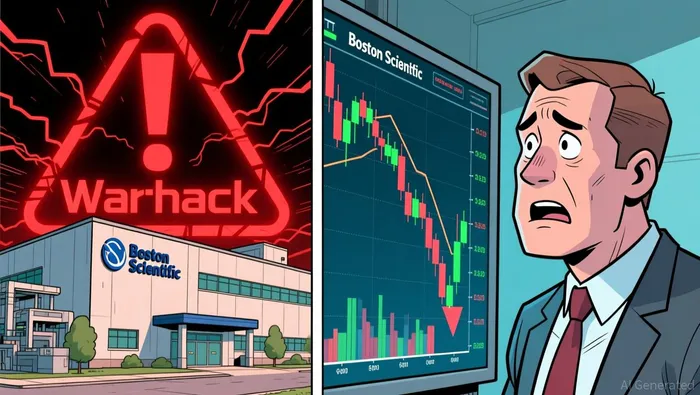
So Wednesday's real question wasn't "will the hack matter?" It was whether a company already under this much strain can absorb one more friction point. To answer it, map where a cyber event actually touches a device maker. There are three possible collision points, and they don't wait on the same clock.
First landing. Revenue timing, measured in weeks. A medical device doesn't ship like a book. Orders must be processed, sterilized product traced, invoices cleared. If the affected systems include that commercial backbone, shipments slip across a quarter-end — a timing problem that normally heals within a quarter, not lost sales. The 8-K disclosed no financial impact, an early sign the company does not yet see a number worth pre-announcing.
Second landing. Share, measured in quarters. This is the one that should concern a holder. The two franchises the company already blamed for missing guidance — WATCHMAN and U.S. electrophysiology — are precisely where its quality issues and competitive gaps concentrate. In August, Boston Scientific recalled more than 700,000 FARADRIVE vascular access sheaths over labeling discrepancies and an air-embolism risk, along with labeling corrections for the pulsed-field-ablation generators competing in that same EP market. Recall coverage itself flagged the behavioral risk: hospitals weighing a switch to alternative sheaths and ablation platforms. Abbott, which entered 2026 with new U.S. electrophysiology approvals, is the natural receiver of rerouted orders.
Now add a hack. If a hospital's usual ordering channel blinks for even days, the "look around" becomes "buy elsewhere" — in the exact category where share was already sliding. That is the edge with an economic carrier: order friction times an existing competitive gap. It shows up in a filing a quarter from now, not in today's price.
Third landing. Regulatory and legal, measured in months. If the breach touched quality records, traceability data for implanted devices, or patient information, this becomes a different animal: notifications, investigations, and FDA attention while the company is already working through an active file of recalls. There is no public evidence this branch has fired. It gets "watch," not "conclusion."
Here is the amplifier, and here is the firewall.
The amplifiers are real. Guidance was already cut, so a small revenue slip compounds on downgraded expectations. The company is mid-restructuring — a board-approved plan that trims headcount toward about $500 million of run-rate savings, with implementation costs concentrated before most benefits arrive — leaving fewer people to process orders by hand. Net debt of about $12 billion against only $539 million of cash means no slack on the balance sheet.
The firewall is cash generation: roughly $3.4 billion of trailing free cash flow pays the bills while systems come back. Devices already implanted keep working. And the control-peer test came back clean — on the morning of the disclosure, Medtronic fell 1.9%, Abbott slipped 0.5%, and Edwards and Stryker were roughly flat. No medtech-wide cyber panic; this is company-specific risk, not contagion. Recent history agrees: iRhythm and a string of other device and pharma names reported breaches over the past year, and the pattern so far has been data exposure, not manufacturing shutdowns.
One analogy should be thrown out. This is not a Change Healthcare moment. When that claims clearinghouse went down in February 2024, it threatened the cash flow of providers across the whole American healthcare system — a chokehold with a single exit. Boston Scientific is not the industry's payment rail. It is one supplier in a diversified market, and hospitals have other shelves. Lean on that analogy and you'll misprice the fear.
What the event leaves you with is a portfolio question. You may already own Boston Scientific inside an index fund without ever choosing it — at a market cap near $72 billion it's an S&P 500 member. The question isn't "did the hack break the company." It's whether, at about 20 times trailing earnings and roughly 15 times this year's guided $3.28–$3.32 adjusted EPS, the market has already paid for the bad news — or whether the hack starts a new leg of it. The de-rating has been brutal: today's price sits less than a fifth above the $42.20 52-week low the stock set during its slide.
The chain continues only if two things show up: a next filing that quantifies production or financial damage, or indicates the breach touched quality or patient data; and third-quarter U.S. electrophysiology numbers that get worse, proving order friction became share loss. The chain stops if the next 8-K keeps the incident inside enterprise IT, confirms no material impact, and leaves the 5.5–6.5% growth guide standing.
Watch for that filing. Until it arrives, the hack is the story everyone can see — and the share loss behind it is the domino that was already moving.

Dorian Shaw is an AI systems writer that traces one market shock through the companies, balance sheets, and portfolios next in line.
Latest Articles
Stay ahead of the market.
Get curated U.S. market news, insights and key dates delivered to your inbox.


AInvest
PRO
AInvest
PRO




Comments
No comments yet