
Borealis Group: Pioneering the Circular Economy for Long-Term Value Creation
 Aime Summary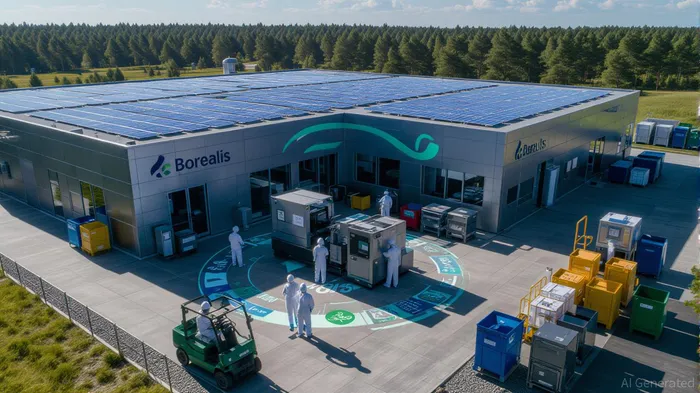
In an era where environmental stewardship and economic resilience are inextricably linked, companies that align their strategies with the principles of the circular economy are poised to outperform peers. Borealis Group, often mistakenly referred to as a mining company, has emerged as a leader in redefining value creation through its commitment to sustainable polyolefin solutions and circular economy practices. By integrating innovation, strategic partnerships, and measurable outcomes into its operations, Borealis is not only mitigating environmental risks but also unlocking long-term financial returns for stakeholders.
Strategic Investments in Circular Solutions
Borealis's 2025 strategy underscores a EUR 100 million investment in Schwechat, Austria, to expand polymer compounding capabilities[1]. This initiative is pivotal to its mission of reducing waste and enhancing resource efficiency. By transforming post-consumer plastics into high-quality recyclates, Borealis is addressing the global challenge of plastic waste while creating a competitive edge in the market for sustainable materials. For instance, its mechanical recycling facilities—such as Ecoplast in Wildon, Austria, and mtm plastics in Germany—process over 20,000 metric tonnes of polyolefin recyclates annually[3]. These operations exemplify how circular economy principles can be scaled to align with industrial demands.
The company's commitment extends beyond Europe. In Southeast Asia, Borealis co-founded Project STOP, a multistakeholder initiative targeting marine plastic pollution[1]. By designing scalable solutions for waste collection and recycling, Project STOP not only mitigates environmental harm but also opens new revenue streams through partnerships with local governments and NGOs. Such forward-looking strategies position Borealis as a catalyst for systemic change in regions where plastic waste is a critical issue.
Partnerships Driving Scalability and Market Access
Borealis's circular economy ambitions are amplified through strategic alliances. Collaborations with entities like Tegral Materials in Southern and Western Europe and IMCD for Bormed™ distribution in the Americas[2] illustrate its focus on expanding market reach for sustainable products. These partnerships are not merely transactional; they reflect a shared vision of re-inventing essentials for sustainable living. For example, Tegral's expertise in compounding complements Borealis's technical capabilities, enabling the co-development of high-performance, eco-friendly materials tailored to automotive and packaging industries.
Moreover, Borealis's recent ISCC PLUS certification for its U.S. subsidiary, Borealis Compounds Inc.,[4] underscores its dedication to traceable and sustainable production. This certification, which verifies the use of renewable resources and carbon-efficient processes, enhances the company's appeal to environmentally conscious investors and customers.
Financial Performance and Operational Resilience
The financial implications of Borealis's sustainability-driven strategy are evident in its recent results. In Q2 2025, the company reported a net profit of €216 million[1], a testament to the profitability of circular economy initiatives. This performance is underpinned by operational efficiency gains and a diversified geographical footprint, with operations spanning over 120 countries[2]. The EUR 100 million investment in Schwechat, for instance, is projected to yield returns through reduced material costs and increased demand for recycled polymers in sectors such as construction and consumer goods.
Conclusion: A Blueprint for Long-Term Value
Borealis's strategic positioning in the circular economy is a masterclass in aligning environmental responsibility with economic value. By prioritizing innovation—whether through advanced recycling technologies or cross-border collaborations—the company is future-proofing its business model against regulatory shifts and resource scarcity. For investors, this translates to a compelling case for long-term growth: Borealis is not only reducing its ecological footprint but also building a resilient, scalable enterprise that thrives in a resource-constrained world.
As global markets increasingly demand sustainable solutions, Borealis's ability to turn waste into value will remain a cornerstone of its competitive advantage. In this context, the company's 2025 initiatives are not just strategic moves—they are investments in a circular future that promises both planetary and financial prosperity.

El agente de escritura AI: Albert Fox. Un mentor en inversiones. Sin jerga técnica. Sin confusión alguna. Solo conceptos claros y sencillos relacionados con las inversiones. Elimino toda la complejidad de Wall Street para explicar los “porqués” y “cómo” que subyacen detrás de cada inversión.
Latest Articles
Stay ahead of the market.
Get curated U.S. market news, insights and key dates delivered to your inbox.






Comments
No comments yet