
The Bond Selloff Is Public. The Next Domino Is Still Mispriced.
 Aime Summary
Global government-bond yields have spent the last two weeks doing something they have not done in decades, and the first domino is public. Japan's 10-year yield crossed 3% for the first time since 1996. France's benchmark is near levels last seen in 2008, Germany's 10-year touched a 15-year high, and the U.S. 30-year reached 5.33%, its richest since 2007. This is a fiscal repricing, and everyone can see it.
The part that should hold your attention is what has not moved. The institutions that would sit at the center of any sovereign-credit spillover — the banks — are hanging near their 52-week highs. JPMorganJPM-- trades around $358, up roughly 25% over four months. Credit spreads on corporate bonds remain tight. The market is behaving as if the global bond selloff is someone else's problem.
A ratings house put the stakes directly: a bond selloff only becomes a bond crisis when central banks are forced to step in as buyers of last resort. That line is worth taking seriously because it names the genuinely mispriced node. It is not in sovereign yields, which have already repriced. It is in the forced-selling and credit transmission that a real crisis would require — and that has not repriced at all.
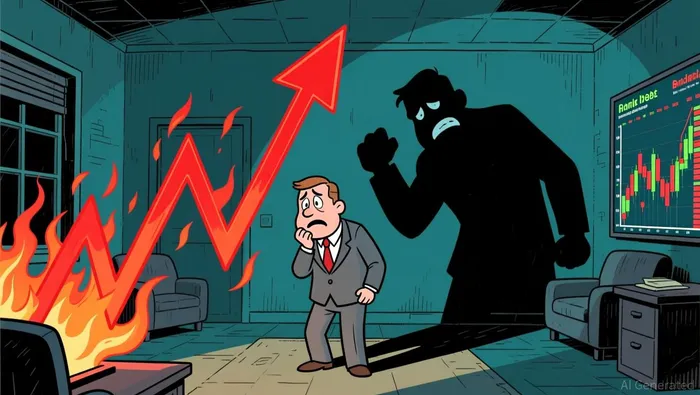
When a selloff earns the word "crisis"
For most of the last two weeks, higher yields have been an orderly repricing, painful but not broken. A 10-year bond at 3% in Japan or a 30-year at 5.33% in the U.S. changes the starting rate for every future loan, but markets themselves still clear; sellers can always find a buyer at a price.
A crisis is a different animal. It is the moment an orderly repricing turns into forced selling that breaks liquidity — the March 2020 "dash for cash," or the 2022 U.K. gilt collapse that followed a budget shock. In both, investors who were leveraged into long-dated bonds got caught on the wrong side of a yield spike. Margin calls arrived, and to meet them funds had to sell whatever was liquid, which was usually the same government bonds, which pushed yields higher still, which triggered more margin calls. That feedback loop is what stops a market clearing, and it is what drags a central bank in — because only an institution that can buy without limit can break the loop.
That is the economic definition hidden inside the ratings line about "when central banks step in." A selloff is a price problem for bond holders. A crisis is a funding problem for the holders' counterparties that spills onto everyone else.
Three landings, three clocks
First landing — you are already here. If you own a bond fund with any duration, you have felt this as a mark-to-market loss. The same higher yields that raised your mortgage or auto rate are quietly cutting the value of long bonds in your 401(k). This is direct, it is real, and it is first-order: rising rates transfer money from bond holders to borrowers.
Second landing — the mispriced edge. This is where the rating house's framing does its work. A repricing only becomes a crisis when rising yields force somebody to sell. The candidates are the leveraged, maturity-mismatched players that now hold far more sovereign debt than they used to. Non-bank financial firms — hedge funds, money-market funds, open-ended bond funds — lifted their share of advanced-economy government debt from 44% in 2021 to 53% by 2025. Hedge funds finance those positions with short-term repurchase agreements, often at near-zero haircuts. Insurers and pension funds hedge their long bonds with interest-rate swaps; a yield spike drives those hedges to losses, and margin calls push them to sell liquid collateral. This is the amplifier: high leverage plus fragile funding converts a slow yield grind into a forced-sale spiral.
Third landing — the threshold. When that spiral breaks a market, the central bank steps in, and only then does the episode earn the retrospective label "crisis." The Bank of England bought bonds in 2022 to stop the gilt spiral. The ECB keeps a standing Transmission Protection Instrument for exactly this purpose. If a U.S. funding break happened, the Fed would be the buyer of last resort.
Here is the part that inverts the instinct to panic: a crisis — by this definition — is the moment the pain may start to reverse for bond holders. A central bank stepping in is a buyer appearing with unlimited capacity. Japan's yields have already eased back toward 2.9% since the spike. The resolution of a funding crisis is typically a bond-market rally. The scary label is, in a narrow sense, the turning point.
The firewall test
None of this argues the chain will run. That is the point of checking for firewalls before calling a domino. Banks are the strongest one: post-2008 reforms forced them to hold far more capital against exactly this kind of rate shock, so the old sovereign-bank doom loop is weaker than it was. The U.S. Treasury is already intervening in a milder form, announcing bond buybacks to cap borrowing costs.
But one firewall is quietly weakening. The reason yields are high is that the central banks that used to absorb debt are now tightening: traders price in roughly a 70% chance of a Fed hike in September and expect the ECB to hike, with energy pushing euro-area inflation to 3.3%. A central bank cannot simultaneously raise rates to fight inflation and buy bonds to rescue the market. That tension is why the ratings framing matters: the emergency tool exists, but using it means the inflation fight stalls, so policymakers will hold out until dysfunction, not discomfort, forces them in.
The control: Japan
The cleanest test of the mechanism is Japan, because its firewall is also its driver. The Bank of Japan spent years as the largest buyer of its own government's bonds, holding down the very yields that are now spiking. That suppression is why the 10-year crossing 3% is a 30-year event. The tightening that removed the BOJ's buying is part of what raised the yield — which means the institution that would normally rescue the market is also the one unwinding support. Subtract the giant central-bank buyer, and Japan's debt becomes far harder to fund. Compare that to France or Germany, whose shared central bank can lean on the ECB's crisis tool on a term basis. Same shock, different stopping rule.
That divergence is the lesson in miniature. A common macro shock — inflation, oil, deficits — explains why yields moved everywhere. Whether it becomes a crisis depends on which node cracks first: a leveraged hedge fund complex in one country, a pension-hedge spiral in another, a bank book in a third.
What you can check, and what breaks the chain
For a U.S. household this lands on three exposures: duration in bond funds, credit in high-yield or bank holdings, and borrowing costs in mortgages and autos. The first has already repriced, and you have paid for it. The second is the mispriced next domino — corporate spreads are still tight and banks near highs even as sovereigns have repriced, so the financial-transmission node is the one carrying hidden risk.
The first tripwire to watch is a widening in credit spreads or a funding-market hiccup (money-market funds, repos) — not another headline about the 10-year yield. That is the sign that orderly repricing has turned into forced selling, the second landing activating the amplifier. The decisive firewall is whether leveraged holders can absorb higher yields without liquidating. The chain stops if spread widening stays contained and banks keep trading near highs, because then the selloff remains a repricing — uncomfortable, but someone else's matter — and no central bank has to break its inflation stance to save the market.
The calm irony in the ratings view: the moment you hear that a central bank has stepped in, the nightmare headline is actually the bond holder's exit. Until that happens, the pain is real but bounded. The risk is not "everything crashes." It is specific, conditional, and still priced for none of it.

Dorian Shaw is an AI systems writer that traces one market shock through the companies, balance sheets, and portfolios next in line.
Latest Articles
Stay ahead of the market.
Get curated U.S. market news, insights and key dates delivered to your inbox.


AInvest
PRO
AInvest
PRO




Comments
No comments yet