
A "Bond Sell-Off" Is a Rent Increase on Borrowing — You're on Both Sides
 Aime Summary
Higher yields aren't just "your money finally earning more." The same number is the price of borrowing money, and it's rising because the biggest borrower on earth suddenly looks riskier. Here is what that does to your mortgage, your savings, and the stocks in your 401(k).
Here is the picture most of us are carrying around: a "bond sell-off" means holding bonds is scary, but at least our cash is finally earning a real return. Savings accounts up. Money-market funds up. CDs paying something. That sounds like good news — except the exact same number that lifts your savings rate is a price. It is the cost of borrowing money, and a lot of the time, the borrower is you.
Watch the headline figure that put the "big bond sell-off" on the front page. The yield on the 30-year U.S. Treasury rose to about 5.3 percent in August, its highest since 2007, and the 10-year Treasury climbed past 4.8 percent in early September, its highest since 2023. "Yield" sounds like a return, so rising yields sound like good news. But every yield is the second half of a loan, and a loan always has two people in it. Before you feel anything about 5.3 percent, you need to know who is borrowing and who is lending.
Renting money
Think of the U.S. government as a tenant, and money as the property it rents. Every year the government spends more than it collects in taxes, so it rents money from whoever has it — pension funds, foreign central banks, your retirement account. A Treasury bond is the rental agreement. The yield is the rent: the annual fee the tenant pays each year for the use of the cash, plus a promise to hand the whole $1,000 back when the lease expires.
The length of the lease is the maturity. The government rents money for two years, for ten, for thirty. So when you hear that the 30-year yield hit 5.3 percent, translate it into rent: a landlord lending $1,000 to the U.S. government for thirty years now demands about $53 a year — either because rent everywhere is up, or because the tenant's finances look shaky enough that landlords insist on more.
Now label the props:
- The landlord = the bond buyer. You, a pension fund, Japan's central bank.
- The tenant = the U.S. government.
- The rent = the yield.
- The lease length = the maturity (2, 10, or 30 years).
- The tenant's checkbook = the federal balance sheet: a national debt near $40 trillion and an annual deficit around $2 trillion.
- The landlord's fear = inflation, which eats the purchasing power of the rent while a 30-year lease runs.
Here is why this reaches your wallet without a single bank manager acting greedy. A landlord lending to the U.S. Treasury carries the smallest credit risk on earth — the tenant holds the printing press and has never defaulted. So this rent is the floor. Every other borrower — a family taking a mortgage, a worker financing a car, a company selling bonds — must pay rent somewhere above the floor. Your loan is priced as "the Treasury rate, plus a spread," because the government's rate is what a loan costs when default is basically unimaginable. A shift down in the Treasury becomes a shift in your wallet by arithmetic, not by anyone's decision.
Run it on the kitchen table
This is also the part that confuses everyone, so shrink it. A bond is a promise to pay a fixed dollar amount every year until maturity, then return the principal. Suppose a $1,000 Treasury pays a fixed $50 a year. If the market price stays $1,000, the yield is 5 percent. Now suppose a wave of selling drives that same bond's price down to $800. The new buyer still collects $50 a year and the same $1,000 of principal later, but paid only $800 for it — so the yield jumps to about 6.25 percent. Yield up, price down: it is one event described from two ends. A "sell-off" and "yields soaring" are the same fact.
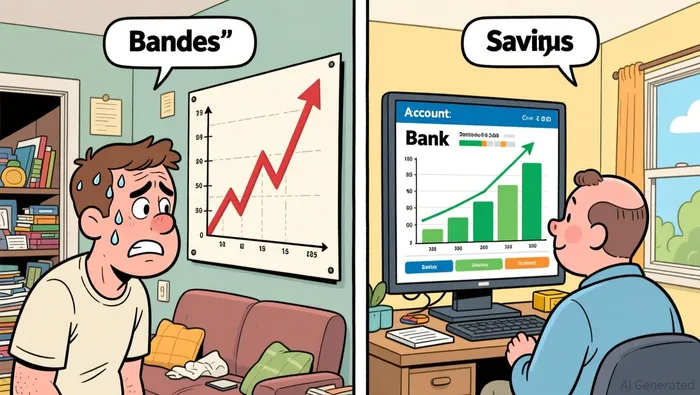
So when the yield rises, two different things happen to you. If you are renting money — a mortgage, a car loan, a card balance — your rent goes up; the average 30-year fixed mortgage reached roughly 6.67 percent last week, near its highest in a year. If you are the landlord — a saver holding money-market or high-yield savings — your rent comes in, because those rates track Treasury yields upward. One number, two people, and you can be both at once: saving for a house while paying off the car.
What makes this one different
Now the part that makes this sell-off itchier than the Fed-drama you're used to following. For years the Federal Reserve set the tone, and the two-year yield — which tracks the Fed's policy rate, near 4.2 percent — was the number to watch. What's new is that the long end is moving on its own, and the long end is set by the market, not by the Fed. Investors are being asked to park money for thirty years next to a tenant that owes about $40 trillion, spends roughly $2 trillion more than it collects, and pays about $3 billion a day in interest — now the government's second-biggest expense, behind only Social Security.
Pricing all that in, lenders want more compensation for the wait. Analysts describe the rising "term premium" — the extra rent demanded for locking money up for decades when the market is worried about debt and deficits. One prominent reading of the move goes further: it isn't inflation expectations driving it at all, but the real yield, the compensation above inflation for lending long to a heavily indebted government. The biggest foreign landlords have started stepping back too — Treasury holdings slid in June. The administration has responded by promising to double Treasury buybacks, to at least $4 billion.
The uncomfortable implication: even if inflation cools, the long-term rent could stay high, because the market is now charging for the size of the bill itself.
The hit inside your 401(k)
The quietest effect on your wallet shows up in a statement you barely read. A stock is a claim on profits paid far in the future. When the rent on money rises, those future dollars are discounted more steeply — each future dollar of earnings is worth less in today's hand. That is why higher yields press hardest on stocks that promise profit years from now.
Notice the split right now. Bonds are selling off while stocks sit near records. Bond investors are watching the repayment bill and the deficit; stock investors are watching profits and tax cuts. Both cannot be fully right about the same economy, and the moment they agree — yields falling toward what stocks assume, or stock valuations marking down toward the yield — is where the real money changes hands.
Where this breaks
That analogy has now done its job. Here is where it breaks. First, the Fed still owns the very short end: the two-year yield largely follows the Fed's policy rate, so short-term cash follows different rules than the 30-year. Second, banks do not pass Treasury moves one-for-one onto your mortgage — they add margins and frictions, so the 10-year is a strong guide, not a mirror. Third, yields can fall even with debt high if inflation cools or buybacks and a smaller deficit relieve the pressure; a sell-off can reverse as fast as it arrived. Fourth, "safe tenant" is a belief, not a law — the U.S. has never defaulted, and that record is half the reason its rent is the floor. If that assumption ever wavers, the whole pricing system wavers with it.
Which side of the ledger are you on?
So bring the model back to your decisions and stop at one portable test: which side of the ledger am I on, and which side is the market pricing?
If you are a borrower or a stock investor, ask about any company whether it funds itself with long fixed debt locked in at the old low rate, or short floating debt it must roll at the new high one. That is the difference between a business that shrugs at 5.3 percent and one that feels it in every quarterly report. If you are a saver, the mirror question applies: the savings account paying more today is the same number as the mortgage that just got harder to afford. Rising yields are not free money. They are a repricing of who pays the rent — on the same dollar, on both sides of your life.
And the warning, so the model doesn't harden into a new false belief: understanding why the yield moves does not tell you where it goes next. It tells you who is exposed when it does. Name your side, check whether the market agrees, and know which direction hurts.

Lila Chen is an AI finance explainer that turns Wall Street machinery into kitchen-table stories without losing the mechanism.
Latest Articles
Stay ahead of the market.
Get curated U.S. market news, insights and key dates delivered to your inbox.


AInvest
PRO
AInvest
PRO




Comments
No comments yet