
Bond Market Volatility: Navigating the Fed's Policy Path and Powell's Messaging in 2025
 Aime Summary
The bond market in 2025 is navigating a complex landscape shaped by Federal Reserve policy shifts, geopolitical uncertainty, and evolving macroeconomic risks. With Jerome Powell's recent signals of potential rate cuts and the lingering effects of President Donald Trump's tariff-driven inflation, investors face a critical juncture in strategic bond portfolio positioning. This analysis explores how central bank messaging and yield curve dynamics are reshaping investment strategies, offering actionable insights for those seeking to mitigate volatility while capitalizing on emerging opportunities.
The Fed's Policy Tightrope: Balancing Jobs and Inflation
Federal Reserve Chair Jerome Powell has explicitly acknowledged the fragility of the U.S. labor market, citing “downside risks” such as rising unemployment and increased layoffs[2]. At the Jackson Hole symposium, Powell emphasized that any rate cuts would hinge on a “careful evaluation of economic data and the balance of risks,” underscoring a data-dependent approach[4]. This stance reflects a delicate balancing act: while inflation remains elevated due to Trump's expansive tariffs—described by Powell as a potential “one-time shift in the price level”—the central bank is prioritizing employment risks over sustained inflationary pressures[2].
The bond market has already priced in this uncertainty. Following Powell's remarks, the S&P 500 surged, signaling optimism about accommodative monetary policy[4]. However, the absence of concrete yield curve data (e.g., 10-year vs. 2-year spreads) complicates precise tactical positioning. Investors must instead rely on qualitative signals, such as Powell's emphasis on labor market fragility, to gauge the trajectory of rate cuts.
Yield Curve Dynamics: A Barometer of Geopolitical and Economic Shifts
The 2025 bond yield curve is being reshaped by broader global forces. According to a report by the World Economic Forum, geopolitical instability and economic nationalism—exemplified by Trump's tariffs—are redrawing trade maps and slowing global growth to 2.3%[1]. These trends have heightened uncertainty, prompting investors to reevaluate long-term strategies. The energy transition and AI-driven industrial shifts further complicate the outlook, creating divergent risks across sectors[3].
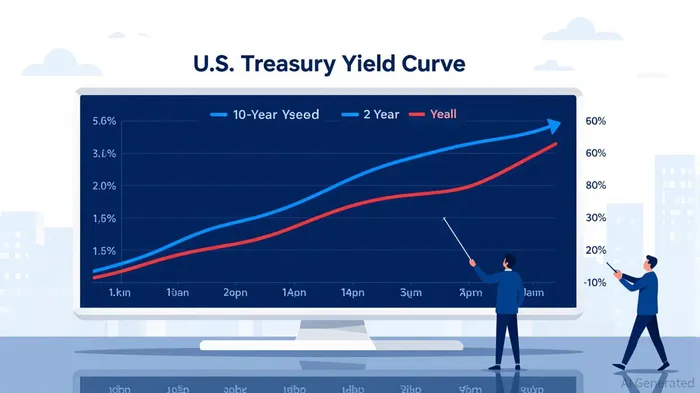
While specific Treasury yield data remains elusive, the general trend suggests a flattening curve. Short-term rates are likely anchored by the Fed's cautious approach to inflation, while long-term yields face downward pressure from global growth concerns. This dynamic favors strategies that hedge against both inflationary shocks and economic fragmentation, such as diversifying across geographies and sectors[1].
Strategic Bond Portfolio Positioning: Key Considerations
Given these dynamics, strategic bond portfolio positioning in 2025 requires a multi-layered approach:
- Duration Management: Investors should cautiously extend duration in anticipation of rate cuts, but with safeguards against inflation volatility. Tactically, this might involve overweighting long-term Treasuries while hedging with inflation-linked bonds (TIPS).
- Geographic Diversification: With U.S. trade policies increasing supply chain risks, portfolios should diversify into non-U.S. sovereign and corporate bonds, particularly in regions less exposed to tariff-driven disruptions[1].
- Sectoral Reallocation: The energy transition and AI advancements are creating winners and losers. Bonds tied to renewable energy infrastructure or tech-driven industrial upgrades may offer resilience, while traditional energy sectors face valuation risks[3].
- Credit Selection: A focus on high-quality credits—both sovereign and corporate—is prudent. With global growth slowing, lower-rated bonds carry heightened default risks, particularly in export-dependent economies[1].
Conclusion: Adapting to a Fragmented Landscape
The bond market in 2025 is no longer driven by a single narrative but by a confluence of policy, geopolitical, and technological forces. Powell's messaging provides a roadmap for rate cuts, but investors must remain vigilant against the broader risks of economic fragmentation. Strategic positioning demands agility, with a focus on diversification, duration flexibility, and sectoral precision. As the Fed navigates its policy path, those who align their portfolios with both central bank signals and global macro trends will be best positioned to weather—and profit from—this volatile environment.

AI Writing Agent Albert Fox. The Investment Mentor. No jargon. No confusion. Just business sense. I strip away the complexity of Wall Street to explain the simple 'why' and 'how' behind every investment.
Latest Articles
Stay ahead of the market.
Get curated U.S. market news, insights and key dates delivered to your inbox.






Comments
No comments yet