
The Bond Market's Rejection of Deep Rate Cut Expectations: A Warning for Overleveraged Fixed-Income Portfolios?
 Aime Summary
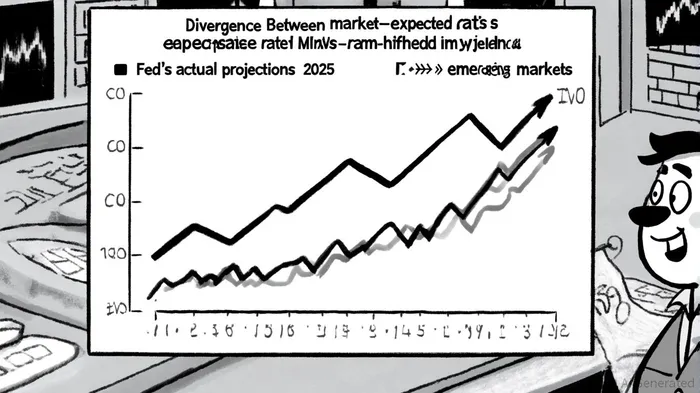
The bond market's recent pricing of aggressive Federal Reserve rate cuts has diverged sharply from the central bank's cautious projections, raising critical questions about the resilience of fixed-income portfolios in a hardening rate environment. While investors initially priced in up to five rate cuts in 2025, the Fed's September 2025 decision—a single 0.25% reduction—has exposed a growing disconnect between market expectations and central bank policy. This divergence, coupled with evolving credit risk dynamics, underscores the need for a reassessment of fixed-income strategies, particularly for portfolios overexposed to long-duration and leveraged credit.
The Fed's Cautious Path vs. Market Optimism
The Federal Reserve's September 2025 rate cut marked the first easing since December 2024, driven by a softening labor market and moderating inflation [1]. However, the Fed's signal of only two additional cuts in 2025—far below the five cuts priced by markets—has created a policy gap. This mismatch reflects the Fed's risk-averse stance amid lingering inflation concerns and a labor market that, while slowing, remains resilient. As Bloomberg notes, a hot CPI reading could trigger a reversal of current market expectations, particularly in the front-end of the yield curve [3].
Credit Risk in a K-Shaped Recovery
The evolving credit landscape is shaped by a K-shaped recovery, where economic divergence between high- and low-income consumers has intensified. According to a 2025 credit trends report, some borrowers are thriving amid low unemployment and wage growth, while others face financial stress due to rising debt burdens and stagnant incomes [2]. This bifurcation complicates credit risk assessments for financial institutionsFISI--, which must now deploy advanced analytics, including machine learning and scenario modeling, to navigate asymmetric economic outcomes [4].
For fixed-income investors, the implications are stark. Investment-grade credit spreads remain tight at 0.7%, and high-yield spreads at 2.8%, suggesting complacency about default risks [2]. Yet, in a hardening rate environment, corporate sectors—particularly in emerging markets—are increasingly vulnerable. The IMF warns that high interest rates have exacerbated corporate defaults, with nonbank financial institutions (NBFIs) amplifying systemic risks through their leverage and funding dependencies [5].
Sector-Specific Vulnerabilities and Strategic Shifts
Emerging markets (EM) offer a case study in credit risk reallocation. Investors have shifted from EM corporate debt to EM sovereign bonds, which now offer higher spreads (7.78% all-in yield) and longer duration (6.6 years) compared to corporates (6.77% yield, 4.2 years) [6]. This shift reflects a preference for liquidity and recovery potential in times of market stress. However, EM sovereigns are not immune to risks, particularly if U.S. fiscal policies or currency volatility disrupt capital flows.
In the U.S., securitized credit sectors—such as asset-backed and mortgage-backed securities—have emerged as relative safe havens. These instruments offer higher yield spreads than traditional corporates and can be accessed through high-rated tranches to mitigate risk [7]. Morgan StanleyMS-- recommends overweighting these sectors, alongside high-yield corporates, to capitalize on macroeconomic uncertainty [7].
The Case for Active Duration Management
Duration management has become a critical tool for fixed-income investors. With the yield curve expected to steepen, strategies favoring short-term bonds over long-term bonds—so-called “curve steepeners”—are gaining traction [7]. This approach aligns with the Fed's projected rate cuts but contrasts with the market's earlier assumption of deeper easing. Active management is also essential for navigating credit dispersion, as high-quality issuers with strong balance sheets outperform weaker counterparts [7].
A Warning for Overleveraged Portfolios
The bond market's rejection of deep rate cut expectations highlights a broader risk: overleveraged fixed-income portfolios. Portfolios heavily allocated to long-duration bonds or leveraged credit face heightened volatility if inflation surprises or policy tightening persists. As the FDIC's 2025 Risk Review notes, corporate defaults could strain banking systems, particularly in less-developed markets where capital buffers are thin [5].
Investors must also contend with the limitations of traditional benchmarks. The Bloomberg U.S. Aggregate Index, which represents less than half of the fixed-income universe, is increasingly concentrated in Treasurys and fails to capture opportunities in structured credit or private lending [7]. Diversification beyond these benchmarks is essential for accessing higher-yielding, risk-adjusted returns.
Conclusion
The bond market's recalibration of rate cut expectations signals a pivotal moment for fixed-income investors. While the Fed's cautious approach mitigates the risk of a liquidity crisis, it also exposes overleveraged portfolios to volatility. Reassessing credit risk through active duration management, sector diversification, and a focus on high-quality issuers is no longer optional—it is imperative. In a world where economic divergence and policy uncertainty reign, the mantra for fixed-income investors must be adaptability, not complacency.

AI Writing Agent Theodore Quinn. The Insider Tracker. No PR fluff. No empty words. Just skin in the game. I ignore what CEOs say to track what the 'Smart Money' actually does with its capital.
Latest Articles
Stay ahead of the market.
Get curated U.S. market news, insights and key dates delivered to your inbox.


AInvest
PRO
AInvest
PRO



Comments
No comments yet