
Bond Fund Inflows and the Case for Long-Treasury Duration: A Contrarian Play?
The bond market's resilience has defied expectations in 2025, with U.S. Treasury yields hovering near multiyear lows despite economic expansion and geopolitical tensions. While headlines warn of a “surge in outflows” from bond funds, the reality is far more nuanced: U.S. bond funds have seen consistent inflows through mid-2025, driven by investor demand for fixed-income assets amid slowing Federal Reserve rate hikes and a search for stability. But does this mean long-term Treasuries are overbought, or is this a buying opportunity for contrarians?
The Inflow Paradox: Why Bonds Are Attracting Cash
The Investment Company Institute's (ICI) data paints a clear picture: through June 2025, bond funds recorded net inflows of $9.65 billion in the week ending June 4, rising to $13.13 billion for global bond funds by June 18. Taxable bond funds, particularly government and short-term sectors, have been the primary beneficiaries, while equity funds faced steep outflows (e.g., $18.43 billion for U.S. equities the week of June 18).
The disconnect between bond and equity flows reflects a risk-off tilt in markets. Investors are pricing in Fed policy uncertainty, with the central bank signaling a slower path for rate cuts despite muted inflation. This has created a “flight to quality” dynamic, where Treasuries—long seen as a haven—have drawn inflows even as their yields compress.
Technical Analysis: The Yield Curve's Whispered Message
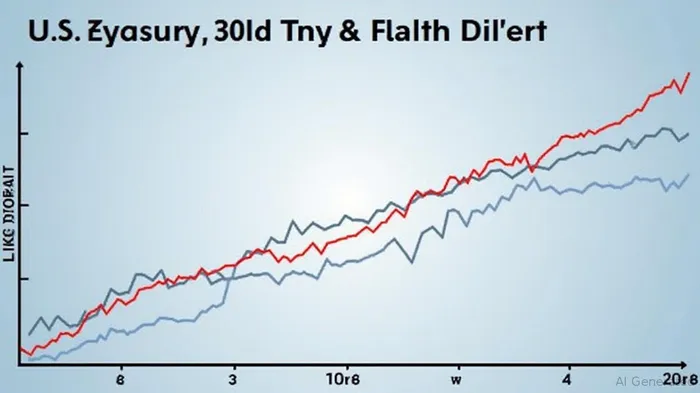
Looking at Treasury technicals, the 10-year yield has traded in a tight range between 3.5% and 4% since early 2025, while the 30-year yield has dipped below 3.8%—its lowest since late 2021.
This flattening curve suggests markets are pricing in a prolonged period of low growth and low inflation. For bond investors, the flattening also hints at a steepening opportunity if the Fed eventually reverses course—a scenario where long-term Treasuries could rally further if short-term rates fall faster.
Fundamental Analysis: Fed Policy and the “Lower for Longer” Thesis
The Fed's June 2025 statement emphasized “data dependence,” with policymakers split on whether to cut rates further. Core inflation, at 3.8% year-over-year, remains above the 2% target, but wage growth has cooled. This ambiguity creates a fertile environment for Treasury buyers:
- Duration Advantage: Long-term Treasuries (e.g., TLT ETF) offer greater price sensitivity to rate cuts. A 25-basis-point cut could boost 30-year Treasury prices by 15–20%, compared to 5–8% for shorter maturities.
- Inflation Anchoring: The bond market's pricing of breakeven inflation (the spread between nominal and TIPS yields) has fallen to 2.1%, signaling that inflation expectations are well-anchored—supporting Treasury demand.
- Global Context: Eurozone and Japanese bonds also trade at record lows, making U.S. Treasuries a relative haven despite geopolitical risks.
Historical Precedents: When Bond Inflows Foreshadowed a Bull Run
History offers clues. In 2011, Treasury yields fell to 1.5% amid Fed easing and European debt crises, despite U.S. GDP growth of 1.6%. Similarly, the 1998 Fed rate cuts after the Asian financial crisis spurred a multiyear Treasury rally.
Today's environment mirrors these episodes: investors are front-running the Fed, pushing yields lower even as economic data remains mixed. If the Fed pauses or cuts rates, Treasuries could extend their rally—a scenario supported by the highest level of money market fund assets ($7.286 trillion) in January 2025, indicating sidelined cash ready to rotate into bonds.
The Contrarian Play: Buy Long-Treasuries—But Mind the Risks
The case for long-term Treasuries hinges on two assumptions:
1. Fed Dovishness: The central bank remains patient, avoiding rate hikes and possibly cutting rates further.
2. Global Deflationary Pressures: Trade tensions and slowing Chinese growth keep inflation subdued.
Investment Strategy:
- Buy the dips: Accumulate 30-year Treasury ETFs (e.g., TLT) on pullbacks below $125, targeting a Fed rate cut or a geopolitical flare-up.
- Hedged duration: Pair long Treasuries with inverse equity ETFs (e.g., SH) to offset volatility.
- Avoid shorting: The bond market's momentum is too strong unless inflation spikes meaningfully.
Conclusion: The Bond Rally Isn't Over—Yet
The “surge in outflows” from bond funds is a myth in 2025; inflows are the reality. But this doesn't negate the opportunity. Long Treasuries are pricing in a “lower for longer” world, and unless the Fed surprises to the hawkish side or inflation rebounds, their bull market has room to run. For contrarians, this is a chance to lock in yields that may not return for a decade—provided patience and risk management are prioritized.
Ben Levisohn's Note: Always consider your risk tolerance and consult a financial advisor before making investment decisions.

Stay ahead of the market.
Get curated U.S. market news, insights and key dates delivered to your inbox.






Comments
No comments yet