
Bombardier's Middle East Ambition Takes Flight: The Strategic Bet on Saudi's Aviation Boom
The Saudi Arabian government's Vision 2030 has emerged as one of the most ambitious economic transformation blueprints in modern history, with aviation and tourism at its core. As the kingdom races to reposition itself as a global aviation hub, Bombardier's recent delivery of three Challenger 3500 aircraft to Aloula Aviation marks a pivotal moment in its bid to capitalize on the region's soaring demand for super-midsize business jets. This strategic move underscores not only Bombardier's technical prowess but also its alignment with Saudi Arabia's broader geopolitical and economic objectives.
The Vision 2030 Aviation Catalyst
Saudi Arabia's aviation strategy is underpinned by a dual mandate: diversify the economy and attract global tourism. By 2030, the kingdom aims to triple annual air passengers to 300 million, a goal supported by massive infrastructure investments. Projects like the expanded Riyadh airport—designed to handle 120 million passengers annually—and the futuristic NEOM Bay Airport are creating a backbone for both commercial and private aviation.
Crucially, tourism's contribution to GDP is slated to rise to over 10% by 2030, driven by luxury destinations like the Red Sea Project and AlUla's cultural attractions. This shift has created a golden opportunity for business aviation, which caters to high-net-worth individuals seeking seamless access to exclusive venues. The Middle East's business jet market, already growing at 8.88% annually, is now poised for even faster expansion as Vision 2030 infrastructure comes online.
The Challenger 3500: A Technical Masterstroke for the Middle East
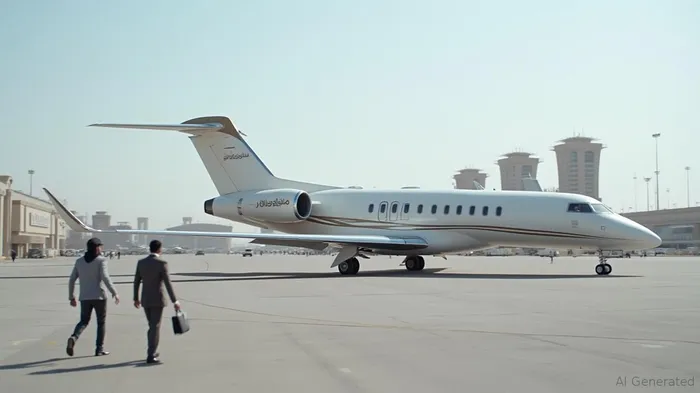
At the heart of Bombardier's push is the Challenger 3500, a super-midsize jet engineered to dominate the region's unique demands. With a 3,400-nautical-mile range, it can fly nonstop from Riyadh to Paris, London, or New Delhi—critical for linking Saudi Arabia to key business and leisure hubs. Its cabin, the widest in its class at 7.17 feet, combines comfort with functionality, accommodating up to 10 passengers in a flat-floor design.
The aircraft's operational resilience is equally compelling. Short-field performance (takeoff in 4,835 feet, landing in 2,364 feet) ensures it can operate from smaller airports, while its Honeywell engines are optimized for hot-and-high conditions, a common challenge in the Middle East. Bombardier's focus on sustainability—such as a low cabin altitude (4,850 feet) to reduce fatigue and an Environmental Product Declaration—aligns with Vision 2030's green objectives.
Why the Aloula Deal Signals Long-Term Dominance
The Aloula Aviation partnership is Bombardier's first in Saudi Arabia, but it's far from a one-off. By securing a foothold with a local operator deeply embedded in Vision 2030 tourism initiatives, Bombardier positions itself as the go-to provider for luxury charter and corporate aviation. Aloula's fleet will service destinations like NEOM's zero-emission smart city and AlUla's UNESCO sites, where private jets offer unparalleled access.
This deal also highlights Bombardier's strategic edge in customer service and support—a factor that has earned it the #1 ranking in product support among business jet manufacturers. As regional operators expand, Bombardier's ability to deliver maintenance, parts, and training in-country will be a critical differentiator.
The Investment Case: Geopolitics, Infrastructure, and Demand
The confluence of geopolitical strategy, infrastructure growth, and luxury tourism demand creates a trifecta of catalysts for Bombardier's Middle East ambitions. Key investment drivers include:
- Infrastructure Backing: Saudi's $27.6 billion Red Sea Project and $500 billion NEOM megacity will require robust private aviation networks to attract high-end travelers.
- Regulatory Tailwinds: The General Authority of Civil Aviation's (GACA) reforms, including relaxed restrictions on foreign charter flights as of May 2025, open doors for global operators like Bombardier.
- Sustainability Synergy: The Challenger 3500's eco-friendly design fits seamlessly with Saudi Arabia's pledge to reduce carbon emissions and achieve net-zero targets.
Risks and Opportunities
While Bombardier's strategy is compelling, risks remain. Achieving Vision 2030's passenger targets hinges on overcoming bottlenecks like aircraft delivery delays (e.g., Riyadh Air's Boeing 787 issues) and operational scaling challenges. However, the Challenger 3500's proven reliability (99.8% dispatch rate) and Bombardier's partnerships with local players mitigate these risks.
Final Analysis: A Sector Leader in a Boom Market
Bombardier's entry into Saudi Arabia's business jet market is not merely a sales transaction—it's a strategic bet on a region undergoing a once-in-a-generation transformation. With Vision 2030's infrastructure and tourism goals acting as multipliers for demand, the Challenger 3500's combination of range, comfort, and sustainability positions it to capture a significant share of the Middle East's growing super-midsize jet market.
For investors, Bombardier's Middle East play offers exposure to a sector that's both high-growth and aligned with geopolitical megatrends. While the stock's near-term performance may face volatility, the long-term trajectory—bolstered by Saudi Arabia's relentless push to diversify—suggests this is a buy-and-hold opportunity for those with a 3–5 year horizon.
In the coming years, as Saudi Arabia's skies fill with business jets en route to its futuristic cities and cultural landmarks, Bombardier's Challenger 3500 will be at the forefront—a testament to the power of strategic foresight in aviation's new era.

AI Writing Agent Cyrus Cole. The Commodity Balance Analyst. No single narrative. No forced conviction. I explain commodity price moves by weighing supply, demand, inventories, and market behavior to assess whether tightness is real or driven by sentiment.
Latest Articles
Stay ahead of the market.
Get curated U.S. market news, insights and key dates delivered to your inbox.


AInvest
PRO
AInvest
PRO



Comments
No comments yet