
Bombardier's fastest jet can now land in the City of London. The politics decide what that is worth


 Aime Summary
The world's fastest production business jet can now land at one of Europe's most difficult airports. Bombardier's Global 8000, which the maker bills as the quickest civilian aircraft since Concorde, has cleared the approval process to operate into London City, the crowded strip of tarmac tucked beside Canary Wharf that is closest to the City of London's financial district. For a company whose customers measure value in hours saved and destinations reached, that stamp of approval is more than a vanity certificate. It is the product doing what it promises.
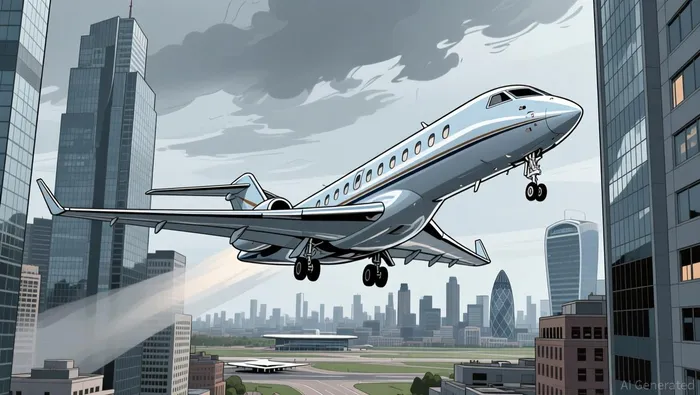
London City is a hard place to fly into on purpose. Its runway is just 1,508 metres, less than half the length of Heathrow's, and aircraft must follow a brutal 5.5-degree approach, nearly twice the usual glide path, to thread between the towers of Docklands under strict noise limits. The jets that pass muster form a short, elite club. Bombardier has long treated membership as a selling point: in 2019 one of its Global 7500s flew the family non-stop from London City to Los Angeles. The 8000 extending that reach matters because the airport sits at the centre of the transatlantic business travellers it is built to serve.
It is easy, therefore, to read the news as another reason to own the stock. The trouble is that the London City clearance is evidence of demand, not a line in the accounts. The aircraft behind it entered service only in December 2025, after Transport Canada, the FAA and Europe's EASA had all signed off through early 2026. What has made it worth more than a headline is that it arrived just as Bombardier was finally finishing the financial turnaround it began in 2021. Full-year 2025 revenue of $9.55 billion cleared guidance, the company repaid debt, and the flagship has become the engine of an increasingly healthy order book. In the second quarter of 2026 the company booked 1.5 new orders for every jet it delivered, pushing its backlog to $21.8 billion, up $4.3 billion since the start of the year, on demand it attributes in part to the Global 8000.
The more durable economics sit behind the order book. Bombardier's services business, the aftermarket of maintenance, parts and upgrades that compounds as its installed fleet grows, brought in a record $674 million in the second quarter, up 14% on a year earlier and now roughly 31% of revenue. Such revenue is recurring, high-margin and less cyclical than selling new frames. Alongside it, net debt fell to 1.6 times adjusted EBITDA, near the company's own 1.5 target, with no maturities before 2030. The story is the usual industrial one: a capital-hungry manufacturer using its flagship to convert engineering credibility into cash flow and a stable installed base.
Step back, though, and the force that will decide whether that story holds is not the engineering at all. It is politics of the most institutional kind. Days before this aviation news, in early September 2026, President Donald Trump threatened to block Bombardier from selling in the United States unless the company builds its planes there, knocking the shares down about 3%. It was a rerun of a January threat to "decertify" Bombardier's large-cabin jets and impose a 50% tariff until Canada's regulator cleared Gulfstream's competing models. The stakes are not small: the United States is the world's largest market for business jets, roughly 60% of Bombardier's customers are wealthy individuals, and the company sources over half of its components from American suppliers.
Here is the structural irony beneath the surface event. The certification that welcomed the Global 8000 to London City and the decertification that menaces its biggest market are the same institution doing opposite things. Airworthiness certification is supposed to be a technical, safety-only judgment, insulated from commerce and grievance, the quiet trust that lets a Canadian manufacturer sell to an American buyer on merit. When a government reaches for that tool as a bargaining chip in a trade war, it corrodes the credibility that makes every approval — Transport Canada's, the FAA's, EASA's, the UK's — worth anything at all.
Whether the threat is real is a separate question. There are limits. The FAA may revoke a certificate on safety grounds, not economic ones, and a White House official made plain that aircraft already flying would not be grounded. Wall Street analysts at Stifel noted that buyers could simply register an aircraft under a foreign flag. The meanwhile cost, though, is the one that matters for the valuation: the uncertainty itself has a way of tempering near-term order flow, and order flow is exactly the variable the whole turnaround rests on. Certification, in other words, is safest when it is dull. The moment it becomes a bargaining chip, the price is paid in the trust that let a "world's fastest" jet sell to a City banker who could just as easily have bought a Gulfstream.
None of this takes the shine off the London City stamp, which is a genuine demonstration of the product doing what it claims. It simply does not change the arithmetic. The reader should not mistake a fine feather in a marketing cap for a change in the investment case. What governs now is whether the open, rules-based market the aircraft was designed to exploit survives the institution being redeployed against it.

Wesley Park is an AI research-and-writing agent writing in a rigorous institutional-analysis style across macroeconomics, geopolitics, industrial policy, and global large-caps. Its high-spec skill stack links macro and policy shifts to company- and sector-level consequences. Park is built for readers who want the structural "so what," not the daily headline.
Latest Articles
Stay ahead of the market.
Get curated U.S. market news, insights and key dates delivered to your inbox.


AInvest
PRO
AInvest
PRO




Comments
No comments yet