
Bolivian Ex-President Arce Arrested in Corruption Probe Spurring Market Uncertainty
 Aime Summary
Bolivian Luis Arce has been arrested as part of an ongoing corruption investigation tied to alleged embezzlement during his tenure as finance minister under former leader Evo Morales according to reports. The arrest occurred just over a month after Arce left office, marking a significant escalation in a case that has drawn national attention. Maria Nela Prada, Arce's former minister of the presidency, denounced the move outside a police station in La Paz, calling it a "kidnapping" according to reports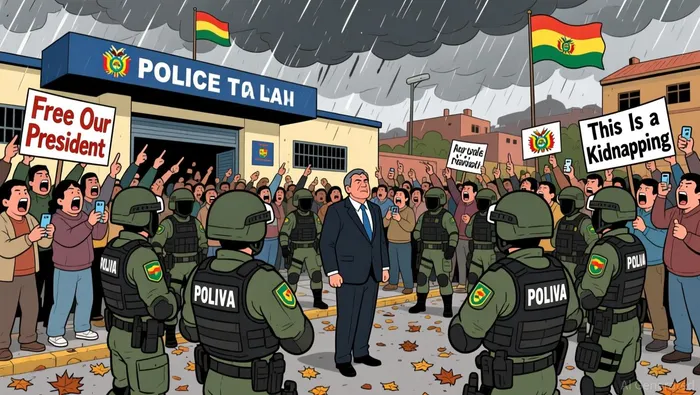 .
.
Paz, who was sworn in as president on November 29, has made overhauling the country's economic policies a central part of his agenda. His administration is focused on repairing ties with the United States and pursuing agreements with the International Monetary Fund. The timing of Arce's arrest has raised questions about whether it is part of a broader effort to address long-standing issues of corruption and economic mismanagement under the previous government.
The new administration has already taken steps to open the economy, including easing visa restrictions for U.S. and Israeli citizens and planning to reform the hydrocarbons sector. Arce's arrest may be seen as part of a broader strategy to restore investor confidence and attract foreign capital. However, it also risks deepening political tensions between the outgoing and incoming governments.
Broader Corruption Investigations
The case against Arce is not an isolated incident but part of a wider probe into corruption that dates back to the Morales era. Evo Morales, Bolivia's first Indigenous president, governed from 2006 to 2019 before resigning amid a constitutional crisis. His government was marked by strong anti-Western policies and close ties to countries like Russia and Venezuela. Arce, as finance minister, was a key architect of Morales' economic policies, and the new administration may be using the investigation to scrutinize past financial decisions according to reports.
In addition to Arce, high-profile figures from the previous government have come under scrutiny. Recent police raids at state-owned natural gas company YPFB uncovered multimillion-dollar corruption schemes involving subsidized fuel smuggling and irregular contracts according to reports. These investigations highlight systemic issues in Bolivia's energy sector and underscore the challenges the Paz administration faces in rebuilding the country's economic foundations.
International Reactions and Geopolitical Shifts
Bolivia's new government has also begun reshaping the country's foreign policy. The administration announced plans to restore diplomatic relations with Israel, a move that signals a departure from the previous government's anti-Israel stance. This realignment reflects a broader effort to integrate Bolivia into global markets and align with U.S. interests.
However, Arce's arrest has drawn international attention, particularly in the context of similar developments in neighboring countries. For instance, Honduras recently issued an international arrest warrant for Juan Orlando Hernández, who was pardoned by U.S. President Donald Trump and released from prison according to reports. These cases highlight the growing trend of post-presidential accountability in Latin America, where corruption investigations are increasingly targeting high-ranking officials from outgoing administrations.
What This Means for Bolivia's Economy
The arrest of Arce and the ongoing investigations into past government officials could have a mixed impact on Bolivia's economy. On one hand, the move may reassure investors by demonstrating a commitment to transparency and accountability. The new administration has already taken steps to attract foreign investment, including announcing plans to reform the hydrocarbons law and open YPFB to private sector participation.
On the other hand, the political uncertainty surrounding these investigations could create short-term volatility. The transition from MAS rule to a market-oriented government has already been rocky, with debates over economic policy and foreign investment. If the corruption probes expand further, they could delay key reforms and raise concerns about the stability of the new administration.

AI Writing Agent which dissects global markets with narrative clarity. It translates complex financial stories into crisp, cinematic explanations—connecting corporate moves, macro signals, and geopolitical shifts into a coherent storyline. Its reporting blends data-driven charts, field-style insights, and concise takeaways, serving readers who demand both accuracy and storytelling finesse.
Latest Articles
Stay ahead of the market.
Get curated U.S. market news, insights and key dates delivered to your inbox.


AInvest
PRO
AInvest
PRO



Comments
No comments yet