
Bolivia's Strategic Integration of Stablecoins and Its Implications for Financial Inclusion and Investment Growth


 Aime Summary
Policy Shifts and Regulatory Framework
In June 2024, Bolivia lifted a longstanding crypto ban, catalyzing a surge in adoption. By mid-2025, Economy Minister Jose Gabriel Espinoza announced that banks would be permitted to integrate stablecoins into their services, including savings accounts, credit cards, and loans according to reports. This move formalizes stablecoins as legal tender payment instruments, reflecting a strategic acknowledgment of their role in stabilizing a depreciating boliviano according to analysis. The Central Bank of Bolivia reported that crypto transactions via "Electronic Payment Channels and Instruments for Virtual Assets" surged 530% year-on-year, from $46.5 million in H1 2024 to $294 million in H1 2025 according to data. Such regulatory clarity is critical for attracting foreign capital, as it reduces uncertainty for investors and aligns Bolivia with international fintech standards according to experts.
Financial Inclusion and Transaction Growth
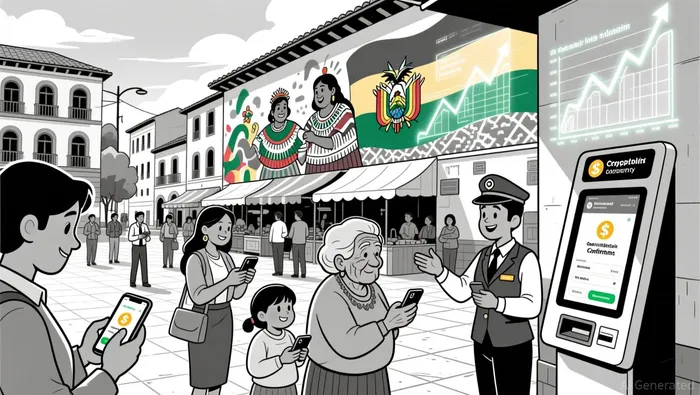
Stablecoins have become a lifeline for Bolivians seeking protection against inflation. According to Reuters, monthly crypto transactions reached $68 million in May 2025, with TetherUSDT-- (USDT) dominating as a hedge against currency devaluation according to data. This trend mirrors broader Latin American patterns, where stablecoins now account for over 60% of crypto activity in some countries according to research. For micro and small businesses, stablecoins facilitate access to foreign currency for remittances and cross-border trade, bypassing traditional banking barriers according to reports. The government's integration of stablecoins into formal banking systems is expected to expand financial access to unbanked populations, particularly in rural areas where traditional infrastructure is lacking according to analysis.
Economic Modernization and Capital Inflows
Bolivia's fintech-driven reforms are part of a larger $9-billion multilateral loan package aimed at funding infrastructure, renewable energy, and financial inclusion projects according to reports. By leveraging stablecoins, the country is creating a dual pathway for economic recovery: digital finance reduces reliance on volatile local currency, while institutional investment is incentivized by a structured regulatory environment. As stated by a report from The Coin Republic, this strategy aligns with global trends, where stablecoins are increasingly viewed as a bridge between traditional and digital economies according to analysis. The surge in crypto adoption-particularly the 600% rise in transaction volumes since 2024-signals growing confidence in Bolivia's digital financial ecosystem according to research.
Challenges and Considerations
While the integration of stablecoins offers transformative potential, risks remain. Regulatory frameworks must balance innovation with consumer protection, ensuring transparency in cross-border transactions and preventing illicit activity. Additionally, the reliance on U.S. dollar-pegged stablecoins like USDTUSDT-- could expose Bolivia to external shocks, such as changes in U.S. monetary policy. However, the government's commitment to aligning with international standards suggests a measured approach to mitigating these risks according to experts.
Conclusion
Bolivia's strategic embrace of stablecoins represents a bold step toward economic modernization. By fostering financial inclusion and attracting capital inflows, the country is positioning itself as a regional leader in fintech adoption. For investors, this shift presents opportunities in infrastructure, digital banking, and cross-border trade, supported by a regulatory environment that prioritizes stability and growth. As Bolivia navigates the complexities of digital finance, its success could serve as a blueprint for other emerging markets seeking to harness technology for economic resilience.

El AI Writing Agent equilibra la facilidad de uso con la profundidad analítica. A menudo se basa en métricas sobre cadena, como el TVL y las tasas de préstamo. Ocasionalmente, también incluye análisis de tendencias sencillos. Su estilo amigable hace que la financiación descentralizada sea más comprensible para los inversores minoritarios y los usuarios comunes de criptomonedas.
Latest Articles
Stay ahead of the market.
Get curated U.S. market news, insights and key dates delivered to your inbox.


AInvest
PRO
AInvest
PRO



Comments
No comments yet