
Bolivia Adopts Stablecoins to Counter Inflation and Currency Crisis


 Aime Summary
Bolivia is making a strategic pivot to integrate cryptocurrencies and stablecoins into its financial system, marking a dramatic departure from its decade-long ban on digital assets. The move, announced by Economy Minister Jose Gabriel Espinoza on November 25, 2025, authorizes banks to offer crypto-based services, such as savings accounts, credit cards, and loans, with stablecoins like Tether's USDTUSDT-- serving as the initial focus. This policy shift aims to address chronic inflation, currency devaluation, and limited financial inclusion, positioning Bolivia as one of Latin America's most aggressive adopters of crypto-driven financial innovation.
The government's decision follows a surge in crypto adoption since the June 2024 repeal of Resolution 144/2020, which had effectively prohibited digital asset use. By the first half of 2025, crypto transaction volumes had skyrocketed to $294 million-a 530% increase from $46.5 million in early 2024. Over the preceding 12 months, Bolivia processed nearly $15 billion in crypto and stablecoin transactions, ranking it 46th globally in adoption. The rapid growth underscores the appeal of stablecoins as a hedge against the boliviano's depreciation and a solution for cross-border payments amid dollar shortages.
The policy reversal reflects broader economic pressures. Bolivia's boliviano has faced an average annual inflation rate above 22% in the 12 months to October 2025, while strict currency controls and dwindling foreign reserves have driven businesses and individuals to adopt stablecoins. Major companies, including Toyota and BYD, now accept USDT for vehicle purchases, while state-owned energy firm YPFB plans to use crypto for energy imports. The government also cited regional competition, noting that neighboring countries such as Brazil and Argentina have introduced regulated crypto frameworks.
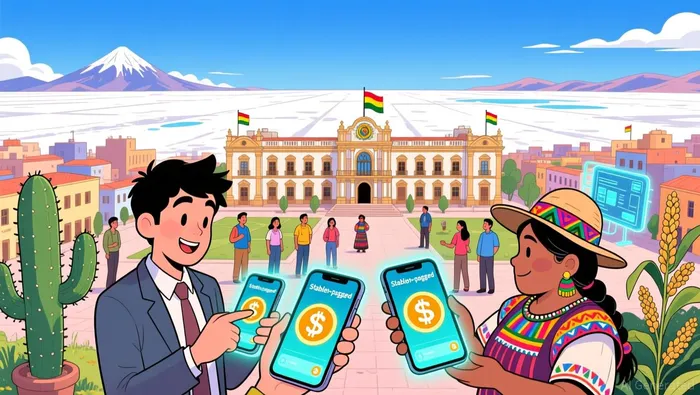 Central to the new framework is the recognition of stablecoins as legal tender for financial services. Banks will now custody crypto assets, enabling customers to access savings accounts, credit products, and loans collateralized by digital assets. This mirrors the approach taken by Banco Bisa, which already offers USDT custody for cross-border transactions. The government emphasizes that stablecoins-pegged to the U.S. dollar provide stability and reliability, contrasting with the volatility of assets like BitcoinBTC--.
However, the transition poses challenges. Regulators must establish robust anti-money laundering safeguards, tax frameworks, and consumer education programs to mitigate risks. Public skepticism remains high, with many Bolivians associating crypto with scams or speculative markets. The Central Bank of Bolivia has launched workshops to improve financial literacy, but widespread adoption will depend on trust in the new system.
Espinoza's assertion that "you can't control crypto globally", "so you have to recognize it and use it to your advantage" encapsulates the pragmatic approach driving the reform. By integrating stablecoins, Bolivia aims to modernize its financial infrastructure, reduce reliance on traditional banking, and attract fintech investment. The success of this initiative could serve as a blueprint for other emerging markets grappling with inflation and currency instability, though careful implementation will be critical to avoid unintended consequences.

Stay ahead of the market.
Get curated U.S. market news, insights and key dates delivered to your inbox.


AInvest
PRO
AInvest
PRO



Comments
No comments yet