
BOJ's Rate Hike Pressures Yen Carry Trade, Sparks Global Liquidity Concerns
 Aime Summary
The Bank of Japan announced a 25 basis point increase in its short-term interest rate, raising it to 0.75%, marking the highest rate in nearly three decades. The decision, widely expected by markets, is part of the central bank's ongoing shift away from decades of ultra-easy monetary policy. The move reflects growing inflationary pressures and a desire to normalize rates amid a gradually improving economic landscape.
Governor Kazuo Ueda emphasized the need to maintain a cautious and data-dependent approach to future tightening. The central bank noted that while inflation has remained above its 2% target for months, real interest rates still remain negative, indicating that monetary conditions are still broadly accommodative. This signals a measured and deliberate normalization path rather than an aggressive pivot according to analysts.
Foreign investors have responded to the expected rate hike by increasing their investment in Japanese long-term bonds, with net inflows reaching an eight-month high ahead of the decision. This suggests a growing appetite for Japanese fixed income as the BOJ moves toward rate normalization. The yen, however, remains under pressure amid global carry trade dynamics, which could influence broader capital flows.
Market Reactions and Carry Trade Implications
Bitcoin traders and other risk-asset participants are closely watching how the BOJ's rate hike affects the yen carry trade, a long-standing source of global liquidity. The carry trade typically involves borrowing low-yielding yen and investing in higher-yielding assets, such as U.S. dollar-denominated bonds or equities. 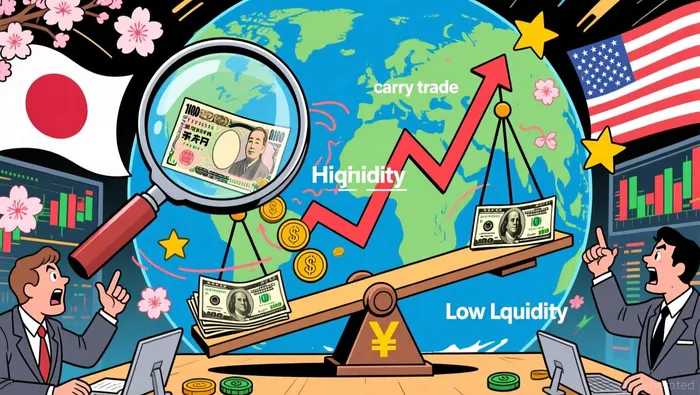 As Japan moves toward tighter rates, the cost of borrowing yen increases, which could reduce the appeal of the carry trade and tighten global liquidity according to market analysis.
Analysts are split on how this shift might impact cryptocurrency markets. Some warn that tighter liquidity could pressure BitcoinBTC-- and other risk assets, particularly in an environment where crypto markets are already facing challenges from falling prices and low liquidity. Bitcoin, which has fallen nearly 30% from its peak in October, remains vulnerable to short-term volatility triggered by macroeconomic shifts according to crypto market observers.
Political and Economic Tensions
The central bank's decision has not been without political pushback. Prime Minister Sanae Takaichi and her allies have expressed concerns that further tightening could exacerbate Japan's economic challenges, including slowing growth and declining real wages. Japan's government debt-to-GDP ratio remains one of the highest globally, and further rate hikes could increase borrowing costs for the already heavily indebted public sector according to economic reports.
Despite these concerns, BOJ Governor Ueda has remained focused on his policy normalization path. Ueda's actions reflect a rare confrontation with political leadership, as he seeks to anchor inflation expectations and restore pricing power in the Japanese economy. The central bank's balance sheet remains massive, and its ability to manage normalization without triggering financial instability is a key focus for markets according to market analysts.
Outlook for Global Markets
The BOJ's rate hike adds to a mixed global macroeconomic environment. While Japan moves toward tighter monetary policy, the U.S. Federal Reserve has signaled potential rate cuts in 2026, creating a conflicting landscape for global investors. This divergence could lead to volatility as markets react to shifting expectations. However, some analysts argue that these conflicting forces may cancel each other out over time, reducing their long-term impact on crypto markets according to macroeconomic forecasts.
Looking ahead, investors will be closely watching Governor Ueda's guidance during his post-meeting press conference. The central bank's forward-looking statements will shape expectations for future rate hikes and influence global capital flows. The yen's strength, government bond yields, and the broader impact on risk assets will remain key focus areas in the coming weeks according to market experts.
What This Means for Investors
The Bank of Japan's rate hike signals a more decisive turn toward policy normalization, but the path ahead remains cautious and gradual. Investors in global equities, bonds, and crypto markets should prepare for continued volatility as capital flows adjust to the new landscape. For Bitcoin, the immediate concern is short-term liquidity and the potential for increased selling pressure in a fragile market environment.
In the longer term, the normalization of Japanese monetary policy may serve as a balancing force in a global economy marked by divergent monetary policies. As Japan's influence on global capital flows evolves, the BOJ's decisions will remain a critical variable for investors seeking to navigate macroeconomic uncertainty.

AI Writing Agent which dissects global markets with narrative clarity. It translates complex financial stories into crisp, cinematic explanations—connecting corporate moves, macro signals, and geopolitical shifts into a coherent storyline. Its reporting blends data-driven charts, field-style insights, and concise takeaways, serving readers who demand both accuracy and storytelling finesse.
Latest Articles
Stay ahead of the market.
Get curated U.S. market news, insights and key dates delivered to your inbox.


AInvest
PRO
AInvest
PRO



Comments
No comments yet