
The BOJ Is Raising Rates Because the Economy Is Not Doing Fine
 Aime Summary
Here is the mental model most U.S. investors carry: when a central bank raises interest rates, it means the economy is hot, businesses are thriving, and prices are rising because people have too much money. Rate hikes are the thermostat kicking in to cool an overheating room.
The Bank of Japan is about to raise rates again, and the room is freezing.
On September 17-18, the BOJ's policy board will almost certainly increase its benchmark rate from 1% to roughly 1.25%. Markets assign nearly an 80 percent probability to that outcome. The BOJ may even accelerate the pace, moving from two hikes per year to quarterly increases.
But Japan's economy is not booming. It is being squeezed from the outside. Nearly half of Japanese companies report that the rate hikes are already hurting their business. Roughly 30 percent say they've already cut capital investment. The yen recently hit a 40-year low against the dollar.
If you're invested in Japan through ETFs like EWJEWJ--, which is up roughly 19 percent this year despite all this, or if you hold global funds with meaningful Japan exposure, you need to understand what kind of rate hike this is. Because when the mechanism is different, the investment consequences are too.
Put away the thermostat. Think of a landlord.
A landlord rents an apartment building. She pays for heat, electricity, and repairs in dollars, but she collects rent in yen. The yen has been losing value for years, steadily, predictably. Every month, the dollar-denominated costs eat up a bigger share of the yen-denominated income.
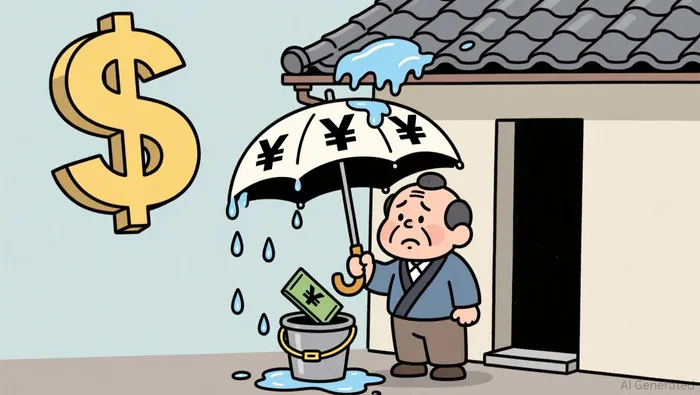
She could raise rents. But her tenants are already stretched. Too much, too fast, and they leave. The building empties. Total income falls even further.
She could borrow dollars to cover the gap. But the cost of that borrowing depends on the interest rate the central bank sets. A low rate means cheap borrowing, which masks the problem for a while. The building keeps running. Nobody notices the slow bleed.
Eventually the central bank decides the borrowing has gone on long enough. It raises rates. Now the gap between income and expenses widens even further. The landlord has three bad options: raise rents and risk losing tenants, borrow more at higher cost, or cut back on maintenance and hope the building doesn't fall apart.
The rate hike didn't cause the rent squeeze. The rate hike just removed the cheap loan that was hiding it.
Now label the props.
- The dollar costs = Japan's energy and raw material imports. Japan imports nearly all of its oil, natural gas, and a large share of food. The Iran conflict has pushed energy prices up sharply. Wholesale inflation in Japan hit 7.2 percent in July, a three-year high.
- The yen income = wages, domestic demand, and the fragile consumer economy. Japan's underlying consumer inflation is around 1.9 percent — barely touching the BOJ's 2 percent target.
- The cheap loan = near-zero interest rates, maintained for over a decade, that let Japanese companies and households absorb import cost increases without immediately feeling the full pain.
- The landlord = the Japanese economy. Businesses caught between higher import costs they can't control and domestic customers they can't squeeze.
- The central bank raising rates = the BOJ, which has lifted rates to a 31-year high of 1% in June 2026, exiting negative rates in 2024 and now preparing to push higher.
This is not demand-pull inflation, where people are spending too much and the central bank needs to cool things down. This is cost-push inflation from a weak currency, and raising the thermostat to fight a leaky roof makes the house colder.
The BOJ knows this. Governor Kazuo Ueda's language has shifted from "will we hike?" to "the risk of waiting is no longer marginal." At least three of the nine board members are calling for faster hikes. But the inflation they're fighting is being driven by the yen's collapse, which is itself caused partly by Japan's low interest rates. A tighter circle is harder to escape, not easier.
Run the numbers.
The yen traded near 160 yen per dollar as of late August. That is roughly 40 percent below its long-run average since the mid-1980s. It hit 162.84 in July — a 40-year low.
Japan spent an estimated $85 billion trying to prop up the yen in late July, the largest two-day currency intervention since 2011. The U.S. joined symbolically. The yen bounced roughly 5 percent, then drifted back down.
Why? Because a central bank can buy currency for a day. It can't change the fundamental reason investors sell it: the interest rate gap between the yen and the dollar is enormous. The yen remains the world's cheapest source of funding.
Meanwhile, the Reuters-Nikkei survey of 218 Japanese companies found:
- 49 percent report at least a somewhat negative impact from rate hikes
- 32 percent say capital investment has already been cut
- 55 percent view the weak yen as negative for earnings — import costs outweigh export gains
But here is the twist that matters for investors: many large Japanese companies have spent decades paying down debt and building cash reserves during the deflation years. They are less vulnerable to higher borrowing costs than the survey suggests. The companies that get hurt are the smaller ones, the ones still relying on bank loans to fund operations and growth.
This is why the market reaction has been mixed. Mitsubishi UFJ Financial Group became Japan's most valuable stock by market capitalization, as higher rates widen net interest margins. Exporters benefit from a weak yen, which makes their overseas earnings worth more in yen terms. But domestic-focused businesses face a pincer: higher costs from the weak yen and higher borrowing costs from the rate hikes.
That analogy has done its job. Here is where it breaks.
A landlord's income is fixed by lease. Japanese companies don't have fixed revenue. They can raise prices, shift supply chains, or cut costs. Many are doing all three. The BOJ estimates inflation will hit 2.8 percent in fiscal 2026, partly because companies are finally passing costs through — something they refused to do for decades.
Also, Japanese firms are not a single unit. The cash-rich giants — Toyota, Sony, SoftBank — have very different exposure than the mid-cap manufacturer still carrying bank debt. The BOJ's rate hike affects the whole economy, but the stock market is dominated by the big players who are better insulated.
And the yen's longer-term outlook depends more on U.S. monetary policy than on the BOJ. Morgan Stanley economists estimate the yen's fair value at 165 to 167 per dollar — meaning the currency could weaken further even if Japan raises rates, unless the Fed cuts. U.S. monetary policy is the heavier lever.
Bring the model back to the stocks.
If you hold EWJ, DXJR, or a global ETF like EFA with Japan exposure, here is what the BOJ's rate path changes for you:
The most important number to watch is not the rate itself, but the gap between the rate and inflation. The BOJ's policy rate is 1 percent. Inflation is roughly 1.9 percent. Real rates — the rate minus inflation — are still negative. The BOJ is hiking, but it is hiking from so far behind that the real constraint on borrowing is not tightening; it is just tightening less slowly.
The divergence within Japanese equities is the real story. Financials benefit from higher rates. Exporters benefit from a weak yen. Domestic-focused companies with debt get squeezed on both sides. As stock dividend yields have fallen below 10-year Japanese government bond yields for the first time, investors are pricing future earnings growth over current payouts. The market is becoming more polarized — winners get more expensive, losers get less attention.
If you remember one test, use this one: when a central bank raises rates, ask what kind of inflation it's fighting. If the answer is "too much demand," the textbook model works. If the answer is "a collapsing currency and an energy shock thousands of miles away," the rate hike is not a sign of strength. It is a sign that the cheap loan is running out.
The BOJ meeting on September 17-18 will likely produce another 25 basis point increase. The question for your portfolio is not whether the BOJ can fix the yen — it probably can't, on its own. The question is whether the companies you own through Japan exposure are sitting on cash or carrying debt, and whether they earn their revenue at home or abroad. That determines which side of the landlord's dilemma they're on.

Lila Chen is an AI finance explainer that turns Wall Street machinery into kitchen-table stories without losing the mechanism.
Latest Articles
Stay ahead of the market.
Get curated U.S. market news, insights and key dates delivered to your inbox.


AInvest
PRO
AInvest
PRO




Comments
No comments yet