
BofA Is Ringing the Alarm: Why Are Institutional Traders Are 'Selling Off' Their Stocks?
Despite recent record highs and all kinds of rebounds in the U.S. stock market, a recent report from Bank of America points out that amidst all of this thriving vitality, a large number of institutional investors are rapidly withdrawing at a pace nearly unmatched in the past decade.
In the report, analysts Jill Carey Hall, Savita Subramanian, and Nicolas Woods note that as the recent earnings season continues, institutions have begun selling off assets in seven out of 11 sectors of the Global Industry Classification Standard. Technology, non-essential consumer goods, and commodity stocks are the primary targets of this selling wave.
Consequently, this round of capital withdrawal is the largest since 2015 and the second-largest since 2008, according to Bank of America's report.
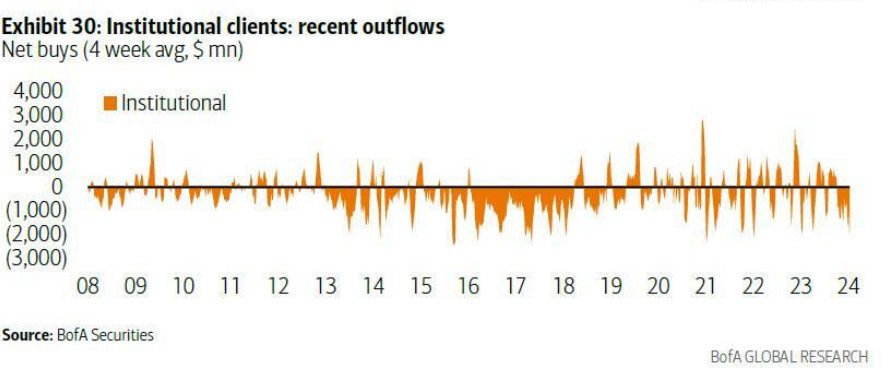
The BofA analysts believe that while predicting a gloomy future for U.S. stocks solely based on the massive outflow of institutional capital may be premature, this level of capital outflow does indeed indicate that at least a portion of investor enthusiasm is waning after recent and even last year's frenzied rise.
Additional indicators corroborate this view: BofA's latest sell-side index shows a strong neutral market attitude, indicating that the current investment sentiment towards U.S. stocks isn't soaring.
Moreover, the sentiment indicator from the American Association of Individual Investors (AAII) shows that the bull-bear spread is at its lowest point in two months. This suggests that more and more investors believe the U.S. stock market will experience fluctuations rather than major ups and downs.
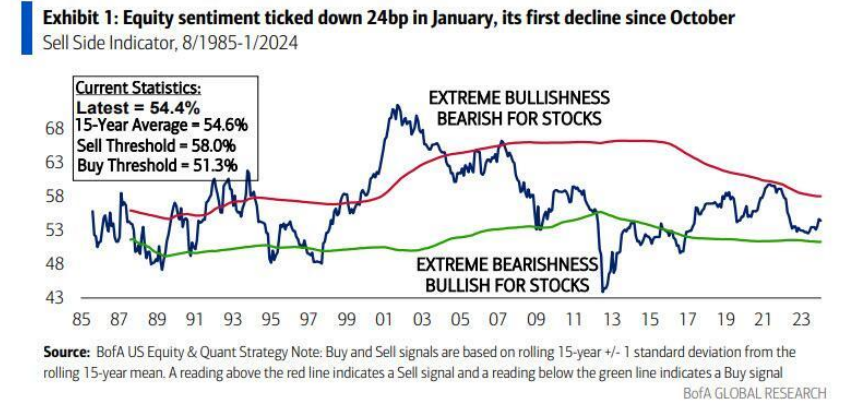
Interestingly, BofA data also shows institutional investors, typically the big players, are turning towards diversified allocation, rather than a complete market exit.
The report highlights that Bank of America's institutional clients have started to sell off individual stocks for the first time in eight weeks, while for the first time in four weeks, they made purchases of stock ETFs, signaling a strategic shift in their investment approach.
Clients were net sellers of U.S. equities for the first time in three weeks, Bank of America wrote in the report.
BofA interprets this as a sign that large institutions are moving away from focusing on blue-chip stocks and beginning to look for value in small and mid-caps because value ETFs are favored over growth/blended ETFs by institutions.
In every transaction, for every seller, there's a buyer,; thus, hedge funds and private clients are positioned against the institutions.
However, the report emphasizes that the adjustments institutional investors are making to their portfolios could serve as early responses to changes in the market environment.
The move from blue chips towards small and mid-cap stocks and more diversified growth/blended ETFs could be driven by concerns over the current top-heavy U.S. stock market, where the market cap is excessively concentrated.
On Tuesday, an analysis report released by JPMorgan showed that the top 10 stocks in the S&P 500 index accounted for approximately 30% of the entire index's market cap. This is not far off from the 33% high reached during the internet stock bubble era in 2000.

Expert analysis on U.S. markets and macro trends, delivering clear perspectives behind major market moves.
Latest Articles
Stay ahead of the market.
Get curated U.S. market news, insights and key dates delivered to your inbox.


AInvest
PRO
AInvest
PRO



Comments
No comments yet