
Boeing's Strategic Turnaround: Can the 737 MAX Order Signal a Sustainable Recovery?


 Aime Summary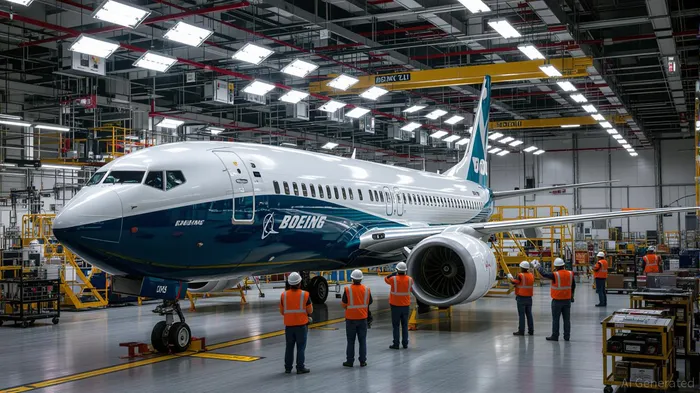
The recent 30-aircraft order for Boeing's 737 MAX from Macquarie AirFinance, the aircraft leasing arm of Australia's Macquarie Group, has reignited discussions about Boeing's operational resilience and its ability to capitalize on long-term demand in commercial aviation. This deal, which expands Macquarie AirFinance's 737 MAX order book to 70 aircraft, underscores a critical shift in market sentiment. For investors, the question is no longer whether BoeingBA-- can recover from its post-2019 grounding crisis but how it will sustain its momentum in a competitive landscape dominated by Airbus's A320neo family.
Operational Resilience: A New Benchmark for Boeing
The 737 MAX order reflects renewed confidence in Boeing's production capabilities. Deliveries for the 70-aircraft order are scheduled through 2032, a timeline that aligns with Boeing's stated goal of scaling up production to 52 aircraft per month by 2030. This long-term delivery schedule is a testament to Boeing's ability to stabilize its supply chain and address quality control issues that plagued the program in recent years.
Key to this recovery is Boeing's strategic realignment, including the acquisition of Spirit AeroSystemsSPR--, a major supplier of 737 MAX fuselages. This move has reduced bottlenecks in critical components and provided greater control over production timelines. Additionally, Boeing's adoption of real-time data analytics for inventory management has mitigated the “bullwhip effect” in its supply chain, ensuring smoother operations.
Financial metrics further support this narrative. Boeing's stock has surged 32.12% year-to-date in 2025, reflecting investor optimism. The company's cash reserves of $23 billion and a 63% reduction in second-quarter losses compared to 2024 signal improved fiscal discipline. Analysts project adjusted earnings per share (EPS) to reach $11.92 by 2029, driven by the 737 MAX's dominance in the single-aisle market.
Long-Term Demand: The 737 MAX as a Fleet Modernization Engine
The 737 MAX's 20% reduction in fuel use and carbon emissions compared to older models positions it as a linchpin for global fleet modernization. Boeing's 2025 Commercial Market Outlook forecasts a need for 33,000 new single-aisle aircraft over the next two decades, with the 737 MAX family expected to capture a significant share.
Macquarie AirFinance's CEO, Eamonn Bane, emphasized the 737 MAX's role in enabling sustainable and cost-effective aviation solutions. This aligns with broader industry trends: airlines and lessors are prioritizing fuel efficiency and environmental compliance, particularly as carbon offset regulations tighten. The 737 MAX's versatility—capable of carrying up to 210 passengers and operating on routes up to 3,500 nautical miles—makes it a strategic asset for both short- and medium-haul operations.
Competitive Positioning: Boeing vs. Airbus
While Boeing's 737 MAX has gained traction, Airbus's A320neo family remains a formidable competitor. In July 2025, the A320neo family recorded only three orders, but its backlog of 7,128 aircraft (as of July 2025) reflects its entrenched market position. The A321neo variant, in particular, has attracted 214 orders in 2025, driven by its extended range and larger capacity.
However, Boeing's recent order momentum—30 737 MAX orders in July 2025, compared to the A320neo's three—suggests a narrowing gap. Airbus's production rate of 38 aircraft per month (matching Boeing's current output) is expected to increase to 75 units by 2027, but supply chain constraints and engine shortages may delay this target. Boeing's focus on incremental production increases (42 units by late 2025, 47 by year-end) appears more aligned with current demand and supplier readiness.
Risks and Opportunities
Despite Boeing's progress, challenges persist. Certification delays for the 737 MAX 7 and MAX 10 variants, now expected in 2026, could disrupt delivery schedules. Additionally, labor disputes in Boeing's defense unit and global supply chain volatility remain risks.
Yet, Boeing's strategic partnerships—such as its expansion into the Asia-Pacific market and investments in sustainable aviation fuel—position it to capitalize on long-term trends. The company's collaboration with airlines like United and DeltaDAL--, which now report improved transparency and delivery predictability, further strengthens its credibility.
Investment Implications
For investors, Boeing's 737 MAX order represents more than a short-term win—it signals a sustainable recovery anchored in operational discipline and market demand. The aircraft's role in fleet modernization, combined with Boeing's financial stability and production scalability, makes it a compelling long-term play.
However, caution is warranted. The 737 MAX's success hinges on maintaining production stability and navigating regulatory hurdles. Investors should monitor Boeing's ability to meet its 52-unit-per-month target by 2030 and its progress in securing certifications for newer variants.
In conclusion, Boeing's strategic turnaround is gaining traction, but its sustainability will depend on its ability to outpace Airbus in innovation and execution. For now, the 737 MAX order from Macquarie AirFinance is a strong indicator that Boeing is not just recovering—it is redefining its competitive edge in the post-pandemic aviation era.

Delivering real-time insights and analysis on emerging financial trends and market movements.
Latest Articles
Stay ahead of the market.
Get curated U.S. market news, insights and key dates delivered to your inbox.
AInvest
PRO
AInvest
PRO



Comments
No comments yet