
Boeing's Strategic Resurgence: Can Strong Orders and Operational Gains Justify Bullish Sentiment?
The aerospace industry's recovery is being fueled by Boeing's operational turnaround, highlighted by record deliveries, a landmark order from Qatar Airways, and a string of upgraded price targets from analysts. Despite lingering risks like regulatory hurdles and trade tensions, the company's progress in stabilizing production, diversifying its order book, and improving margins has sparked optimism. Let's dissect the strategic advantages driving this bullish sentiment and assess whether Boeing's valuation aligns with its growth potential.
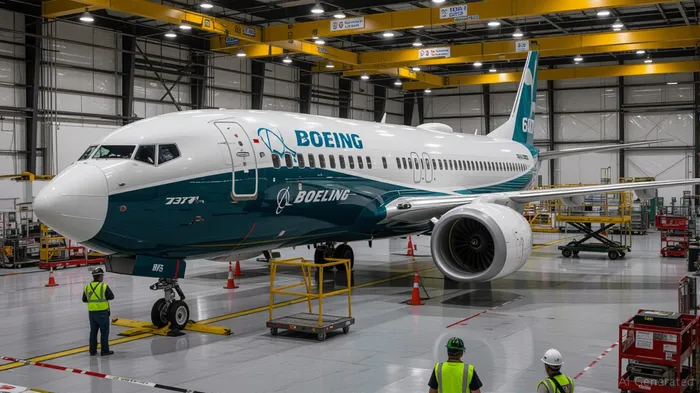
Strategic Advantages in Aerospace Recovery
Boeing's Q2 2025 performance marked a critical inflection point. The company delivered 150 commercial aircraft, a 63% year-over-year increase, driven by the 737 MAX (104 deliveries) and 787 Dreamliner (24 deliveries). This outperformance reflects progress in ramping up production to 38/month for the 737 MAX and 7/month for the 787, with plans to further increase capacity. Analysts at Wolfe Research and TD Cowen cite these metrics as evidence of operational discipline, raising price targets to $230 and $230, respectively.
The $96 billion Qatar Airways order—130 787s and 30 777-9s—added $600 million to $1 billion to Boeing's Q2 results and boosted its backlog to $460 billion, a multiyear revenue runway. This deal not only signals demand for widebody aircraft but also underscores Boeing's ability to secure large-scale orders amid competition from Airbus. Meanwhile, defense programs contributed 36 deliveries in Q2, including Apache helicopters and KC-46 tankers, demonstrating resilience in a sector with stable government spending.
Supply Chain Resilience
Boeing's ability to scale production without bottlenecks has been a key differentiator. While past struggles with the 737 MAX certification and 787 door incidents caused delays, recent improvements suggest better execution. Fitch Ratings upgraded Boeing's credit outlook to “stable” in June 瞠 2025, citing reduced litigation risks and stronger liquidity. Analysts at UBS noted that Boeing's focus on “operational excellence” has improved cash flow, leading to a $226 price target.
However, risks persist. A U.S.-China tariff dispute could disrupt deliveries to Asian markets, and the ongoing IAM machinists strike threatens production timelines. Yet, Boeing's June delivery figures—42 737 MAXs—suggest it's mitigating labor disruptions, at least temporarily.
Long-Term Demand Drivers
The global passenger traffic rebound post-pandemic is a tailwind for BoeingBA--. Airlines are modernizing fleets to replace aging aircraft, with single-aisle jets like the 737 MAX dominating demand. Boeing's 787 and 777X programs target long-haul routes, capitalizing on rising demand from emerging markets like India and Southeast Asia.
Defense spending also remains robust, with governments investing in modernization. Boeing's F-15EX and KC-46 tanker programs align with U.S. and allied nations' priorities, offering steady revenue streams. Goldman Sachs highlighted this dual commercial-defense strategy, maintaining a “Buy” rating with a $257 target.
Valuation and Investment Considerations
Boeing's stock has risen 24% year-to-date to $227.55, nearing its pre-pandemic highs. The average price target of $227.85 (from 21 analysts) suggests modest upside, but the $275 target from Redburn Atlantic hints at aggressive growth expectations.
Compared to peers like Airbus, Boeing trades at a discount. While Airbus trades at 13.68x EV/EBITDA, Boeing's negative EV/EBITDA reflects lingering losses. However, Jefferies argues that Boeing's margin expansion goals (targeting 10% by 2026) could re-rate its valuation. A visual comparison of Boeing's stock performance versus Airbus over the past year would show Boeing outperforming, a trend analysts expect to continue.
Near-Term Risks and Investment Thesis
Bearish concerns linger:
- Regulatory delays: The FAA's scrutiny of the 787 door plug issue could delay certifications.
- Debt and margins: Boeing's $36 billion debt load and 6% commercial margin in 2024 require improvement to sustain growth.
- Trade tensions: A slowdown in Chinese orders could dent deliveries.
Despite these, the July 29 earnings report is a pivotal moment. Analysts will scrutinize margin progress and production rates. If Boeing exceeds expectations, the stock could breach its consensus target.
Conclusion
Boeing's operational recovery, bolstered by a record order backlog and improved margins, positions it as a compelling buy for investors willing to tolerate near-term volatility. While risks like regulatory setbacks and labor disputes remain, the company's progress in stabilizing production and diversifying its portfolio suggests it's well-placed to capitalize on long-term demand. For a conservative approach, investors might wait for post-earnings clarity, but the average 4.27% upside to $227.85 and potential re-rating make Boeing a buy for those with a 3-5 year horizon.
Final Take: Boeing's strategic execution and long-term demand tailwinds justify cautious optimism. Investors should monitor the July earnings report and regulatory milestones closely.

Delivering real-time insights and analysis on emerging financial trends and market movements.
Latest Articles
Stay ahead of the market.
Get curated U.S. market news, insights and key dates delivered to your inbox.
AInvest
PRO
AInvest
PRO



Comments
No comments yet