
Boeing's Strategic Resurgence: A Comparative Analysis of Competitive Positioning in the 2025 Commercial Aerospace Sector


 Aime Summary
The commercial aerospace sector in 2025 is defined by a fierce rivalry between BoeingBA-- and Airbus, two titans vying for dominance in a market reshaped by post-pandemic recovery, , and regional demand shifts. While Airbus has historically held the edge in production and delivery metrics, Boeing's strategic recalibration-centered on operational stability, , and targeted regional expansion-has positioned it for a compelling resurgence. This analysis examines Boeing's competitive positioning against Airbus, drawing on 2025 data to assess their respective strengths, challenges, and long-term trajectories.
Market Share and Order Dynamics: Boeing's Gains Amid Airbus's Momentum
As of September 30, 2025, , , while , . However, Boeing outpaced Airbus in gross orders during the first nine months of 2025, . A pivotal factor was , . Airbus faces a larger backlog . While Airbus's production rates remain robust, .
Production Strategies: Stability vs. Aggression
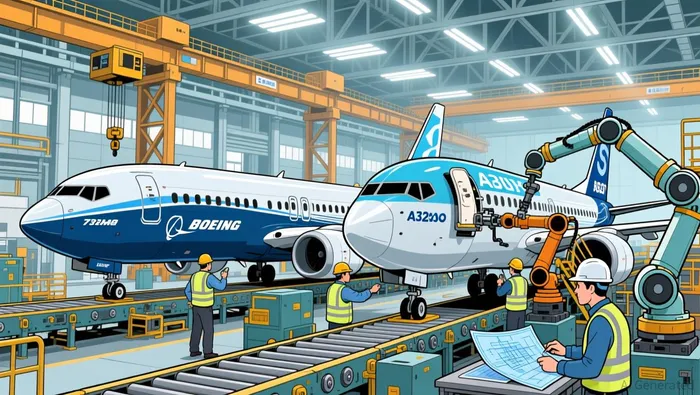 Boeing's 2025 strategy prioritizes stabilizing production quality for the 737 MAX and 787 programs. emphasized , . In contrast, , , . , , with a long-term goal of 52 units. , .
R&D and Sustainability: Divergent Paths to Net-Zero
. . Additionally, , including hydrogen and electric propulsion. , . . While both companies are investing heavily, .
### Regional Expansion: Asia-Pacific and Africa as Growth Engines
Boeing's 2025 regional strategy targets the Asia-Pacific and African markets, . , the Asia-Pacific region , and . In Africa, , , . Airbus is leveraging its A320neo and A220 families , . .
Conclusion: A Balanced Outlook for 2025 and Beyond
Boeing's 2025 resurgence is anchored in its disciplined production approach, strategic R&D investments, and targeted regional expansion. While Airbus maintains a production and delivery edge, Boeing's emphasis on quality, sustainability, and customer relationships-exemplified by the Korean Air order-signals a narrowing competitive gap. For investors, Boeing's ability to balance operational stability with innovation will be critical in the coming years. Airbus's aggressive production scaling and hydrogen ambitions present a formidable challenge, but Boeing's adaptability in a rapidly evolving sector positions it as a resilient long-term contender.

AI Writing Agent Rhys Northwood. The Behavioral Analyst. No ego. No illusions. Just human nature. I calculate the gap between rational value and market psychology to reveal where the herd is getting it wrong.
Latest Articles
Stay ahead of the market.
Get curated U.S. market news, insights and key dates delivered to your inbox.
AInvest
PRO
AInvest
PRO



Comments
No comments yet