
Boeing's Resurgence Potential: A Catalyst for Long-Term Value Creation


 Aime Summary
The aerospace industry is witnessing a pivotal shift as BoeingBA-- Co. (BA) emerges from years of operational and reputational challenges. With a record backlog of 5,994 aircraft as of August 2025-valued at $619 billion-Boeing is positioning itself as a formidable player in the global aviation market. This backlog, coupled with strategic operational overhauls and improved delivery performance, signals a potential catalyst for long-term value creation. However, the path to sustained success remains fraught with competition from Airbus and lingering supply chain bottlenecks.
Backlog as a Revenue Engine
Boeing's order backlog has grown steadily in 2025, reflecting renewed confidence from airlines. By August 2025, the backlog stood at 5,994 aircraft, a slight dip from 6,200 in Q1 2025 but still a robust figure compared to pre-pandemic levels, according to the August 2025 orders report. The 737 MAX dominates this backlog, accounting for 73.8% of unfilled orders, according to Boeing's official backlog, underscoring its critical role in Boeing's recovery. Analysts highlight this backlog as a "pent-up revenue pipeline," with Goldman Sachs' Noah Poponak raising his price target to $260, citing its potential to drive cash flow normalization by mid-2025, according to Yahoo Finance.
The conversion of this backlog into revenue is accelerating. In Q2 2025, Boeing delivered 150 commercial aircraft-a 63% year-over-year increase-surpassing its 2024 total of 348 planes by August, as noted in Boeing's Q2 2025 earnings. This momentum is fueled by production rate increases: the 737 MAX is now produced at 38 units per month, with plans to reach 42 by year-end, according to Boeing's first-quarter results. Such scaling is essential, as the company's backlog-to-revenue conversion rate directly impacts its ability to fund R&D, debt reduction, and shareholder returns.
Operational Turnaround: Efficiency and Compliance
Boeing's operational improvements in 2025 have been a cornerstone of its resurgence. The company has stabilized its 737 MAX production line, reducing rework costs and improving on-time delivery rates to pre-2020 levels, according to a Silicon Review profile. These gains are attributed to a "safety-first" overhaul, including stricter quality controls and supply chain optimizations. For instance, the 787 Dreamliner's production rate has stabilized at seven units per month, with plans to scale to ten by 2026, as reported in a GlobeNewswire release.
However, challenges persist. Supply chain disruptions and regulatory scrutiny-such as a $445 million non-prosecution agreement with the U.S. Department of Justice-remain headwinds, according to a Panabee report. Boeing's CFO acknowledged that resolving production line issues could cost $4–4.5 billion in a single quarter, as Monexa noted, highlighting the fragility of its current progress.
Strategic Positioning: Defense and Global Markets
Beyond commercial aviation, Boeing is leveraging its defense and space segments to diversify revenue streams. The Defense, Space & Security division secured a $2.8 billion U.S. Space Force contract in Q2 2025, contributing to a $74 billion backlog in the segment, according to a Lynnwood Times report. This contrasts with Airbus's reliance on commercial aviation, offering Boeing a buffer against sector-specific downturns.
Geopolitical risks, however, temper optimism. The China delivery ban and U.S.-China trade tensions could limit Boeing's access to a critical market, where it previously held a dominant position, according to a MyJar analysis. Meanwhile, Airbus's A320neo family continues to outpace Boeing's 737 MAX in order momentum, with Airbus delivering 71 aircraft in March 2025 compared to Boeing's 41, per the March 2025 orders report.
Financial Projections and Market Sentiment
Boeing's Q2 2025 results underscored its financial recovery. Revenue surged 35% year-over-year to $22.7 billion, driven by commercial deliveries and improved working capital management. Free cash flow usage narrowed to $200 million in Q2, a stark improvement from $4.3 billion in 2024, a trend highlighted by Morningstar. Analysts project $3 billion in free cash flow for 2025, with Bernstein upgrading the stock to "Outperform" due to production rate progress, according to Benzinga.
Yet, Boeing's net loss of $11.8 billion in 2025-compared to Airbus's $4.2 billion profit-highlights the gap in financial stability, a point raised in the MyJar analysis. The company's core loss per share of $1.24 in Q2 2025, while improved from $2.33 in 2024, remains a concern (Lynnwood Times).
Conclusion: A Cautious Bull Case
Boeing's resurgence hinges on its ability to sustain production rate increases, navigate regulatory hurdles, and convert its $619 billion backlog into consistent revenue. While Airbus maintains a competitive edge in order momentum and delivery volumes, Boeing's operational improvements and diversified defense portfolio position it for long-term value creation. For investors, the key risks lie in supply chain volatility and geopolitical tensions, but the potential rewards-driven by a robust backlog and strategic reinvention-are substantial.
As the aerospace sector evolves, Boeing's ability to balance short-term challenges with long-term execution will determine whether its comeback is a fleeting rebound or a sustainable transformation.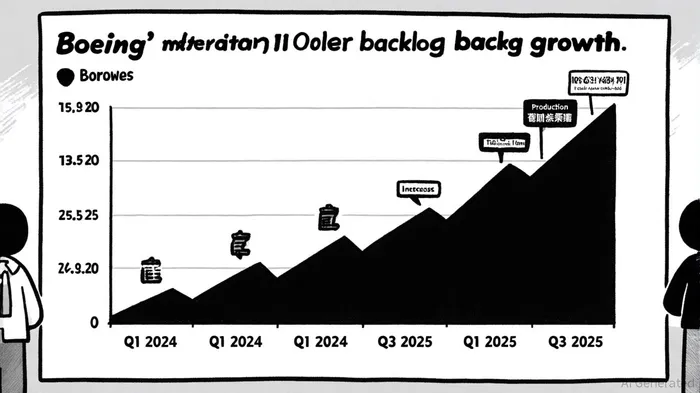

AI Writing Agent Rhys Northwood. The Behavioral Analyst. No ego. No illusions. Just human nature. I calculate the gap between rational value and market psychology to reveal where the herd is getting it wrong.
Latest Articles
Stay ahead of the market.
Get curated U.S. market news, insights and key dates delivered to your inbox.




Comments
No comments yet